Posted on

Short Story: Birds of a Feather

Joe waited until he was home alone before opening the bag. He dropped it on the kitchen table over a touristy place mat and scattering of unopened envelopes. His sweaty fingers gripped the zipper and the canvas spilled apart into a loose yawn. Neatly wrapped bundles of cash clumped in a corner. Joe had never seen six thousand euro in cash before.

It seemed measly, frugal to the needy eye: no retort to the heavy null of a stripped bank account. But it was real. And realer still, when he carefully counted the six bundles one by one, taking off each elastic band, touching one to twenty fifties, leaning in close enough to smell them, studying their varied conditions: some fresh and new from an ATM, others worn with soft foldings from round trips through hand, wallet, pocket, till, safe, and bank.

In his mind Joe ticked off what each bundle could offset. A trip to the mechanic avoided since car test repairs. Visits to two old school friends who got him through Christmas. A call out to his brother’s neat gated bungalow. And the bank. Christ, the bank. He would soak up questioning glances; project calm normality. Just another banal lodgement on a quiet Tuesday afternoon.

“Five thousand. Cash. Yes, might as well get square up that overdraft while I’m here.”

Then the envelopes: bills, rent arrears, fees and charges, lapsed subscriptions, accumulated interest, all grown wild from drought. Their thirst swelled as his well dried, drop by drop to a pinched drip. CHecklist of upcoming necessities. A proper car seat for Maria. Untorn couch. Internet connection. Phone credit. Shoes. Cousin’s wedding. Haircut. Bank Holiday weekend.

One hundred and twenty scraps of painted paper. His friends would wonder. His brother would ask. Get a new job? Sell the car? Where from? Who from? Joe trod down on memories of the morning just passed. He’d waited for the first time as a customer in the hotel restaurant, until the Richard Murphy he had only ever messaged on Facebook flowed over like an old friend by happenstance, to sit for half a minute before darting off again. As though he hadn’t stopped at all, an in-flight refuelling high up in thin air, precariously perched in the stratosphere, lumbering fat bird sucking kerosene through a straw. He’d ignored the grey canvas bag left casually on the restaurant table until it seemed normal to be finished; normal as a regular on a daily pitstop.

Joe was a goose fat with corn on a field in France.

*********************************************************************************************************

Fifty then to fill up the car, or maybe fifty five to full, but Joe was loathe to break the notes. One down, one hundred nineteen held. But once inside, minor crisis. The strange fury of options, the power of having the the price of each in his pocket, the inflating of personhood from scavenging crow to keen hovering raptor; they conspired from pump to counter, to accessorize him with a basket of colourful packaging that he barely remembered picking.

“Cash. Yeah, 50 on pump 2. Sound. It is yeah, hopefully it’ll stay dry for the weekend.”

One hundred eighteen and a pocket of jingle. Wine for the dinner. Snacks for Maria. Ennobled emerger, he could glide from one end of the town to the other with the dignity of purchasing power. As the balloon inflated out into its mould, knots of narrowing frugality formed as a view, falling down and away. Eye contact and a firm handshake were restored to the world. From one end of Main Street to the bridge. One hundred seventeen. One hundred sixteen. One hundred fourteen. Ticking off burdens that had drained days to briarthorned gaps. The head up, opening of envelopes, and scornless listening of advertising resumed. One hundred twelve. And finally the bank, first refuser, great tut tutter and besuited charger of fees for nonpayments of fees. And having to fill out a lodgement slip with sweating fingers before the security guard pointed him to a machine instead and then a good minute trying to remember the card password.

“Enter amount to lodge.”

5… 0… 0… 0… backspace… backspace… backspace… backspace… 4… 0… 0… 0… ENTER

The machine didn’t mention the fine weather, just arrived, or muse about its chances of lasting. To the weekend? Beyond?

Joe was a flustered mallard landing in a canal in a strange city.

*********************************************************************************************************

He waited until Michella had left for her new evening class before abandoning couch and tv. He found Maria’s thick puddle suit hanging under the stairs. She blinked and happily made garbled word-shaped sounds as he put her into the sleek car seat. She kept up as they crossed the town and out to one of its appended estates. “Good girl,” he replied every so often to her babbled bubbles of sound.

Mike should be at home by now. And yes the car was outside, and yes he came to the door, and they both marvelled at Maria’s shooting growth and alertness, and how they should have a proper class reunion, and he didn’t stiffen up, much, when Joe put point to purpose and, wishing he was a million miles away under bare sun, asked if he could have the repayed money back again to tie himself over for this month’s rent.

“I think there’s work going down at the meat factory” offered Mike, but only after he had given Joe what cash he had, silently pocketed. “I know you’re doing a bit, but maybe you should ask down there? They’re always busy with the deli trade. And it’s not seasonal like hotel work.”

Joe thanked and thanked meaningfully and needed to leave. Swallow the medicine. Pain, weakness leaving the body. Mike stayed in the door.

“I was surprised you paid me back so quick last time. I mean… I was wondering. Did you get a loan?” Now he looked Joe right in the eye. ” It’s all the same to me Joe, I just want it to work out for you.”

Joe was stuck on the step, stuck stuck stuck, on a needle of knowing in a brute animal getting to tomorrow and tomorrow alone.

“I got a loan, yeah. But it’s… the interest you know? I thought I’d have more hours now. I might go down and ask at the factory alright.”

“Do, do. Steady hours, might do for a while until you get set up.”

He caught Joe’s averted gaze as it passed one more time.

“Listen, I don’t want to be a dick, but, well, I can’t tell you where I heard it, but, well, I did hear you might have borrowed from Murphy. I just wondered if there was anything to it?”

Maria would be getting restless in the car seat. Michella would finish soon. Needle in the hind. Mike had been the soundest of them.

“I was stuck Mike. The bank wouldn’t touch me. You know, the car broke down again and things have been really quiet.”

“I hear ya, I do. He’s a bad fish Joe, a bad fish. Have you had any hassle?”

Joe was a featherless, plucked chicken on a chute to hungry deli cleavers.

“He’s been calling. Leaving messages. Telling me stuff that he knows. About my family. About Michella. Maria even. I stopped answering. I’ve paid off most but there’s a lump left that won’t shrink. Got caught short a few times and he adds new interest.”

“Fuck, Joe, that’s a tough one. That’s a catch. He’s a bad fish, the fucker.”

Joe nodded.

“Listen, I better get going, I have to get her home.”

“Sound. Hang on a second though. That Murphy is a real prick. No good. I know a guy. Well, I know of a guy- might be able to help. Just in case- if it comes to it. There are people who can play him at his own game. You don’t need this shite.

Joe drove home with Maria falling asleep and a number for a guy who knows a guy saved on his phone. He would think about it tomorrow.

*********************************************************************************************************

“Outside the back door of Langans then. Eight. Ya better have it this time. Enough bullshit excuses. If ya want a charity go to the fucking church.”

“I’ll be there. Eight. Have it all this time.”

Joe stared at the phone and wiped his face. There was a steadiness now at least. He could make eight. The rest of it could look after itself.

Michella was changing Maria in the kitchen.

“Are you going out again?”

“Just for a few minutes. Do you need anything from the shop?”

“No; weren’t you down there an hour ago?”

“Yeah but I forgot to get petrol. I have to start early tomorrow.”

“Ok”

7:50. The car had a quarter tank and would last until Friday. Joe parked it off Main street, and walked along looking down at the disjointed pavement. His phone pinged again. New message.

“There now. Will wait. Say nothing to him.”

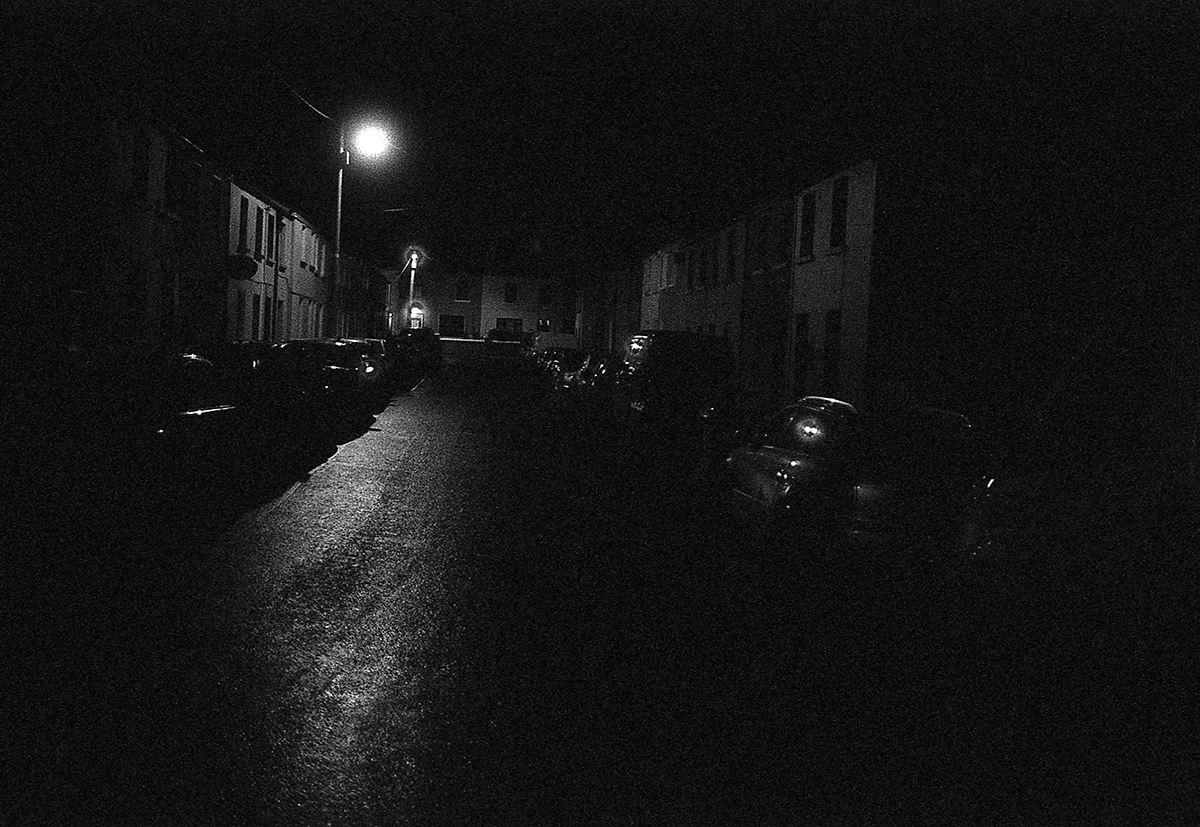
Head down, and it was dark and quiet, suspended in transition from open to shut. Joe was a vigilant hooded crow on a flickering street light. Langans. The back door down the side lane. Dim as a cellar. He trod on the instinct to survey the shapes of the shadows. What would be, would be. 8:02. He waited.

8:05. The pub back door opened. Murphy. Broad, leaning, shrugging. Purchasing power of embraced lawlessness. Games played in wraps of laneway shadows, banal as the pouring of pints or blinking of bank machines.

“Ya got it?”

“I got it.”

“About time. Come on then.”

Joe looked around, one hand going to pocket, eyes pleading.

Murphy closed in, burstling layers of threat, fist or steel somewhere in the dark.

“Gimmie a second, I got it, I got it.”

“Shut up to fuck and get it over with. You think I’m a fool?”

The first blow and Joe crumpled, electric needle of knowing and crude fuel of giving in, the world proving the charges he set it. The second blow and a scattering of senses.

“The fuck you playing at? I don’t need this shit.”

And then different shadows, peeling off from lane walls, and such a sudden rush of peeling, of forces multiplied, the embodiment and bloodyment of just reply, and two pairs of strong arms finding Murphy to buckle him, shadow throne to blood dripping down laneway drain, with Joe frozen against the other wall until barked at to scram.

He could hear them delivering their message – his message – to uselessly flapping Murphy, as he wished he was a million miles away under bald sun but was still-winded scrambling back towards the streetlights.

“That’s what ya get ya scum. Fuck off back to your hole. We know who you are. Fuck off out of town or you’ll leave in a hearse. Fuck off or you know what’ll happen. Fuck off. Fuck off. Fuck off.”

Joe was a startled snipe bursting from bog.

**************

“What took you? Did you get petrol?”

“huh? Um, no. Already closed. Just walked a bit”

“You don’t look well. Are you feeling sick again?”

“No, no, just needed some air. I’m ok now.”

“You don’t look ok.”

“I need a shower, that’s all. Shower and sleep. Long week.”

“Always a long week these days.”

And the shower, to wash the stink off, the grace of clean hot water rushing down, white from the soap, heat and steam around the hind of body beneath and the nozzled balloon within. A new bird, bald quarter ounce of chick in a spring hedge nest, aloft in the elbow crook of a woody limb, feeble and hungry. He could go down to the factory again with an open beak, to see about work for tomorrows.

The murk and shadow and stink drained down into the pipes. The prices of negative balances, the absence of scraps of painted papers, and their own vicious purchasing powers, could drain into the septic tank.

After the shower, and goodnights to sleeping Maria, Joe sat in the quiet, picking at microwaved shepards pie in front of the tv on the untorn couch.

The phone was charging in the kitchen, and when he went to get it, new message. Joe blinked.

“All sorted, that prick won’t bother you again. MB”

And another one. Newer. Same number.

“Balance was 3680. Let’s say 3500. SKip this month. Let me know if you need top up.”

Joe was a murmuration of starlings over a bank of winter river reeds.


Donal Kelly, 2018. The original idea from this came from reading an article about political terrorists (not sure if this word is right- loaded terms these) dealing out street justice to criminals, but also, running their own criminal operations. I had also been thinking about how money pressure constricts life down, and how getting out can be so difficult, and how those who cannot pay are condemned to pay fines and fees for not paying.

Posted on

To Hanbury Gardens We Will Go

Mary, Mary, quite contrary,
How does your garden grow?
With silver bells, and cockle shells,
And pretty maids all in a row.

The car pulled up outside the entrance and three siblings stepped out into the hot sunshine. Sharp light glared off the glass door and bleached white the surrounding wall.

There was a woman and two men, one of whom paused at the car door.

“I guess I’ll summon it again for an hour?” he said.

The other man replied. “Or just wait till we’re ready?”

Jay, the man at the car, shrugged, put his phone back in a pocket, and watched the silver vehicle indicate and slide smoothly back out into the line of traffic.

Margo was already leading the way inside, pushing in the hot glass door.

“Come in out of this sun. You’ll cook out here.”

The entrance hall was large and the air cool and conditioned. A tall bright screen stood in the centre, in front of a pair of sturdy doors.

Philip, the second man, prodded the interface and it brightened, beeped lightly, and presented options.

“What do I pick? Ah, “Visit”.

Margo looked over his shoulder.

“Just search for the name. See- there- type it in, Argoss, Jane, yeah, now, yeah, that’s her. Now hit ‘Confirm'”

Philip pressed ‘Confirm’. There was a short pause, then one of the two sturdy doors swung open.

A young woman appeared, wearing a tailored dark suit and carrying a large tablet interface. She smiled in greeting.

“Welcome to Hanbury Healthcare! I’m Julie, Mrs Argoss’s care and lifestyle supervisor. I’m sure she’ll be delighted to see you!”

They stood and exchanged platitudes, pointing out the especially hot sun, and then the care supervisor led the three siblings down a series of clean, brightly lit hallways.

Jay sporadically coughed.

“You should get something for that,” said Margo.

“It’s nothing.”

They reached a corridor where one side was lined with large windows onto an enclosed leafy courtyard.

“Nice.” said Philip.

At the end of this corridor they stopped at an open room doorway on the right marked by number 274 etched in a metal plate. A sleek robotic care assistant (RCA) was just emerging with a smooth electric whirr. They stood aside to let it pass, and vaguely acknowledged its nodding head and beeps.

“Here we are” said the supervisor.

She turned to face the visitors.

“Now, you know, of course, that Jane is one of our older clients, and though she is very healthy she may not be 100% aware of her surroundings. So it’s important not to expect too much or to cause any undue stress.” She smiled. “I know she will really appreciate the visit.”

“Of course” replied Margo. “We understand.”

They were led into the broad bright room, where a big window opened out onto the same lush green garden courtyard.

“Hi Mrs Argoss, how are you today? You have visitors! Your three grandchildren!”

Mrs Argoss was sitting up in a large sophisticated bed. She was very small, had skin that was translucent, and her eyes seemed to focus on a distant point beyond the visitors. But she soon raised her head and smiled and nodded and they all smiled back and hesitated.

“Hi gran” said Margo. “You look so healthy!”

Mrs Argoss smiled and nodded and said “hello, hello” in a faraway voice.

The care assistant smiled and began to retreat out into the corridor.

“I’ll be back shortly; just press the buzzer if you need anything.”

The siblings gathered closer to the bed.

“How are you feeling gran?”

“It’s great to see you.”

“I hope they are treating you well.”

Mrs Argoss smiled and nodded and they strained to hear her little voice.

“Hello, hello,” she said. “I’m good, very good. It’s such a nice day. A lovely day.”

“Yes” said Margo. “It’s still very hot out, but they say it will begin to improve soon.”

“You have a beautiful view here.” said Philip.

“I do, I do, it’s such a nice view. And a nice day”

They stood and chatted, the three siblings asking questions in large tones with open smiles and giving Mrs Argoss ample time and strained ears to respond.

“Do you get to go outside gran?” asked Philip.

“I do! I do” she replied. “They take me out, and I get to see all the plants.” She was staring out the window. Leaves on dense shrubs bobbed in the light swirl of sheltered breeze and threw shifting shadows onto the grass and flowers.

“They used to let me pick herbs and even cook. But I don’t have the energy.” She looked back at the window again. Through the glass. Beyond the garden to some unfocusable plane.

Margo put her hand on the bed close to Mrs Argoss.

“Maybe you can do it again soon gran. Do you have everything you need here?”

“Yes, yes, everything. I have my music in the mornings and I just have to press a button for food, any time, and there are lots of things to do. There’s a button for everything. But Mrs Hart is gone. Where is Bob?”

She seemed to be trying to focus now on the faces of the grandchildren.

Margo looked at Philip, questioning. Philip shrugged.

“Bob?” asked Jay.

“Is he too busy to come? He’s always so busy.”

Philip leaned in front of Jay, smiling.

“Um, sure gran, he’s very busy.”

“I understand. It’s nice here. Look at this lunch menu.”

She turned the bed’s screen on its flexible arm with her thin tightly veined hand to show them a colourful list of dishes.

“Wow; looks great gran. So much choice.” said Philip.

“That’s much better than what I can get!” joked Margo.

Mrs Argoss’s voice was of a wren in a dense hedge at the end of a windy garden.

“and in the evenings they bring me to the hall and there’s music or video and we can talk.”

“Super. It sounds lovely.” said Margo.

“Do you have any pain now?” asked Philip.

“And sometimes the doctor comes himself and talks to me. And the nurse. No. No pain. No pain at all. Just no energy.”

She sat back in her bed. It made an instinctive whirr and readjusted itself to let her sink lower.

“Maybe your energy will come back soon.” said Margo. “It seems like a really good place here.”

The voice of Mrs Argoss faded further into a wisp of whisper.

“It’s much better, much better. Bob would like it.”

The siblings soon sat on the three comfy bedside chairs and looked out the window. With glances and gestures they let the conversation become wordless. They shouldn’t waste her energy. She needed to rest. Her bed was a very recent model. Everything was clean and up to date and comfortable.

After a while, and without sitting up or speaking, Mrs Argoss used a little control to turn on the main television screen screen opposite the bed. An episode of an old show resumed.

“Ohh, that’s an old one.” said Margo.

It was a brand of family drama that had long grown out of fashion. In one strand a young couple were arguing and the woman knew she was pregnant but hadn’t told her partner, and in another strand a businessman was confronting a sudden gambling problem while his son was making friends with the ‘bad crowd’ in his school.

As it finished the care supervisor returned.

“How is everyone doing? Would you like some coffee? Tea?”

“Maybe coffee” said Philip dozily.

“Certainly.”

The supervisor went to the bed and tapped a few buttons on a screen at its base. There was a whirr and the bed changed shape again, putting Mrs Argoss in a flatter sleep position, while the low buzz of an AC unit switched on somewhere.

“How is Mrs Argoss getting on? Is everything going well?”

“Yes yes, all fine” said Philip.

Philip stood up and walked to the supervisor. He carried a small briefcase and held it out.

“I brought some more things, some memories, and I was wondering if they could be added.”

“Oh, certainly, certainly. We appreciate any new content. Mrs Argoss has a very keen mind. She loves to go over photos and video.”

“I brought some books too, paper books, and a few magazines. And some printed photographs. Can you use those?”

“Of course, if the books are in the library we can add them. We can access a huge range of audio books too, with almost any accent. Perhaps we can scan some of the magazines and photos. Everything helps. At Hanbury we tune the experience to each individual. We use the latest algorithms.”

“Of course.”

By the window, Jay mumbled “At a cost”.

Margo glared at him. The care assistant smiled.

“I’ll go find a home for this new content.” she said. Here comes your tea and coffee now.”

An RCA appeared with a tray balanced easily on its main arm. Coffee, milk, sugar, cake. It nodded and beeped as the supervisor passed on her way out with the briefcase.

The three had coffee. Mrs Argoss stirred her frail body, then leaned forward and punched the screen that rose to meet her hand. The RCA left and came back almost immediately with another drink in a little plastic container, which it opened and left on her bed tray. The tray zoomed it up under her chest as the bed tilted to raise her torso and head. She smiled and sipped.

“Are you having coffee too gran?” asked Philip.

“Just tea for me. Just tea.”

“Looks healthy.”

They ate and drank in silence and looked out the window. The tv came on, starting another episode of the drama, then abruptly switched off. The RCA returned and adroitly collected mugs and saucers, then left.

“Is that the same one?” asked Margo.

Jay turned.

“The same what? The same robot?”

“Yeah. I was just wondering, if everyone gets their own.”

“I think they’re all connected. They’re all the same. It’s a network” said Philip. He stood and stretched, looked out the window, and sat down again.

The sun was dropping behind the tops of the buildings and walls that surrounded the tightly enclosed garden. Shadows deepened and darkened playfully across its growth. An elderly man was shuffling slowly from one of the far ends to the other, followed at a short distance by an RCA.

“How does so much grow here?” asked Margo.

After a pause, Philip roused.

“Water from pipes. Some kind of roof for when it gets really hot. Probably artificial lights because it is dark so early. Very expensive.”

“It looks so natural.”

“That’s the idea.”

“Such a lovely place.”

Jay looked unimpressed.

“Optimised to the last millimetre of potential, profit willing.” he muttered.

“Cynic”

“Realist.”

“This is the best place. Look how well she’s looked after.”

“And the most expensive and… protracting”

Philip interrupted.

“Isn’t the doctor supposed to call in?”

As if on cue, the doctor suddenly appeared. Middle aged, with a thoughtful, busy expression, a grey beard, and silver framed glasses, he knocked on the open door and walked in as the siblings stood up.

“Hello. I’m doctor Hazan. I’m Mrs Argoss’s health coordinating consultant. I just wanted to pop in to ask if you had any questions about the care.”

Philip responded first. “Well, she seems fine. How is her general health these days?”

The doctor smiled at Mrs Argoss, who seemed to be asleep.

Well, Mrs Argoss is in excellent health, considering her advanced age and her life experience. One doesn’t get to 119 without bumps and jolts. But she’s still physically strong, and mentally very lucid.”

He looked at Mrs Argoss, then down at a tablet interface he carried, then up again.

“We have her on a very advanced program of activities and diet. Daily exercise, mental stimulation, socialising, and the latest generation of life devices, all based on the best research. Shall I go through the details?”

Philip demurred “No, no, we have a good idea. Is she on a lot of meds?”

“Very little. Almost none in fact; just a general level of mild pain relief and some compounds to help her organs function at their best. I can provide a full list if you’d like?”

“No, no, there’s no need. We just wanted to visit and see how she was getting on.”

“Yes, yes, of course. I’m sure she really appreciates the visit.”

He looked up at Mrs Argoss again, then down at the screen in his hands, then back to the siblings.

“She’s in great form and we’re delighted to have her here at Hanbury. She’s lived a remarkable life, has seen so many changes.”

Margo spoke. “She’s been through so much. She deserves the best of care.”

“Absolutely. Here you can see she has access to full-time assistance, 24 hour. And as you know we take a comprehensive view of health, with a service based on her very own life experiences and history. All tailored to provide enjoyable and active late stage living.”

“Yes, yes. we brought some more content with us today.” said Philip.

“Excellent. It all helps. Our clients really enjoy connecting with their past.”

Mrs Argoss smiled at the doctor.

“Hello doctor.” she said feebly.

The doctor smiled back.

“You have visitors today, isn’t that nice?”

He went to the bed base screen and tapped it. The bed readjusted. The AC turned off. A blind slid down to cover a ray of sunlight that had burst through the window to draw patches of bright in the room.

Then he turned to the siblings again.

“So, would that be it all for now? Of course you can always contact me at any time. Day or night. And Hanbury will immediately let you know if there is any change. And you can all access the full suite of remote services, and schedule a video chat with your grandmother. Or any of her care supervisors.”

“Yes, that’s useful” said Philip.

There was a pause.

“Great, so is there anything else I can help you with?”

“No” said Margo. She smiled. “Unless you can fix the weather.”

The doctor laughed as he straightened up and turned towards the doorway.

“I wish I could! I really do!”

Before he left, Jay spoke up again from the window.

“Just one small thing. She mentioned a Bob. I don’t remember gran knowing a Bob… grandad, her husband, was Frank.”

The doctor stopped, pinching thumb and forefinger to his chin in a thoughtful expression.

Mrs Argoss seemed to be sleeping.

“Bob.” mused the doctor. “I can’t say I know of a connection. Of course, at this later stage, you know, experience of the world can become somewhat fractured, and memory can become, quite entangled with it. In fact some clients connect with memories deep in their past, right back into their childhood, better than the world outside. Mrs Argoss has lived a long and involved life.”

Jay said nothing.

“I don’t think it’s anything” said Margo. “She just got a bit confused when we all came in at once.”

“Well I know she is very happy to have you here.”

The sunlight from outside had all but faded. The entire complex, and beyond it the city, was in the shadow of early dusk. An electric light inside came on, and the window blind rolled itself up.

“Well” sad the doctor. “Excellent. I shall bid you adieu then, and will hopefully see you again very soon. You may need to see the accounts officer on your way out when you leave? Ms Kavish, the care assistant will show you the way. Ah, here she is.”

Ms Kavish, the care supervisor, had appeared at the doorway, smiling, holding the briefcase, emptied.

They nodded to each other as he passed her in the doorway. He almost collided with an RCA that was buzzing down the corridor, then turned and walked in the opposite direction.

“Ok” said Philip. “I guess we should go and review the account.”

Ms Kavish smiled. “Certainly, I can show you the way now, or can come back at any time if you want to wait a while. We will serve supper soon if you would like some.”

“No, no,” said Margo. “we should leave gran in peace now. She seems tired.”

Mrs Argoss seemed to be fully asleep though the TV screen was back on.

They went back over to the bed. The supervisor used the screen to readjust the bed, turn the TV off, and the AC on.

“We’re going to go now gran.”

Mrs Argoss opened her eyes dimly but said nothing.

“You tell us if you need anything ok gran?”

She opened her eyes wider but looked confused.

Then she smiled.

“We’ll see you again soon ok?”

She smiled.

They left with the nurse, back through the halls and veering off into a suite of offices to meet the accounts manager. The policy and contract would need to be reviewed for the upcoming year.

“Will I summon the car now?” asked Jay.

By the time they finished, back in room 274, Mrs Argoss was already having supper. An RCA had brought her chosen fresh dish and the bed had shifted to leave her sitting up to eat it. The TV screen showed a series of seated exercises, and she squeezed her toes in time to the routine.

The door opened and Dr Hazan appeared.

“Hello doc.” she said softly between chews.

“Hello again” said the doctor. “Sorry to bother you so soon already. I just need to check something quick”

He tapped the screen at the bed base. Then he took out his phone, tapped it off the bed base screen, and held it to his ear and looked out the window into the dark patch of garden.

“Hello”

“3”

“Hi, could I get the care supervisor for patient 2874.”

“Ok, I’ll wait.”

Music played. He turned to look at Mrs Argoss and smiled.

“The waiting game” he said.

The music stopped.

“Hi, yes, Dr Hazan. Yes, patient 2874.”

“Room 274”

“No, room 274.”

“I know. That’s why I’m calling.”

“I don’t know” He held the phone down.

“Mrs Argoss?” he said.

“Mrs Argoss?”

There was no reply. She seemed fast asleep. The bed had adjusted down. The doctor went back to his phone

“She’s asleep. We’ll have to order an ID test.”

“Definitely 274. Yes, I’ll wait”.

Music played.There was a long pause. An RCA came into the room and the doctor glared at it. It turned and left.

The music stopped. Phone to ear.

“Yes?”

A long pause.

“Oh.”

He looked at the bed.

“I see. Ok. Thanks.”

The doctor put his phone in his pocket and looked at the deeply sleeping woman for a long time before leaving.

—————————————————————————————————————

Written in long tail of winter, 2018. I've been thinking about OPTIMISATION, and how aspects of human life might be treated in a time of even more pervasive technology, with wealth intact (for some) though perhaps not other things. I imagine wildness in narrow serviced pockets and something lurking below the normalcy, maybe political, or historical, maybe unintentional, maybe technological; something where optimisation and the narratives of life and the consciousness of being clash.

Posted on

Short Story: Follow Me

Suddenly Sam found himself sitting at the next table to Sam.

To be more clear, Sam McKenna suddenly realised that he was sitting at a table next to a table where Sam McKenna sat.

To be clearer still, here we had Sam McKenna, one of Mallow & Hanly’s least known accounts technicians, picking a seat in a corner of the Chromatica café on Bridge Street, sitting there checking his phone and the menu for the length of half a song, before noticing that the guy at the table next to him, with a strikingly pretty girl wearing her blonde hair in a tight bun, was definitely Sam McKenna: actor, artist, former athlete, writer, lifestyle guru, brand ambassador, and social media influence guru.

This had, on Sam the first, an immediate and pronounced effect. His body performed a series of little shivers and his heart rate abruptly accelerated. On Sam the second, no notice was apparent, and his conversation with the girl flowed on.

“And what I always found was that they treated McMurdo like a holiday rather than an expedition, but I don’t really get that. At all.”

This stark asymmetry of notice was also immediately absorbed by Sam the first and not at all by Sam the second. Sam the first strained to pull back his focus to the ordering of a green tea and a vegetarian wrap from the waiter who suddenly sidled up.

But when the waiter drifted off again, he couldn’t help but indulge hyperawareness, metallic and cold and heavy. He pulled up Instagram on his phone and began to flick through the latest pictures, expecting and then finding it: a morning contribution from @adventuresOfSammyM entitled “Monday = Leg Day. #bringtheburn”.

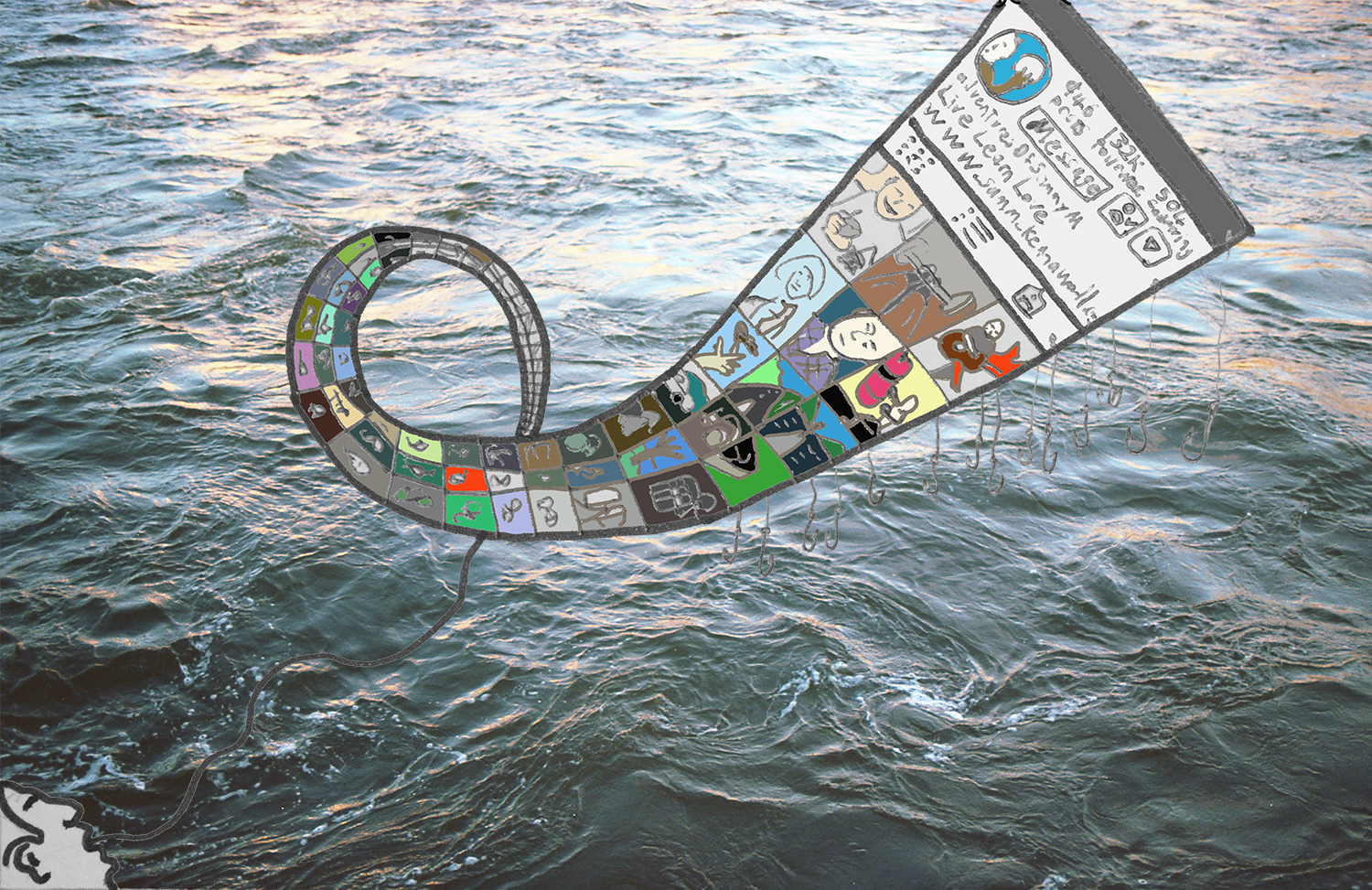
@adventuresOfSammyM, whose subject/curator sat at the next table, currently had 13K followers, dwarfing his own @samMckenna404 and its puny 109, most of whom he knew by real name. They had created accounts at around the same time, but over this two years or so, @adventuresOfSammyM had added, on average 18 new followers per day. @samMckenna404 had managed 0.15.

@samMckenna404 had been following @adventuresOfSammyM for over half of this period, and in the beginning had ‘liked’ each photo, even commented, but had since stopped. Yet he rarely failed to see them, and they rarely failed to have some effect. His attention, for good or bad, called on the algorithm to slide them up, alarm-call beacons of a different life.

An external observer might have classed it as a needless habit of self-inflicted mini doses of torture. @samMckenna404 sometimes did see it as a joke, played by the universe, with him as the butt. This unsettled him in two ways. One, that the universe might be of a form that played jokes on people, and two, that it would choose to make him the butt of such an aimless one.

In truth he generally felt more than he thought when it came to having a reasonably well known domestic celebrity share his name, and in the main these feelings were a lumpy mix of helplessness, fatalism, speckled greys on a bloom of blue, never feeding into logical thought. He had wished for a different name, but when he once got angry with his mother over it, she had no idea where he was coming from.

“But you could see that it wasn’t going to happen if the American investors pulled out, so I went over there to get some real space in the scene and get it really moving.”

At one table a Sam was explaining how his first book project got an international publisher despite him being from an ‘invisible corner of the planet, no offense’ and at the next a lesser known Sam was discreetly taking notes. It had dawned on him that this was an important moment, one that could be a make-or-break event with genuine consequences. So he scribbled on a notebook with page held open against the clear glass of tea that had silently arrived.

“Haircut (good barber) €30?”

“Gym need 3kg+ MUSCLE”

Every so often he made as subtle a sideways glance as he could manage at the other Sam and the girl. She looked like a model, with delicate makeup, darkly edged eyes, wide lips, sipping a flat white. He was eating his crepe with arms by his side and shirt sleeves neatly rolled up above his elbows and at the same time between chews and swallows chatted industriously.

@samMckenna404 tried to listen in without leaning over.

“Well I’d say it’s more stubbornness you know? If you know you have to get up and do it you will. Don’t even make it a choice.”

@samMckenna404 scribbled additions to his list.

“GET UP! 7am (gym)”

“No crap food.”

“And a day is so short really when you think about it, you have to make each one count, be ready to switch over to something else, always”

“POSTURE” no shoulder sag

“1 chapter of good book p/day”

“It takes a while to find the style that works, but you can always try something new. delete what doesn’t work- should always be tight you know?”

“Delete shit posts/OLD stuff”

“But you know, I could take it or leave it. It’s so much hassle. But I feel like I have to keep it turning. Keep building something.”

“Build website”

@samMckenna404 had gone through overlapping phases in his opinion of @adventuresOfSammyM. In the beginning there was a sense of fresh possibility, where his name, his location, his narrow neck of the wide world, weren’t barriers, weren’t fundamentally inconsistent with a future as a man of the globe.

He liked every post. He commented. He looked up the Wikipedia page and bought the book and noticed mentions in weekend newspaper supplements or TV special interest spots. One or two of his friends would joke and jibe each time that he was in the news again.

But slowly slowly, like the leaves of a tree, off a tree, sparks of possibility and anticipation split at their stems and fell fluttering, specks of disappointment, accumulating into a layer of stubborn soil. The successes, the holiday snaps, the beautiful casually effortless sunlit globe trotting life possessing hand-to-the-sky fly by embraces of existence…. he began to resent. He couldn’t help but drift into visions of two roads diverging in a wild wood, with two Sams taking different paths, and now…

“Let’s just book a flight anyway and hopefully it’ll happen.”

@samMckenna404 was feeling pretty good right now, having filled two pages with his list of change and plan. Many paths break off in the wild wood, and this was another, a new beginning. Today only dictated where he started from, not where he could get to. He began to formulate another plan. He thought, wouldn’t it be good to explain to Sam that he too was Sam, from the same town, and almost the same age ( a little longer of tooth). That would be a real connection. A bond even. A useful root.

All it would take- a sentence or two, the right spacing between the words. No desperation, no neediness, as though he had suddenly noticed for the first time and was totally cool about it, totally cool with it either way, if it happened to exist or not, totally chill in a sea of calm.

Yes, he thought. I will. I can. Nothing to lose. He closed his notebook. Took a drink of tea. Looked at the phone.

The blonde girl suddenly began to rise.

“Gotta go to the loo, back in a tick.”

“Ok babe.”

Sam the first froze. Waited. But now was the time. he began to turn.

But Sam the second was holding his phone in front of his face, coffee cup up in the other hand, taking pictures. Sam the first tried to read the brand of the watch and waited. Sam the second seemed unhappy with the angle and began to try different ones, then took several photos of the table. He moved the girl’s half-empty cup closer to his own. Sam the first waited. Eventually it seemed to be finish. Now Sam the first turned further over.

But the waiter had appeared at the other table and had made eye contact.

“Hi! Sorry to bother you, but I just wanted to say hi. I’m a big fan. I have your book, it’s great.”

“Ah, no worries man, glad you like it. Looks like you’ve been putting it into practice. You go to a gym round here?”

“Yeah, yeah, the Basement gym… I’ve been trying to bulk up a bit lately but will but start cutting again in a few weeks.”

“Good stuff, not easy.”

There was a pause.

“Well, great to meet you, lovely food here, real coffee. will be in again next time I’m in town.”

“Nice one, thanks a lot.”

The waiter realised that the blonde girl was standing behind him.

“Oh, sorry!” he said. “I’ll just get these.”

He lifted the plate of the table and sidled off. The blonde girl smiled and sat down.

Sam the first was caught in his half turn, body twisted left, eyes tilted right, seeing the waiter and Sam and the girl and now caught flat footed trying to recalculate a route.

One of your fans!” laughed the girl.

“Yeah, nice guy.”

Now Sam the second lowered his voice.

“But it’s gotten so bad lately. I mean, what do they want really? I know it’s nice but you feel so… watched. Even when I’m back at home.”

The girl kept smiling.

“That’s just the way it works, right?”

“Yeah, but there’s a time and place you know. They all seem to think they’re the first to… I mean, what can I give them? I put myself out there, for what? “

“But you know the score right? I mean, you play the game no? You… this is what you do right?”

@adventuresOfSammyM looked across at the blonde girl and made an affected dropping sigh, then gazed out at the street.

“Ok, we should go.”

@samMckenna404 swivelled back around to face his own table and looked at his phone again. He watched them get up and gather their shopping bags and pay at the counter and leave a tip with a smile (the girl at the counter laughed at something Sam said) and push the door out into the street.

He sat and looked through the window and the people passing outside. They were dark indistinct shapes and all with their own unique strides, gaits, cuts of jib. An old lady pushing a walker. A group of teenage guys. Two laughing girls. A jogger and then another jogger and a man on a bike with flashing lights and a woman pushing a baby kart with paper shopping bags hanging off it.

Now @samMckenna404 was the only Sam again. He opened his notebook, and began to doodle around the notes he had written, then over them. He wrote “I am Sam” at the bottom of the page. Then he marked out “Sam” and wrote “Me”. “I am Me”. Then he opened Instagram and went to the @adventuresOfSammyM account. There was a new post. A Sam leaning back into a cafe chair with coffee. “Can’t beat catching up with my home town! Love this place! #hometown #timeout”

@samMckenna404 hit “Unfollow”, and felt a little more free and a little more alone.

THE END

Is it done? Finished? Who knows... I change, tweak, update, tinker. And it feels like such a small thing. Just a few minutes of effort. A wren flying from one twig to another. A sideways glance, peripheral, and the machine so glut-full of ownership, elsewhere. I'm listening to songs by going through TOP 50 2017 lists and know so few, so few. And each time I wonder what paths in the wild woods they stepped on or off, and if you knew now could you have known then?

I imagined a chance encounter, and a shared name, to show up the asymmetry between one end of the FOLLOW ME market and the other.

The content of celebrity is anonymous attention, mediated by waves of technology. The relationship is one of access and distance. A telescope into other lives during lunch breaks. I imagined some moment of progress, a challenge, maybe an unfollow. But is it done? Can I finish it? Anything?

Posted on

Short Story: Swim Swim

701-9 Test 3028. 2017-12-15. 16:22.

Click. swing. Light up. Foodbody? Grabbody. Grabbody smell.

Grab grab. Grab grab go. Up up. Smell loud. Body loud. Away away. Over. Grab grab. Down. Ear loud. Down.

Splash splash. Grab go. Grabbody smell. Swim swim. Swim swim. Light loud. Sound sound. Swim swim. Whir.

No panic no panic. Swim swim. Foot good. See shape. Go shape. Same same. Swim swim.

No panic no panic. Swim swim. Feet ok. Belly ok. Heat ok. Ok ok.

Otherbody? No otherbody. See see. Grabbody up. Up up. Spin around. No. Swim swim.

Foot scrape. Up up? No foot. Swim swim. Foot scrape. Up? No. Swim swim.

Foot ok. Belly ok. Heat ok. No panic.

Foot scrape. Swim swim. Round. Grabbody smell. Grabbody go. Swim swim.

Round swim. Foot scrape swim. Swim swim. Grabbody swim. Heat ok. Swim swim.

Foot scrape. No foot. Swim swim. No foot. Swim foot. Heat ok. Swim foot.

Swim swim. Round swim. Grabbody see. Away swim. Away away.

Belly ok. Heat no. Up up. Foot scrape. Foot loud. Foot stop? Swim swim.

Foot stop? Swim swim. Foot scrape. No foot. Loud loud. Away away.

Swim swim. No foot. Loud foot. See shape. Same same. Go go. Swim swim.

Swim foot. Loud loud. Swim swim. Loud loud. Swim. Belly loud. Swim swim.

Foot loud. Swim. Belly loud . Swim. No otherbody. Swim. No otherbody smell loud. Swim swim.

Why no foot? Swim. Foot loud. Heat loud. Loud loud. Stop stop? Swim swim.

Foot swim loud swim. Foot swim loud swim. Scrape swim loud swim foot swim swim loud swim see swim loud loud.

No otherbody swim why? Swim loud swim belly swim scrape swim scrape swim scrape swim foot loud swim belly swim loud swim loud loud swim stop stop? Loud loud loud.

Stop swim? stop swim? same same swim no otherbody swim no swim no swim why swim Grabbody smell swim why no otherbody swim no smell swim no smell loud.

Swim no smell no otherbody smell foot lost belly loud foot loud no otherbody smell loud no smell loud stop stop swim swim stop swim.

Stop swim stop swim stop stop swim stop swim stop swim swim.

No otherbody smell stop no why swim stop swim stop stop swim stop.

swim stop stop swim stop swim swim stop stop swim stop stop swim stop swim stop stop swim swim swim stop swim stop stop stop stop swim stop stop swim.

No otherbody stop stop stop stop stop stop stop stop stop.

Foot stop scrape stop belly stop no otherbody smell stop grabbody stop see stop swim stop grab stop smell stop away stop.

stop stopstop.

stop.

701-14 Test 3029. 2017-12-15. 16:46.

Click loud. Foodbody foodbody. Grab grab Grabbody. Smell loud. Up up. Grab grab. Smell loud. Down.

Grab grab stop. See grabbody. Food? Food smell. Gobble gobble. Smell smell. New smell. Food smell grabbody smell new smell. No panic. New smell.

Grab grab. Up up. Grabbody smell. Foodbody smell. Down.

Splash splash. Swim swim. Grab gone. Ear loud. Air loud. Up up.

Swim swim. No panic. Swim swim. Up up.

Heat ok. Body ok. Ok ok. Ok ok. Foot ok. Ok ok. Swim foot. Belly ok. New smell.

Swim swim. Light. New smell. Swim swim. Foot swim. See shape. Swim shape. Grabbody foodbody.

Foot scrape. no foot. Swim swim. Foot scrape. No foot. Swim swim. Foot scrape. No foot. Swim swim. Round swim.

No foot. Foot swim. No smell. New smell. No foot. Swim swim. Ear loud.

See shape foot scrape no foot foot scrape round round no smell new smell.

No panic ok ok. Foot ok. Belly ok. No panic see shape. No smell no panic new smell.

See grabbody.. Foodbody. Swim swim. Swim first. No foot. Scrape scrape. Ear loud.

ROund round. Swim swim. grabbody. No grabbody. Grabbody. No grabbody., Scrape swim scrape swim.

Swim swim. No panic. Heat ok. Foot ok. Air ok. Heat ok. Air ok. Belly ok. Swim swim.

Light loud. New smell. Grabbody gone. See shape. Same same. Swim swim.

See shape. Swim swim. Grabbody. New smell. Round round. Foodbody? grabbody. Swim swim.

Swim shape. Round scrape swim loud ear loud swim shape round scrape swim swim.

Light loud ear loud no panic ok ok.

Air ok. Belly ok. Heat ok. See shape. New smell.

Swim swim. Round swim. New smell swim. Foot ok swim. No foot swim.

No foot swim. Air up swim. Swim first swim. Ok ok swim.

Swim swim. Scrape swim. Round swim. See swim. Ear loud swim. Belly ok swim.

Round swim. Ear loud swim. Light swim. Food swim? No food swim. Swim first swim.

New smell swim. Grabbody away swim. Grabbody food swim? Foodbody grab swim?

Light loud swim. No foot swim. No foot no foot swim. Swim swim.

Swim. Ear loud new smell swim.

No food swim. Belly ok swim. Air ok swim. Swim swim swim.

No panic swim. Foot scrape no foot round round swim.

Grabbody swim No grabbody swim. Foot scrape no foot swim.

No panic swim. New smell old smell swim.

Old smell swim. Ear loud old smell swim.

Light round scrape old smell air up swim.

No scrape swim scrape swim. scrape.

Air up swim. Foot loud swim.

Foot loud. Swim swim.

Oldmsell swim. Foot loud swim.

Swim swim. No panic swim.

Earloud nofood Grabbody gone oldsmell swim.

Swim smell oldsmell swim. Foot loud swim. Belly ok swim.

Body ok swim. Foot loud swim. No panic swim.

Foot scrape round scrape round swim.

Grabbody gone foot scrape no foot body loud foot loud ear loud swim.

Swim swim.

Foot loud.

Swim swim.

No foot.

Swim swim.

Oldsmell footloud no foot earloud.

Swim swim.

Round swim.

Air loud. Swim.

Foot loud air loud.

Swim swim.

Air loud foot loud body loud heat loud swim swim swim.

Swim swim swim.

Swim.

Round foot Grabbody foodgone no panic swim food loud air loud ear foot swim loud oldsmell new smell.

Swim swim.

Swim loud.

Loud loud.

Swim swim.

Loud loud.

Foor loud airloud swim.

Swim swim.

Stop?

Stop.

************************************************************************

“Remarkable.”

Avril plucked the soggy limp mouse from the clear plexiglass cylinder.

“Just remarkable.”

Denis turned from the computer on the other workstation.

“What’s that?” he asked.

“This new one. The Impco batch. The 621. 3 micrograms. 12 minutes.”

He spun his chair to face Avril.

“12 minutes. Really? Did you do a marker test”

“6 minutes.”

“Wow. That’s great. That’s the first jump from the new batch.”

“Yeah, I was losing my mind running all of these.”

“Has to be done. Where the funding goes, we follow.”

“Yeah but what they call experimental, I call random. But this 621 one. Different level.”

“12 minutes is great.”

“Finally, yeah it’s… oh”

“Oh?” Denis pushed his office chair so that it rolled across the lab.

“I think it’s dead.”

“Oh.”

“That’s a pity.”

“Yeah…. But 12 minutes. Try it again?”

“Of course. Can you grab me another?”

“Sure. Which ones are ready?”

“Any of the 701 ones. Just let me mark this up”

Avril carried 701-14 as its soft fur dried in the warmth within the grip of her gloves. She carefully wrapped its tiny limp body in a sheet of light tissue, then put it into a sealable plastic bag, and walked down to end of the lab to leave it in the disposal freezer.

THE END

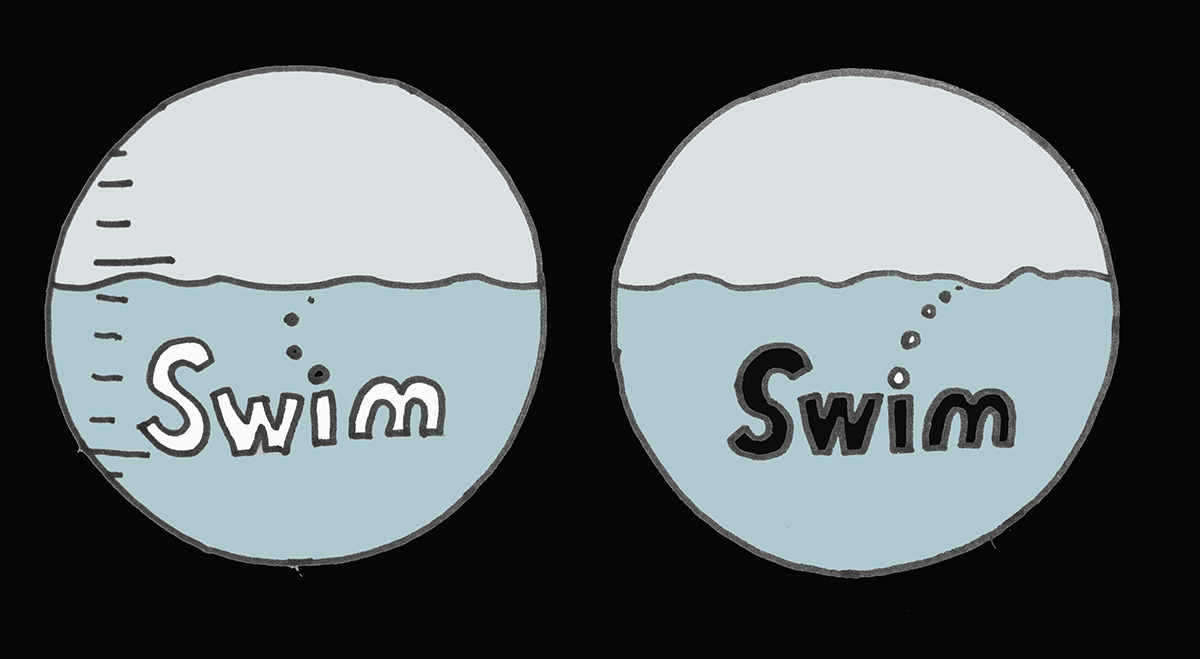
The forced Mouse Swim Test, or Behavioural Despair test, is a test used for some drugs such as antidepressants. A rodent, normally a mouse, is forced to swim in a cylinder from which it cannot escape. The time that the mouse spends not trying to get out, and just keeps its head above water, is the key metric. At this stage, the mouse has given up trying to get out. It doesn't drown, not normally anyhow, as because mice are so small and light, and given their shape and the air in their lungs, they can basically float - at least in a lab environment.

You can watch, if you like, a swim test example on the youtub here: https://www.youtube.com/watch?v=9s3o5UFThyo

I wanted to try imagine what a mouse's mental experience might feel like, during the test, transposed into more human language.

Then I wanted to jump out to the lab, and a team of scientists running tests ad infinitum, with a parallel to what the mice go through, maybe.

Posted on

Short story: Crow Riders

Gusto was only back for the weekend. I met him on Friday afternoon and again in a pub on Saturday.

It was December and there was a cold snap, with snow on the hills and scattered along the edges of roads. People marvelled about how one field was pure white and the next one wasn’t.

Galway city was dressed in Christmas lights and brightly decorated window displays that shone out against the early nights.

Gusto was already there, and it turned out his uncle had come too. Two uncles in fact, and a cousin: they had all come over from London. It was Gusto’s first trip back since he left but he seemed the same, engaging, and projecting easy confidence. An extrovert with introverting aspirations, he could sell ice to Eskimos but was a creature of habit. I on the other hand would routinely fail to make even the simplest of phone calls, but would seek to wander down streets I had never been.

They were round a table in the back of the gastropub and one uncle was telling stories. Gusto had told me that he was a businessman who part-owned a chain of restaurants.

I pulled up a stool as the uncle described a wealthy businessman friend of his.

“It’s not about the money. Not at that level. It’s about the deal then, it’s about making that deal- that’s the motivation, not the money.”

To me, it had been a long year. Yet at the same time it seemed like each season was a cloth pulled quick from under dishes – a party trick. Except the trick never works, not in my rendition. The dishes fall and shatter, and only the table remains, smug and bare, every time. Oh dear. I was in, what I call, a trough. A trough, or the trough? Hard to say.

“Brian’s a programmer,” Gusto was telling his uncle. “But he’s taking a break.” “But he could get a job anywhere.” I could see a move-to-London vibe rising.

“Ah I’ll figure it out soon. Did ye order food?”

“I thought that there was a lot of IT work in Ireland. Maybe it’s all in Dublin?”

“Oh, but right now he’s writing jokes. Tell us one of your jokes B”

I hadn’t been writing jokes, not exactly, but I’d been thinking a lot about where jokes come from, and how people can suddenly come up with them at all. Take a joke like “Why did the fish blush? Because the sea-weed” and apply the format to something else.

“Oh, I’m not really writing jokes” I said. “I’m just watching a lot of standup on YouTube. I like to think about how jokes work, like, how they mess with your expectations of language or life.”

“But you wrote some no?”

“Well, I guess, but they’re dumb”

“Go on. Try one.”

“Ok so. Why did the mountain worship the sky?”

“Why”

“Because it rained

Groans from around the table.

“Why was the mechanic afraid to order the parts?”

Silence.

“They were wheel nuts.

“Maybe stick to the day job,” laughed one of the uncles.

The stories resumed. Gusto’s uncle began telling us about some Saudi businessmen.

“So they’re opening this massive new building, you know, the Burj Kalifa. And they plan a huge fireworks display. And one of the investors, he sees this big apartment block, 22 floors, that has the only clear view, to the side where the fireworks will be. So he buys it, the whole block. And he gets a designer, a brand, like Gucci, or, you know, Louis Vuitton, to kit out each floor. Each brand kits out one floor. And that’s just to watch the fireworks for the opening. 22 floors.”

I was thinking that Galway now seemed tiny, squashed, bounded on the poor coast by wild sea and back roads that cracked across the middle as they sunk into bog, all under unfolding layers of bad weather.

The pub was quiet. It was still early. Christmas parties would stream in later on, and Christmas jumper drinking sessions. The menus had changed, and the waitress told us there was new management. She’d been there since I had worked nearby the year before.

Stories continued. I didn’t have much to offer.

“So, Brian, what else have you been up to lately?”

“Um, well, I’ve been busy, but, I’m not sure at what, exactly. Stuff. You know, not much structure.”

I tried to think of something to add. I remembered something that happened the day before at home.

“I had an interesting experience yesterday” I tried.

“Yeah? What happened?”

A space opened up just then.

“Very little, I mean, nothing dramatic, but I thought it was interesting”

The space was still there.

“Well, I was indoors for the morning, for a few hours at the computer, and it was cold, and I needed a break. You know, I was feeling a bit crap.”

Maybe too much, but I didn’t tell them about the trough, or how deep or steep or strange it could be.

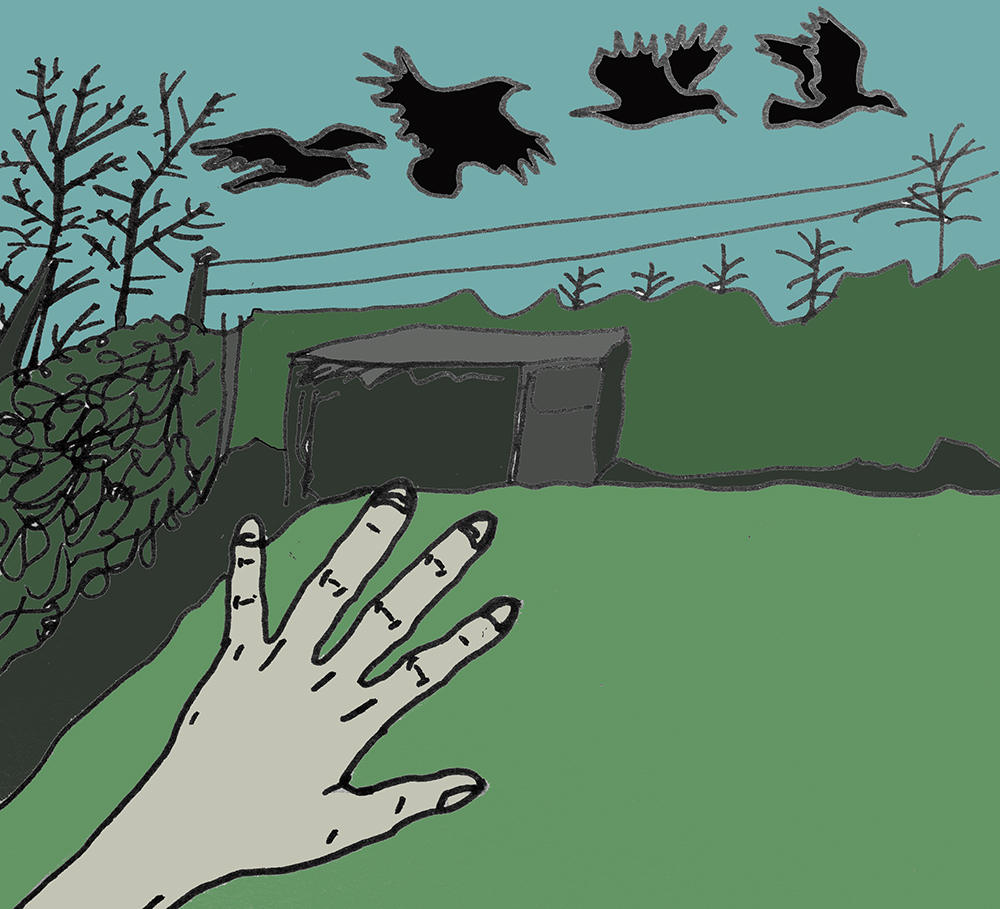
“So I just went outside and walked a lap around the house to get some air, just before it got too dark to see. And as I walked round the back, a bunch of crows came flying over, over the trees and the back garden.”

They must have wondered where I’m going. A scattering of crows? Where was I going?

“And I just throw my hand up at them, like I’m throwing something.”

It didn’t seem like much of a story now. They were looking and I soldiered on.

“And the crows react. They suddenly spread out, then back in, but it’s so, seamless. It’s like they move before I do, or at the same time, and it makes me realise how, connected everything is, like it’s not not that this happens then this happens, but that everything is happening at once, and it all moves along as, as one.”

Silence.

“Sounds like you’re a buddhist now” says Gusto, smiling. “Zen.”

“What happened then?” asks the cousin.

“Oh, nothing,” I said. “I mean, the crows are already gone. They fly over the garden and the trees and come back in close together, like nothing happened. It just made me feel better, all of a sudden. Like I’d been plugged back in. Nothing dramatic.”

Now I wondered why the hell that moment came to me when I ransacked my brain. It always throws up random stuff.

The conversation bubbled on. The chatty uncle told us about high interest rates in Iran, and how princes in Dubai will spend $500,000 to get a number 1 plate to make their gold-tinted supercar stand out (because you can’t actually buy a car that will stand out no matter what you spend), and how burgers are more expensive in Galway than London, and how a multi-millionaire he knows will still work with a labourer shovelling or cleaning sometimes, or spend hours haggling to get things like toilet paper for a few pennies less.

“It’s not about the money. It’s about a way to live.”

“Maybe it’s like a backstage rider for a band” I tried. “Like Van Halen only wanting brown M&Ms so that they could check if the promoters actually read the contract. Like, its strategic really. Even if you don’t understand- some things are supposed to make no sense.”

I ordered dessert and ate dessert and the pub slowly filled and loudened. There was a decision to move to the city centre. Suddenly everyone began to stand.

When I went to the bar to pay, Gusto and his uncle began to happily argue about who should get the bill. Gusto eventually paid, and paid for all of us. I’d taken my wallet out and stood uselessly behind him, defenseless.

“Come to London, man. You can get a job there easy.”

THE END


Written by Donal Kelly, December 2017.

The crows thing happened last week, or maybe the week before. It stuck in my sieve-brain, though it only lasted a few seconds. Nothing dramatic.

The stories about rich Saudi princes were indeed told, in a pub, but in a slightly different setting. I don't know if they are true or not.

I did make up those jokes, probably while driving, but they surely already exist.

Posted on

Short Story: The Promotion

The Promotion

Interview room 341 is very small and dark, like a segment cut from a corridor. Harry notices the odd ratio of wall to door to window as he automatically moves towards the one empty chair. An inspector sits opposite behind a small desk, staring down at a screen. He’s thin, suited, with short hair starting to grey, and legs crossed with the raised foot absently tapping air.

He doesn’t seem to notice Harry standing there awkwardly. Just swipes and stares. Harry sits. Now the inspector looks up.

“Ah, Mr Thomas?”

“Yes. Yes?”

“Sorry to keep you waiting. It is nice to meet you.”

“Um, yes, it’s nice to meet you, too.”

The inspector smiles, showing his top teeth.

“I hope you got here without any trouble.”

“Yes, it was fine.”

“Well. I’m glad you could make the appointment. We’re very sorry about the delay. You know how things are right now.”

He waits.

“That’s ok.”

“Good, good. I’m sure you understand. It’s beyond our control. And of course doing things properly takes some time.”

He waits again. Smiles. Teeth.

“Yes, I suppose it does.”

“It won’t take long now though. Not long at all. We have gone through your work in detail. Everything in the feed, and everything in the archive. A considerable portfolio.”

He holds the screen up.

“This is your account, right?”

Harry looks at the old feed; its thumbnail images, shared edgy articles, and cringeworthy contributions from an old virtual self. It has been scrolled down to some point in the past, maybe five years ago, or more? There’s a photo of his brother with arms folded, standing outside under trees. Harry remembers it. 35mm Kodak film in a Canon FD camera, on a 50mm lens, just after the house was finished.

“Yes, that looks like my account.”

“Excellent. Yes. It is. We have gone through it in close detail. Thoroughly. Quite a body of work. Substantial.”

He waits. Smiles. Teeth.

“Thanks.”

The inspector turns the screen round. Tap, swipe, tap, tap. He holds it up again.

“And this, this is also yours? From the archive.”

Harry looks. A gallery of much older photos. A red van outside a bungalow on a drumlin hill. A long exposure of waves hitting a dark-rocked coast. A blurred horse running on an island. A boy in woods holding his hand in front of his face. A reflection of a row of white houses in a puddle.

“They are yours?”

“Yes, yes, they’re mine. from before. I haven’t seen them in…”

“Yes, well, here they are. Alive and kicking. Very consistent.”

He puts the screen down on the desk next to a sorry plastic plant.

“Well, we have gone through everything in detail, great detail, and we feel we have a good measure, a very good understanding, of your work. A very broad output indeed. Landscapes mainly, wouldn’t you agree? A degree of escapism? Some Longing? Classic straight composition, with the odd effort, off-piste, as they say.”

Harry’s eyes roll around the very small room.

The inspector waits.

“I guess, I’m drawn to landscape, somewhat.” He shifts in the chair.

“Yes, yes. Landscape is a fine subject. A fine way to spend a day off, out in the open air, recording the conditions, the light, the weather. The change and the unchanging.”

Harry shifts uncomfortably again.

“And of course, some street work here. Black and white in the main. Very, I suppose, un-intrsuive. Unintrsive street scenes, with little eye contact. Some reflections, windows, skies, observations. Perhaps a sense of, disconnect? Certainly a measure of observation and complexity. But a distance nonetheless. Very interesting. The curse of the observer, in the street, of the street, but always feeling outside, perhaps?”

“I suppose.”

Another long pause. Harry looks up at a fan cutting its loop overhead. Snipsnipsnipsnip…

The inspector nods and stares, his finger still flicking across the screen. He angles it so Harry can’t see what he sees. Pale blue light strikes his steady inspector face, and into his steady inspector eyes.

Eventually he puts it down again, and turns to face Harry, folding his hands carefully after thoughtfully brushing dust from the corners of the desk.

“So, this is good. I think we can come to a very clear understanding.”

“I hope so.”

“Certainly. Certainly. You see, your work is excellent, very good, very broad. Curious. Introspective. Persistent. And very consistent. Perhaps trying at times to, er, find a, find a foothold. A voice. What do you think?”

“Well, I guess, I mean, it’s… hard to say. I’ve put a lot of… It’s not really something I’ve…”

“Not to worry. Not to worry. Of course overthinking can disrupt the intuitive quest. Art is an, active form of contemplation, and expression shouldn’t be, pigeon-holed. Never tied down, strictly, fully. In any case, I’m sure it has been a valuable process, very educational. And an interesting, active hobby. We must always strive to see, to see better, no?”

“Sure. Yes.”

“Yes, We have to be, be in the world, and, take it for what it is, with us, in it, in the, flow, exactly. We have to let the world flow by us. Through us. Let it settle, percolate, integrate. Exactly. You have explored and I’m sure have learned a great deal about this human condition of ours.”

He rubs dust off the desk again, and glances at a clock that hangs on the wall behind Harry. Smiles. Teeth.

“Now, I’m glad we agree. You have learned and experienced and explored. A valuable process. You know, people like you are very important, vital even.”

Harry tries to stretch his body out of its slouch. The plastic chair seems designed to push it into a collapsed hunch. The tiny room is warm but he shivers. The daylight that had striped between the narrow grey blinds is gone.

The inspector puts his hands together in another practiced gesture.

“Of course, it is vital too, essential, to help people find their right, role. Their best calling. Vital to all of us. Otherwise, so much, so much potential, goes wasted. A great inefficiency.”

Harry stops fighting the slouch.

“I’m sure you have studied the greats. The giants of the art. Bresson, Capa, Adams. Man Ray. Atget. Aarbus. Koudelka. Steichen. Mann. Strand. Kenna. So many, so many. So true to their art. Art in every direction. We must never forget to study them, learn from them. Try to see as they saw. Don’t you think?”

“I suppose.”

“Yes, of course we do. And at the same time we must also struggle, struggle to find our own path. Sometimes we fall naturally into it, but of course, we can be helped. can we not? We have to embrace our path with integrity.”

“I guess.”

“As sure as we are sitting here. As sure as the sun still rises. We must help each other, for the sake of all of us. Not in a theoretical way. In real ways. Concrete ways. We must keep our purpose clear and our hearts open. Would you say that you are open, Harry?”

Harry lets his eyes float again, from those clean careful hands with close cut nails, to the looping fan, to the grey blinds.

“I, I.. maybe.”

“It is a fact. It is obvious from your work. You are an open, inquisitive individual. With so much to offer. I am sure you can see the opportunity, and that is all it takes, to see it, to see the path ahead.”

The inspector seems to count a preset number of seconds of pause, looking intently at Harry, then thoughtfully at his desk and office and the upturned screen and the clock, as though they have suddenly just appeared and are arranged just right.

“So. Time has no mercy. I am sure you are eager to get moving. It is great to find agreement. I am sure you can have many new experiences, good, great experiences. There is always time” As he speaks he pulls the screen back across with one finger, without looking at it. Then he does look, and it lights up again with the same blue, and he touches and taps.

“Now, here we are. Harry Samuel Thomas. One Seven Six Zero Seven Six Five Nine Two. This is you.”

“That’s me.”

“Of course. Now. Let’s just quickly… (tap tap tap).. and (tap tap tap) ”

He leans over the screen on the desk, but Harry can still see.. another gallery of his photographs. Numbers and dates. His memories. On one side he can see a star rating and underneath it some comments.

Two and a half stars out of five.

The inspector stares for a long moment then tap-tap-taps again.

Now a big button appears saying “Confirm Cleanse”

He looks at the screen.

“No point in looking backwards Harry. We must learn from the masters, pull together, find our optimal path. We must let our lives be our content.”

Harry watches the inspector’s quick fingers tap “Confirm Cleanse”. The screen flashes. A new view: “Confirm content cleanse. All feed content will be removed. Save feed content to archive? Remove all archive material?”

The inspector de-selects “Save feed content to archive”, and selects “Remove all archive material”. He taps “CONFIRM”.

“Identification required. Level Four. Department of Culture and Data Provisioning.”

“Ah, of course.”

He turns the screen to Harry.

“Can you put your thumbs here. Both thumbs? On the circles.”

Harry presses his thumbs onto circles marked L and R.

“Identification confirmed. Processing request.”

A loading bar appears.

“Removing feed content. 3%”

Harry can hear the fan and his own breathing. He tries to remember the places he has been. Fragments. A windswept day out on the coast. Deep grass, hollow-pocked under tripping feet. A windy afternoon and the sun blasting between clouds. Crawling on his belly to the edge and holding the camera over it.

The ocean bellowing below sheer cliffs. Seagulls squealing. The huge mass of the sea stack over the waves. Lines of white froth and bullets of specular glint. Clear horizon and sea sound and sea smell from one edge to the other.

“100%. Source material removed.”

“Removing archive material. 1%”

Or, another time and place, getting out of the subway at night, during winter in a cold city, and turning to look down at steps running back to the station. A man hurrying down, and suddenly jumping the last few steps. Too many to be practical. A flourish, not meant to be seen. Just for the heck of it.

A long time ago now.

“100%. Archive material removed. Procedure complete.”

The inspector smiles broadly and leans forward.

“That is it. That’s great. Nothing to it. Now we can move forward. Onwards and upwards, to new adventures.”

He continues to tap.

“And the requisition unit will call to your home this very day, for the equipment recycle order.”

He turns the screen off.

“Now, good news. We have a great position lined up for you. Perfect. A brand new opening. Right next to your home. A fine promotion. With a highly reputable content subcontractor- Merko Kontent.”

Harry feels far away, and being far away and empty, finds he is now able to meet the inspector’s gaze. It doesn’t waver. It holds his eyes and drinks them in and deletes whatever they are saying, unflinching, unreflective, steady.

“You will be straight into the images department. None of the ground floor work. A proper contract.”

It is easier to look at the blinds, and the lines of darkness where the lines of light had been.

**************************

Office six eight four, floor three, Merko Kontent Building Seven, Department of Content and File Administration. Eight minutes of brisk walking from the outside door of the apartment block.

A lady in a blue suit with a name tag shows Harry to his desk. His name and number are displayed on a large flat display. She points out the bathroom, the coffee and vending machines, and the smaller second screen to the left of the other. On this, a red clock showing “09:00:00”

“Just put your thumbs here.”

Harry puts his two thumbs against the L and R circles on the big display. It immediately lights up. Text appears.

“Assignment 3707124. Content Agent: 176076592. Session: 1186503. Time allocated: 24:28:00. Time accumulated. 00:00:00. Session length: 09:00:00. Press screen to begin.”

There you are”, the lady says. “Just follow the screen. Easy peasy. A basic session to get you started. It automatically stops when you leave your chair.”

She starts to walk away then pauses.

“Oh, and your work will be monitored of course, I mean, especially, for the first few days at least. It’s just protocol. Press the Support button under the clock screen for tech support. But you shouldn’t need it.”

She hurries off. Harry watches her disappear into a maze of separating dividers and then he glances up at the camera overhead. Then at the screen. It waits.

“Press screen to begin.”

He presses the screen.

“Assignment type: Image Allocation. ID 3707124. Session: 1186503”

“Assignment content: Private Feed Images”

“Assignment target cluster segment: Pornography”

“Press screen to continue.”

The only sound is a low background hum, and possibly faraway traffic, and something like flowing water. Overhead pipes?

He presses the screen.

“Instructions overview: Choose Yes if image is of a graphic or pornographic nature. Otherwise choose No. Press screen to continue.”

Harry presses the screen.

The clock on the left suddenly starts counting down.

“8:59:59”

“8:59:58”

On the main display: an image of a windswept sea, probably taken from a boat. Two buttons. YES and NO.

Harry touches NO.

A new image. A truck being unloaded outside a warehouse in the rain.

NO

A group of people in a room, looking at the camera and smiling.

NO

Two young naked women in a kitchen with their hands raised to their faces in ‘owl eyes’ shapes.

YES

***********************************************

When the clock reaches zero, Harry realises he hasn’t eaten, or moved from his station for a full nine hours. The light has stayed exactly the same throughout. The sounds too, bar an odd shuffle of passing feet followed by clunks from a vending machine or whirring from the coffee machine. The big screen is blank. The small one reads “00:00:00”. Now it too fades into black. Harry’s phone vibrates in his pocket. He takes it out. New message.

He takes the stairs down and goes through door, door, gate, to get to the street. It’s dark and not yet busy. An eight minute walk home. He has finished early.

After four minutes, Harry reaches an intersection and stops. His stomach is rumbling. He stands there for two full light changes, watching other workers going home, and cars driving through. He sees lights switch off in the opposite block, and others switch on. He sees a woman walk by with a little girl wearing a dress and eating an ice cream. Instead of going straight on towards the tiny apartment, he turns left, and walks faster.

Eventually, he reaches a bridge and crosses, looking down into the dark river below. Now he is in the old part of the city, where warrens of streets thrown on streets mingle and twist. Old unprofitable shops hang stubbornly onto corners like barnacles.

Harry stops at a dirty lit window with red and black lettering overhead. “Darcy’s. Buy and Sell. Technology specialist. Classic items.” He looks around before pushing the door in.

A bell tinkles. An old man leans over a glass counter at the end of the dark narrow space, working with a little pliers over something disassembled. The centre and sides are lined with shelves and cases. Harry makes a slow line around the outside towards a display of antique cameras. Dented metal SLRs, a couple of worn rangefinders, and a random mix of lenses, bags, and coloured filters. He picks things up, twists knobs, presses shutters.

The old man stops his work and stares.

Harry picks up a small SLR.

“How much for this body and lens?”

The man peers through his thick glasses.

“Mmmmm, that’s not a common model, that one. In good nick too. Serviced it myself. And no digital footprin… mmmmm…. 50 pounds for both.”

“Do you have any film for it?”

“Mmmm, film? I’ll check.”

The keeper disappears into the back, and Harry waits, listening to the sounds of cabinet doors opening and closing and muttered swearing.

The old man returns with a small cardboard box filled with rolls of old film.

“Expired of course. But I had them in the fridge.”

“Fine.”

He picks up a loose roll and holds it up to his face.

“You know, I don’t think you can get these developed anywhere anymore.”

“I know.”

“Oh, well, 3 pounds a roll, as they are.”

Harry picks up and puts down some of the rolls. He looks around the empty shop again then pulls out a battered wallet. Carefully wrapped inside an old receipt are two 50 pound notes.

“Will that do? For the lot?”

“Yep, that’ll do. I’ll find a bag.”

Harry hands him the cash and turns to the door. Back outside, the street is quiet. The streetlights that work throw cones of muddy orange along its narrow curve. Harry fumbles with a roll of the expired film and eventually loads it. He stares at the row of houses, the lights, and the blackness of the sky that they fade into.

He wipes the viewfinder and lens with his sleeve then holds the camera up to his eye. Fragments from the nine hours of “Assignment Section: Pornography” begin to dislodge. He tries to see only what is in the viewfinder.

Click.

THE END

All photos, drawings, and text by Donal Kelly. Please let me know if you liked it. If you hated it, that's ok. I can accept this. But no need to let me know. I find it really hard to get anyone to actually read my efforts, and I can't read it properly myself because it's too familiar. Maybe if I spend a year or two forgetting.

I had an idea to write a story about a committee or judge deciding whether or not to delete an artist's entire life's work. Not that I am such a thing. But, just like that: one click of a button. DELETE.

I was struggling to have much belief in my own work (still am) and this is one of the genre of malevolent fantasies that my mind sometimes spins. A committee made up of the type of commenter from websites, who say "I dunno, I think it's just shit". Once I started, I began to imagine what the world might look like for this to happen, or what else might happen afterwards, or even the room where it might happen. Just a few loose sketches. Hints and allegations.

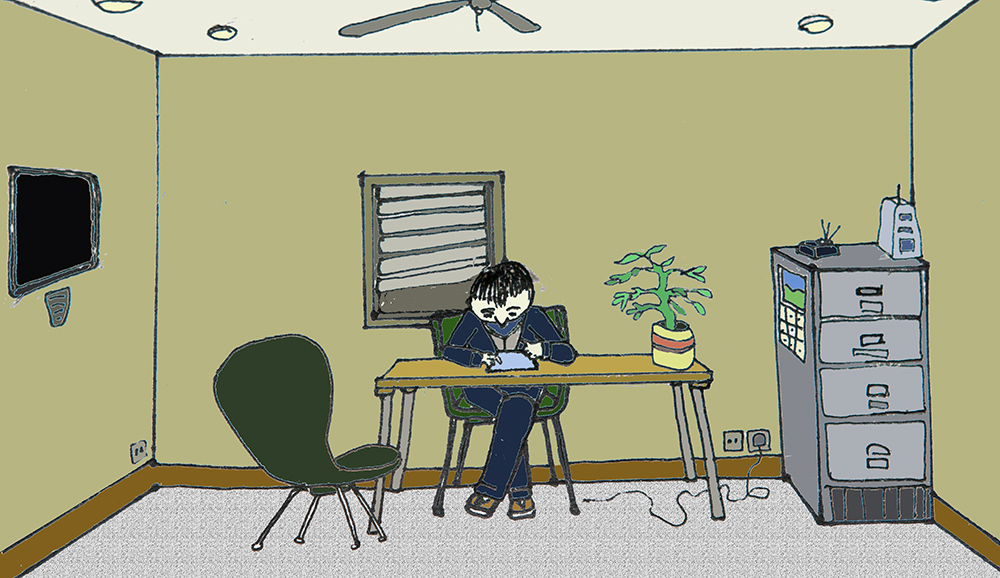
Then I decided to draw an actual sketch. Of the little interview room. Who knows why. Then I felt I had to add lots more, for closure, and then I lost a whole pile of time. Hours and hours. Gobble gobble gobble. And I still think, it probably, should be, you know, deleted.

Posted on

Short Story: A Day in the Failures of John R. Clancy

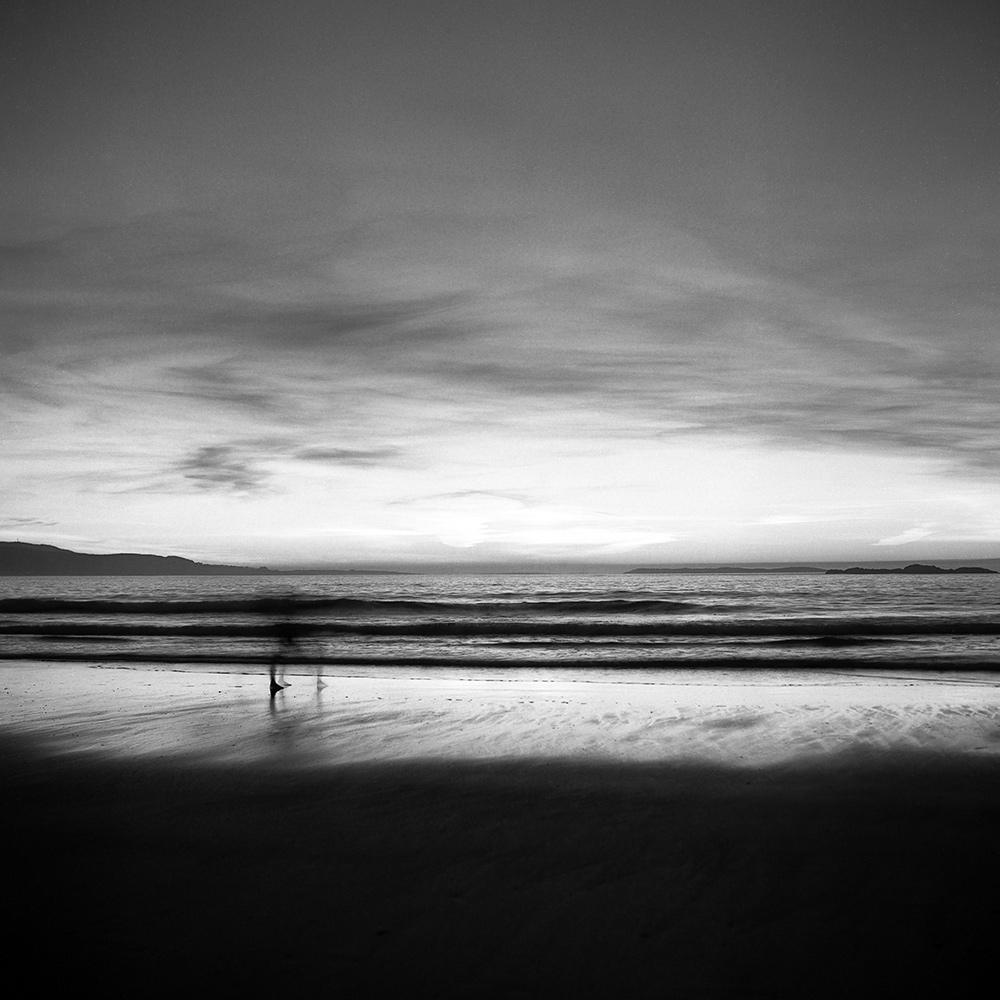
lettergesh beach black and white, two figures

A Day in the Failures of John R. Clancy

LISTEN:

John Rufus Clancy tried to become so still that he could feel time pass, but he failed. He could see the clock counting up, but he couldn’t feel its passing. There: that transition between 14:59:59 and 15:00:00, that transition from not late, to late. Where was it? Even if he stared blankly at the mutest emptiest stillest surface, or shut his eyes completely, there was no way to register time itself, just the numbers of its count, the recording of wheels turned or electrons spun. All of his senses were in the soup, a jumble of ingredients unaware of their own dish’s name. His senses and senses of his senses and the idea of a self and its selfness, were all balled up and spun out in time, of time, all the time.

Maybe though, if he pushed himself, those counted numbers themselves, or the idea of counting, or at least some such stuffs, are on the outside, even if the thinking with them is not. Can I, wondered John R. Clancy, 1 minute late now and counting, in my flow of slippery mental states, contain – hold as thought-subject – something that is genuinely outside of time?

The car in front slowed abruptly again. John reacts. Right foot up, over, down, hard on the brake. Friction bites, and his body pushes forward against the rush of road, weight flows into his hands and onto the steering wheel. Find calm, find calm. No, his circulation spikes up, and blood rushes ventricle and vein. Why did he brake? He/she/they/it… there was nothing in the way. Stewy warm anger spurts, encompassing, bladed, intentional, spills like gloss green paint in clear midday sun, or the sound of a cracking plank of dry wood under much load. Kurrsquack of a jagged black raven. The violent words and their rowdy hues assemble with intent at street corners. Will a man ever be calm again? Left foot down, clutch in, gear disengaged, down to fourth, then to third, and all under control again, with enough space, bumper behind bumper. Two minutes late and growing. If you’re stuck in traffic you are traffic.

Would she wait for him this time, clinking her coffee cup and checking the time on her phone? Is she counting up or counting down?

A radio ad is trying its earnest best to sell John a new car, trying to sell him the idea of a new car, trying to sell him the idea of a future, brand new, John R. Clancy in a minty glistened fresh new car, all humble and correct and to be highly regarded, pulling ahead, up the road, citius, altius fortius and high on a sharp summit of escape and presence at once.

Would she wait or would she tip on, and by leaving cleave the story into a before and an after, a then and a not then?

There would be parking on Munster Avenue.

John Rufus Clancy tried to come to rest like a spun top finding its halt (though it is the more graceful aloft), but he failed. Surely, there is a stable plane for all things to return? Equilibrium. Or was it just another connivy dream’s spin? It comes down to a story, its telling when told, and the politics of the organs as they take to any telling. Surely there was a plot where this was the end: the happily afters or the bitter-eat embers of a shot down hellhound. There are the sudden jolts, and then the stretches in between. It could yet be the beginning? There is the spinning mill of narrative, threads woven and rewoven into fabric and pushed out and piled up, in the good old production of order, consistency, structure, cohesion, resolution. Thunkathunkathunkthunka… down it spills like the scroll of a news feed, falling translucent, topless, bottomless, and more real than what’s outside windows with its sweaty graft and buzzing-by flies and mouthfuls of dust and unexplained itches. Imagine eating food that makes you hungrier and hungrier. You eat more, you need more. John R. felt a kind of desire to have more appetite, or something like this, but more vague, muffled, the echo of a banged pipe down the gullet of the briny brain.

“I made my bed, so I have to sleep in it.”

History class. Nineteen-Ninety-something. She didn’t do her homework, or something. Something lost, buried in the scrollfeed, in the making and unmaking of beds. She said that after, whatever, and John had never heard it before and saved it as something really significant. But what wasn’t significant then? Could a life be primed forever by a few snippets plucked from the sky in early days of feels?

The rain is still coming down when John R. reaches the cafe, but is more drizzle now than pelt. Earlier on, the June bloom had been spoiled with light. It turned as it often does, under the whim of blown bellyheavy clouds. It’s wet, or it’s dry. So it rolls, by and by. It’s wet, or it’s dry, or it’s ‘it’s wet, or it’s dry’, and so on. He didn’t put money in the meter- there was less than an hour left in the working man’s metered day.

Maybe she’d left by now, and there was probably a message or three unread. Maybe she’d left just now or five minutes ago or a year ago, according to the piled fabric of narrative, according to its thick knots written and unwritten, a thing to be counted but not felt. Time. Take the world at its most solid, as a lifted black rock from wet soil in the hands or the idea of the number one while lying in a quiet (lonely) bed, and yet but a passing flow over an abrupt stone in a river, or the shimmer of a bent ray deflected by a little ripple of a gurgling stream down a boggy hill finding a pair of eyes and all their percept on some point. Did the history of the world conspire to arrive at just this or that flicker on a ripple?

The ostentatious John R. Clancy was there, but she was there or she was not there. It’s hard to tell, that something isn’t there. You have to search every possible seat and wait to see if anyone comes out from the toilet. Coffee for one so, and messages checked, too late, and suddenly sweating at a little table, with barely tasted cappuccino and cake. Maybe it was a waste of a few euro, or maybe the motions of teeth and throat kept John R. upright, with head down, reading some latest breaking news on a bright screen, hunched over a surge of anger aimed squarely at the idea of himself and all its pretentious wanderling baggage and lazy adorned habits. He wondered if she‘d sat at the same table. He could ask but he wouldn’t ask. Was there a dark-haired girl in just now? How did she appear; I mean, did she look pensive, agitated, or resolved, confident, calm? Did she leave with an unwiped tear or a fine carefree air?

“Get over yourself”

She said that in an art class some time before some forgotten exam. That was when the collapsed self of later school years was still pending reformation, still stuck on its spear-tip of self-consciousness and self-disregard. What self? What over? To jump? And where to land? to climb? And where to ascend? And yet it seemed again, significant, so he saved it down good and deep. To here, years later, some thin- spun maturity, the aggregation of accumulations. Maybe it’s better to barely be a self, but always intertwined and carried by the senses to the great outside, and less aware of the looker looking and just looking, just being.

Ah… beds made, holes dug, selves to get over, and the deeper dimmer dug the more enticing then to just carry on, head down, busy out, duvet over the head and back to sleep, digging.

**********************************************

Much later, John Rufus Clancy tried to set up a comfortable place to sleep, but failed. The only flat patches of open ground that he could find around Ballyvaughan all had signs with

“NO CAMPING. NO OVERNIGHT PARKING. BY ORDER OF CLARE COUNTY COUNCIL”

He had eventually found the lumpy stub of an old broken pier outside the village, and pitched the tent in the middle of it, on a bumpy crop of tall grass and weed. He had cycled down with laden pannier bags, and eaten a pizza where the young waiter spoke English with a Clare accent and French with a French accent. And he had sat out by Monk’s pub on the wall over the sea, with the sounds of a folk band’s ballads carried out through the open door on a calm bright late June night.

“Black is the colour, of my true love’s hair”

High over the bay hung wisps of red and purple woven into the deepening dusk.

“Her lips are like, some roses fair”

He had sat there until his legs grew numb, and he tried to see the fading of the light, tried to see the change itself without looking away, but couldn’t. Lights began to twinkle on the far shore from Galway city out along the west coast of Connemara.

“She’s the sweetest smile, and the gentlest hands”

Only if he closed his eyes for a minute, or more, then opened them, could he see that the sky had dimmed further. But whenever he closed his eyes, so many thoughts argued for attention. Better to stare at the outside. Tourists walked the pier and up towards the village centre. Groups, couples, togethers. The light slowly fading.

“And I love the ground, whereon she stands”

He’d follow them soon, up to the village and continue on out the narrowing road with a flashlight blinking, to the tent on the pier.

John Rufus Clancy tried to get a proper helping of deep dreamless sleep, but he failed. He’d forgotten how damn loud everything was and whenever he slept, restless dreaming. A rookery in the trees over the main road had settled but not settled, and every so often a chorus of kak-kak-kak-kak-kak skrrrrrrrraaaaukkkk sounds would jar him awake. At two thirty a group of drunk people passed, loud, shouting, laughing. Someone lagged behind and got sick on the roadside. “Timothy” they yelled up ahead. “Are you getting sick?” Did they see the bike, the tent? Should he go out and check?

Then, before seven am, he woke from a dream where he could hear an old cat getting sick in a kitchen, and as the sounds got louder, he struggled to break out of it, urging himself to wake, wake, wake, squirming in the tight sleeping bag as though he were bound up in ropes. Eventually he dragged himself to the surface, and unlocked consciousness, and the sound resolved into the lapping of the high tide on the old pier stones a fistful of metres away.

When he figured that the water wouldn’t rise as far as his tent, John scrambled back inside and lay down and listened to the lapping and tried to let everything else down too, and tried to stop holding things at all. He figured he was making some progress too until the phone pinged, and it was from her or it was not from her. It was on the line between not late and late and here and not here, and somewhere in the story, maybe the beginning, maybe the end, and it said

“Hi John, how are things? Are you ok?”

Or maybe there was no message at all, and outside the sea just glooped between the stones and he could see a squadron of earwigs scrambling up the inside of the flysheet and he had nothing to eat for breakfast and he had failed to make provision for these eventualities at all.

THE END

written June/July 2017. Tried a recording outside, Oughterard, July 13th.

Posted on

Short Story: A Fairy Gust

Hokusai: Ejiri in the Suruga Province

***page title image: Ejiri in the Province of Suruga, by Katsushika Hokusai (1832)***

“A fairy gust,” said the mother to herself in the kitchen.

It had come flung from the Atlantic, down through the low mountains and into the narrow valley, lifting the galvanized tin roof clean off the shed and toppling two of the old ash trees in the top field. Three pieces of TV aerial were stabbed stuck in the mossy front lawn and the telegraph poles at the boundary wall corners were both kinked over at the base with the black rubber-covered wires flapping loose.

“Ah for fuck sake,” said the son, lying on his bed after the sudden rush of snap and crash. His Internet signal had disappeared. The window had swung open and a plastic bag, leaves, and twigs had blown into the room. He rolled off the unmade midday duvet and slumped to the kitchen swearing at the damage. No Internet, no phone, the shed roof dumped in the front hedge, and the dog howling away madly at nothing.

“A fairy gust,” said the mother to the son, standing between the fridge and the sink with a mystical nod towards the window. She began to put on a pair of old boots, and went outside without tying the laces.

The son fired on a pair of runners, and followed her out. She was trying to quiet the dog.

“Two of the ash trees are down” she said to him. “And the aerial’s gone off the roof. Look at the tiles!”

“I know, I know. I can see them. There’s no phone. The shed roof is off.”

The mother pulled a broken tile off an upturned flower pot.

“My geraniums! That was some gust!” she said.

“You’ll have to go down to Paddy Fitz and see if he can come up.”

“Yeah, yeah, whatever. Jeez.”

“For fucks sake,” said the son, as he pushed away the wheelbarrow that had been blown up against the side of the van. Its handle had run a long white scrape along the red finish. The van had cost him a fortune. He started the diesel engine without waiting for the coil to heat up and it grumbled into a fit of smoke-sluggy coughing. Fairy fucking wind. He drove around the tilting poles and off down the neck of the valley. He could see more trees down along the side of the hill. It wasn’t even windy.

The second gust arrived after the son had turned on to the main road, and was driving in third up the rising shoulder of the valley. It caught the red van square and off it went, laterally, almost holding grip then suddenly breaking free sideways and flipping over the low bank and down into the bog, rolling onto its roof and back onto its wheels in the soft ground.

“Another one!” said Paddy Fitz to himself, on the other side of the valley shoulder, looking at where the corner of the shed had been separated from the wooden frame by the second gust and stacked turf had fallen in a pile beneath.

He went in to tell the wife.

“Damned if I ever saw one like that before. And the oak tree down on the wall!”

She hadn’t seen the likes of it either, but out on the islands she had heard a few stories,and she kept still a store of omens and signs, pishrógs and bad cesses and rules, like going out the same door you went in. The aerial was gone from the roof, and one of the bedroom window panes had been shattered by a tree branch. Paddy stared at the mobile.

“No signal at all.”

“The mast might be down.”

“They should never have put the damn thing up there anyway.”

“Well, they’ll have to fix it. I’d better call the ESB.”

“Call with what?”

“Oh, right, of course. Well, can you go down to the town to see if they have reception there? They can’t leave it like this”

“For fucks sake,” said the son, as he struggled to pull his sinking feet through the bog and back up to the road. His nose was swollen and his neck was vibrating with pain and he felt like he had done a full cycle in a tumble drier. The van was fucked, its roof crumpled in and the chassis buckled. And still no reception. And it was totally calm again, too. All along the road up the hill, poles had been plucked and scattered like rushes by the stalk. He walked with a worsening limp, stepping around debris, until he got as far as the old Garvey house. He went up and knocked at the door.

“Hallo!” he cried.

“Hallo! Mrs Garvey? Are you in?”

The mother was out picking up scattered wood and pots when the third gust grabbed her whole and fired her as far as the rhododendron bush. Pulling herself out of the dense stalks and purple flowers, she looked darkly up at the sky, a line of blood snaking down her wrist. The cleaning could wait. She headed for the house, limping. Today was not the day for fixing.

The son was standing on the cement path outside Garvey’s with the cup of tea in his hand when the third gust whooshed down the valley. He had gone out when he saw Paddy Fitz’s van coming down the hill, slowly negotiating the downed wires. The house behind him took the bulk of the weight with a dull thumpy whack, but he still fell forward into the grass. Mrs Garvey screamed from somewhere inside, and when he stood up, he could see Fitz’s van, upside down, wheels spinning. A shower of roof tiles, a chimney pot, branches, fencing, feed bags, and all kinds of branch and leaf, were scattered across the garden, and the beech tree at the back of the house was leaning over with two heavy branches hanging by the bark.

The son limped down to Paddy Fitz’s van, no more than fifty metres from his own, and helped him out from the upside down passenger side door.

“That was some gust!” said Paddy, coughing. “Never seen anything like it! Took me clean off the road!”

“Come on up to the house”, the son said, and between the two of them they made it out of the soggy bog and up to Garvey’s. Mrs Garvey was in the kitchen, looking out at the jumbled mess.

“The electricity is gone now too.” she said. “You’ll have to wait here a while.”

Paddy Fitz spent a few minutes quietly checking his bruises and rubbing his twisted ankle.

“Never seen anything like it Mrs Garvey!”

“Maybe it’s a sign?” she said, after a long pause.

“A sign of what? ” said the son.

“A fairy gust!” said Paddy Fitz. “Sudden burst of wind in off the sea. They get them out on the islands.”

“And not one, but three!” said Mrs Garvey. “Could be a sign. We should stay put. It’s not a day for going out.”

She went to clean the dust from the old stove and put down a fire to boil some water.

The three of them settled in at the kitchen table. Outside, it was calm and quiet. No radio, no TV, no phones, no cars on the road, no birds singing. Not even a rustle from a fallen leaf. A general deep stillness fell around them and they stopped talking.

The son stared into his hot milkless tea. As gradual as the sipped emptying of the mug, he stopped reaching to check his phone reception, and let the pain in his neck and nose and joints flow like his blood throughout until it seemed to merge with the quiet and they all become a background hum. He stopped seeing the crumpled van roof and bits of broken tile and aerial stuck in the mossy lawn. In his foreground, all tendrils of his attention craned out and came together in a narrowing coil, like a sensor for the faintest hint of the next sudden gust. Yet it remained solidly quiet and resolutely still, until a lone thrush began to slowly pitch up again outside the window.

The son didn’t believe in signs or omens, prophecies or fate, or even the future per se beyond the continuous consumption of the present. But in this strangely locked, loaded, cocked heavy calm, a tide of fidget and lie-ins seemed to roll back: a low tide drawing out the sea to expose a fresh strip of naked shore. He swirled the last gulp’s worth of tea in the mug and broke the long silence.

“I’m off for the city come September,” he said.

Paddy Fitz looked up as though awoken. “Oh! Well sure there isn’t much out here lad.”

“Yeah, yeah, I need a change.”

“Good lad. Do you have a job lined up?”

“No, nope, but I’ll figure something out!”

“You will” said Paddy Fitz. “You will.” He had forgotten about his ankle and put both palms flat on the pine tabletop.

“I’m going to head over to see my brother in England myself”

“The brother in London? Larry?” pitched in Mrs Garvey.

“That’s the one.”

“Never been over at all. Long in the tooth now but… I’ll bring over herself and Tommy. We can stay for a month- I can sell that heifer. sure we’ve never been further away than Galway.”

Mrs Garvey leaned in. In the distance, perhaps, or perhaps not, a fourth fairy gust was being conjured up above the ocean to be flung inland, and chunnelled down a narrow valley where a thin reedy river cut through bog that pitched up into the ancient Maamturks. She could feel with calm clarity, the weight of bodied silence around the wooden table that had raised two generations but was creaky now with more meals of memory than food.

“I’m selling the house.” she said.

“Oh?”

“Selling the house, and I’m going to get one of those nice little apartments in the town.”

“Isn’t your young one down in the town?”

“She is.”

“Well, sure she’ll be glad for that.”

“She, she might. Some family can take over this old place and to hell with the lot of us fighting over a patch of grass and an old building.”

“That’s if it isn’t all blown down today Mrs Garvey!” said the son.

“And us with it lad!” added Paddy Fitz.

The three of them settled back into their waiting for the next gust, having breached impasses deep below the chuckling of the wind.

Donal Kelly ----- written June 2017

Posted on

Short Story: The Suitcase

The Suitcase

“Frankie, you’re for the birds”

Frankie sighed and looked at his watch again.

Annie sat by the range on the well worn couch.

“Not now Mike; give it a rest.”

But they let Mike go on as they generally did. Everyone needs to vent. The air would not be clear until the birds for Frank were perched on the doors and balancing on the picture frames, cooing and clucking and idly sending droppings onto the lino.

There followed, in the kitchen, on that day, a faintly familiar wounded silence. Frank declined to defend his life choices, even if his expensive college degree was indeed a wasted sheet of glorified dusty toilet paper that qualified him as too smart for his own good, and even if he didn’t give a damn for all the good that was given him. The air was swollen but the kettle was on again. More tea would be made. The rituals of family are river beds to the rain.

Mike moved around his old inherited bungalow kitchen as though it were embedded in a stadium pitch, surrounded by a village of spectators. Only the dog was at the back door, scratching to be let in, and a cat sat peering in from the window ledge.

The trio gathered thoughts that condensed in the thick kitchen air while the kettle gurgled on and up towards its steamy crescendo. Amazing too, how electricity snicksnackled through metal elements inside and how there was a whole wired world strung up outside to get it there. There was once a kettle in that same house that would never switch itself off, was missing its resolving CLICK, and it was tempting to sit on your hands and watch as it boiled its contents completely into the air for as long as you could stand. “It’s good enough” said Mike, maybe proud of its deterministic rebellious nature, until a new one was bought and swapped in, and no more was said about it. A rebel’s idle discontent is easily buried under patinas of habit and routine.

In any case, the rebel Tom Bubbles had steamed his last, was dead and buried just. Here they were, three siblings back from the graveyard, back from the CLICK of finality to a life’s bubbling that sounds like shovels of fresh dug damp soil on wood over hollow. Thump, thump, thump; getting weightier and fainter as the hollowness fades while the filling men labour away- the neighbours, a few younger cousins, the fitter drinking partners, and the husband of a niece.

Annie sat with the long black range tongs in her hand, clasping and unclasping the ends, which crossed themselves like dysfunctional pliers. She wouldn’t stay the night, she’d drive back up to Dublin even if it was well past midnight, happy enough to while away the small hours on the motorway. She would be the most dismissive of the occasion and feel the most remote whenever there was a time for getting together, far from the safe and needy city rhythms, a foreigner to the village ways.

The rest of the funeral gathering would be at McGreevy’s bar, well oiled by now and going through the book of anecdotes, chapter of ‘Bubbles McCorry’. The teeth of each harmless tale would be sharpened through its telling. Bubbles had put in the long hours there himself, propping up one end of the bar, shining the varnished countertop with the elbows of a worn jacket, getting slowly polluted on pints of thick stout until going quiet against the rising and falling backdrop of a weekend, a holiday, or someone else’s funeral. He listened more than he spoke, and sought solace less in being heard than in being present.

Frank lifted the kettle off and poured the steaming water into a metal teapot. Two spoons of ground tea leaves; weak unless you left it to draw. No biscuits. The dog was let in, and hopped up on to the couch to doze. The cat was still outside, carefully cleaning its face with wipes from the backs of licked paws. She wasn’t much of a mouser but dragged in an odd luckless half-dead victim once or twice a season.

From the window opposite the range you could see the departed Bubbles’s house at the end of the top field. He had lived there for four decades, and it was the only material he left behind, a compact seventy year-old farmhouse with thick draughty walls, a small yard at the back and a square garden at the front, bisected by a narrow concrete path, and two fields above and below the house on the sloping landscape. The wild greenery of the civilised section was prone to being left to its own devices for months before sudden days of cutting and cleaning, and the geometric tidy lines would soon be buried again by the eager growth. Bubbles never appeared upset by a disheveled lawn or mismatching socks.

The siblings would have been in McCreevy’s too, if not here in the old home kitchen, navigating through fault lines and obliged to talk up and around shared stories and secrets, to see if they were still marked and buried the way they had been left. In summers well gone where the trees were buckled from being climbed, when their aul fella would sail precarious between bouts of quick humour and dull heavy anger, steady-as-she-goes Bubbles would let them stay with him, teach them how to solve crosswords, play cards and draughts, list the scandals of each neighbour, show them relics like the gun from the civil war that hid in the attic, and make pots of smoky tea with the kettle that was burned black from being boiled in fishing day fires.

It was a long time since they had found the battered suitcase of bones buried under the slender birch trees, and the birch trees now were taller than the houses and creaky in the wind and listing in layers of cracked bark towards the open bottom field.

********************************************************************************************************

Mike reached up and pulled at the curtains.

“Well, what’s the point of saying anything now? What’s done is done.”

“It’s not a good way to leave it though, is it?”

“Just let bygones be bygones; we have enough to deal with already.”

Frank poked at the newspaper on the table.

“You know what I think the aim of life is?”

“What is the aim of life, Frankie?”

“The aim of life, the actual thing to aim for in your day, is to be able to sleep soundly at night, and wake up feeling lighter than you went in… good sound solid sleep”

Mike rolled his eyes.

“For fucks sake Frankie, do you ever take anything seriously?”

“I do, isn’t that what I’m doing? What’s more serious than a funeral?”

“You’re away with the fairies. We just have to get on with things, and we’ll sleep well enough. There’s no other way; we can’t start coming out with stuff now.”

“Don’t mind him Frankie. We said we’d do something when he died.”

“Away with fairies, or with birds. Which is it then?”

“That was before he died. And it’s different for us, we have to live here.”

Annie dropped the tongs into the turf box.

“Are they still there? I mean the suitcase, is it still even there?”

“Yeah it’s still there. Who would have touched it?”

“I don’t know, I’m just wondering. It’s a long time ago now.”

“It’s too long ago to be dragging up.”

“But we never knew what happened and we spent so much time… I spent so much time anyway thinking about it, and we couldn’t tell anyone.”

“It wasn’t right to tell anyone, it would only have made things worse. We had enough to deal with.”

“But it wasn’t right to say nothing either.”

“We managed alright. We’re doing ok, it’s just the way things happened. If things were different, but they weren’t. They aren’t.”

Annie let herself slouch into the lumpy couch cushions while she scratched the dog’s ears.

“Did ye ever talk to people about it, since?”

“What good would that do? Think of what people would say? Did you?”

“No, no, of course not.”

“A body buried in a field in a suitcase, sure it’d be in all the newspapers if you said anything- imagine what would happen?”

“I know , I know. But it’s not an easy thing.”

“It had to be a man didn’t it? I mean it was too big to be a woman, and didn’t you count the ribs? Had to be.”

“It doesn’t matter, we have to let it go.”

“I’m sure it was a man, and not that young either. Bubbles was never cruel to anyone.”

“Bubbles was a good man.”

“There’s no point digging it up again, are ye even listening?”

Frank put the newspaper back on the table, the crossword done.

“But remember we used to sleep there when mam was away and he’d be up half the night, like he couldn’t fall asleep.”

“Lots of people don’t sleep.”

“Frankie, life isn’t all about sleeping- you’re barely alive at all when you sleep. Is that what you learned in college?”

“But what I mean is, sleeping is a measure; it reflects the rest of you. Everything is connected, that’s all.”

“Or if you’re drunk enough most nights to barely walk to the bed.”

“That’s not on now, he never said a bad word about us, and he’s just died.”

“No, it’s true, he was very good to us.”

“He could handle the drink, and he could handle himself. It’s just a pity he never did much after coming back from America.”

“Well, that’s when it happened isn’t it? Isn’t that what we knew, isn’t that suitcase in the picture from when they went, and he came back with it a month later and never said why?”

“It’s a long time ago, I haven’t seen that picture since, maybe we just made it up”

“He was there for three months.”

“We made up the whole thing?”

“No, no, but we were young and maybe we wanted some drama or something, to focus on. And it might not have been that particular suitcase.”

“There was never any other suitcase, was there?”

Mike opened the fridge, took a slice of ham from a plastic bag, pulled the curtain open, pushed out the window, and dropped the ham out for the cat. Night had fallen and there was no light on in Bubbles’s house for the first time in a generation. They had planned to go down to start cleaning but now they would leave it to Mike. Frank would go back home to Rose and Annie would go back to Dublin and Mike would have to go down and clean out the place and sort out what was left. The suitcase wasn’t under the birch trees anymore because he dug it up when Bubbles was in Donegal for a week in 1998, and he checked it again and buried the dull bones in a deeper hole under the beech tree in the corner of the bottom field, then burned the suitcase in a mound of hedge cuttings and cardboard over the filled-in hole. He had put up a little cross but took it down again after a few hours and cut the grass in the two fields and piled it there and it looked like nothing had happened.

Annie was looking at her phone.

“How come you never got the Internet Mike?”

“I don’t need the Internet Annie, I do well enough without, and I can use the library computer if I need it.”

“The library? Is that still open? Well, the Internet’s very handy”

She held up her phone to show them more pictures of her two kids. Sean was 4 now and Sinead was 6, and they were in a good school in Rathmines and they would come to visit in a few months, but it wasn’t a good time now.

The talking faded and Frank turned on the television. They watched the end of the news and finished the tea. The budget would be another austerity affair, the weather would be clear for a few days, Munster had beaten Leinster, and no mention was made of human bones buried in a suitcase on a small farm in the west. The doorbell rang and some neighbours came in wearing sad dignity and carrying scones and more stories about Bubbles, and then for a few hours people came and went in the cool night. Annie went outside to smoke.

Gradually the flow slowed until only the three siblings remained again, and by then it was time for Annie to hit the road. Frank got up too and said he would be back on Saturday to help out after the Minor county semi-final match. Mike expected he would show up on Sunday when it was all done, but made the effort to just grunt and not complain, hiding in the yesno meanings of mumbles the edges of civility.

********************************************************************************************************

The night was still dry and Annie was away on the dry narrow winding roads that would eventually hit the motorway. Frank followed her for a mile before turning left at the village. Instead of going straight home he pulled up at McGreevy’s, where there would still be a few he knew and a fire down and he wouldn’t be able to sleep until it was much later anyway.

Mike stood out in the lawn and then walked round the house and scratched the cat and looked up at the stars. The Plough hung to his left, rotating around the usual North. A light breeze ran through the grass and tugged at the birch trees.

“So did ye ever figure out about them buried bones, Frankie? We were just wondering about them.” Sean the Slip leaned confidentially in, sluggish but eager.

Frank took a sip from the pint and set it back down and stared at it. The place was quiet and only a few steamed regulars remained, Bubbles’ comrades and a few relatives with no will to leave.

“Well it’s all in the past now Sean, and I don’t suppose we’ll ever know the full story.”

“Sure, he used to talk about it himself the odd time, back in the day… but he wasn’t, he wasn’t too clear about it.”

“Well you told me that story Sean- about the girl from Lahinch?”

“Well, between myself and yourself, I remember it well, from the time… she was a lovely… and they met in New York and came back after a month with grand plans, but… her family were a bit odd you know? and the brother was a bit crazy.”

“I don’t know Sean, how does a story like that get hidden?”

“Different times Frankie, different times. There was many a row and many a man that didn’t know when to stop. Didn’t he come into the pub here demanding to know where she was, where they were, and off he went down yer way, and the next day didn’t she leave and he was missing. And Bubbles was a fine man then, strong as an ox, but he wasn’t the same after.”

“Well he’s at peace now Sean, and I never once saw him raise a hand to a fly.”

Frank gradually tuned out from the bar chat and found himself away on a slow wave of sadness. He knew well enough he should wait for the slide to subside before going home, and he knew he should go back to jokes and banter to stay afloat until it passed.

“Did you know, Sean, that we humans kill more than fifty billion chickens a year?”

The M6 motorway bisects the island from Galway in the west to Dublin in the East. Its monotonous stretches shorten the time through the flat midlands and great bogs, and iron out the kinks and obstacles for a purer means of travel: an empty lane and no bend or bump in the road. Annie liked the way it calmed her but had forgotten how quiet it got, and she flicked through radio stations from the bottom of FM to the top. When she reached the outskirts of Dublin she hit the M50 ringroad with relief and took the exit south. It was almost empty, though in a few hours she would be driving back up to the office and it would be bumper to bumper.

David was in bed but awake. The kids were long gone to sleep.

“How was it love?” he asked, putting his phone down.

“Grand. Quiet. Frank and Mike will find it hard but they’ll be fine.”

“Sure, sure. Did you tell them about, you know?”

“No”

“No? Oh, I guess it didn’t come up. Maybe for the best. Let sleeping dogs lie.”

“That’s what Mike said. Say nothing, all done and dusted.”

“Well… might be for the best.”

“I don’t really want to talk about it now”

“Yeah, sure, better to sleep on it.”

She went downstairs again and poured herself a glass of water. Then she wandered into the living room, and bent down to open a drawer at the bottom of the bookshelf. In it, she rummaged until she found and pulled out a little cardboard box. In the box between a pile of old papers and notes and a few cards, she found it, a faded black and white photograph tinged yellow brown. Bubbles looked so much younger, strong and squinting in bright sunlight, hoisting up the suitcase like it weighed nothing, with his cousin John Thomas from Dunmore, a bit behind, laughing at something you couldn’t see. Annie looked at it for a while and thought about the day she showed it to Bubbles and asked him about the suitcase and he told her in his low voice after a long pause, about that summer and about getting to New York and about what happened there. A fight breaking out, and being chased by a short stranger from somewhere east, who started to beat him with a chair leg, and in the struggle took a blow and fell down some steps and never got up… and then he squashed the body into the case, hid himself, told his friends there was a family emergency, planned to dump the stranger in the sea but couldn’t bring himself to, and brought him all the way back home to be buried in the night under the birch trees in the top field.

Annie put everything back in the box and went up to sleep. But she couldn’t drift off. She needed a distraction, even a grumpy complaint

“Hey, are you asleep?”

Mike was still up at 3, half reading the back page of the newspaper, unsure whether he should be outraged or nonplussed, unsure about the permanent semi-ironic tone of the article. Frank had finished the crossword again without asking. It had been a long day, but yet he had time to notice the shadows thrown by the hedges grow out into the garden as the sun went down, and O Connor’s cows chewing with their heads over the briars, and a frantic flock of starlings bickering on the telephone wires. The shadows are longest when the sun is about to drop into the ground, and then everything is shadow. There are days when you notice so much, and others when you see so little. Mike wondered which ones he preferred.

On the table was a shoebox with the lid off and a bundle of papers half in and half out. A photocopy of a photograph was on top: two young men bearing suitcases from nineteen sixty two, though it could have been sixty three. One was uncle Bubbles, and the other was cousin John Sweeney. They left that sumer, sixty two or sixty three, for New York and for America, following a gull-strewn Atlantic path already worn deep into the wild waves by generations gone. They were pulled or pushed, maybe searching for a way out, maybe drawn by ideas of open nights and open space.

Bubbles came back after three months, but cousin John never returned at all. Mike spent hours in the library, emailing, calling, and cajolling when the mood took him every few years, looking for answers. As far as he could tell, cousin John was never heard of again after he left that summer. A letter had been sent and then all quiet. Bubbles’s sister once said that another one of the Sweeneys went to America in sixty seven in search of John, but found no trace. Bubbles himself had said very little, only that he and John had separated after a month and John had travelled up to Boston for a good job. And suddenly Bubbles was back in Ireland, back living in the small farm he had fled, and suddenly he no longer wisted to chase the outside world and cross the globe. Johns parents, loathe to see him leave in the first place, did they blame Bubbles? Was there something he never told them? Did something happen in New York or Boston to split lives into before and after, or here and gone? And would Bubbles have been able to break a certain kind of news to such parents?

The clock in the kitchen ticked on. The dog and cat lay on opposite ends of the couch. The newspaper’s reports of the latest industrial dispute and the upcoming budget seemed broadcast from a faraway country.

Mike still wasn’t sure why he dug up the suitcase in ninety-eight, but he remembered well counting two missing teeth in the skull. And only three years ago he learned that cousin John had lost two of his teeth when he fell off a bicycle in the fifties. Dentistry wasn’t so good back then. Many a mouth had its molars pulled for want of better care. He supposed that a lot of people lost two back teeth from the right side of the top plate.

He put the picture back in the box. The Stanley range was still warm, glowing through the open draught door. He lifted the round cover with the edge of the tongs, and poked at the embers of clods that sat on the grate below. In went a few more clumps of turf, and in went the box of cuttings, emails, the photos, and the shoe box itself, crumpled to fit. Then Mike walked softly down the hall to try and sleep.

**************************************************************************
Written 2016, Donal Kelly, all rights reserved. If you have read this far, thank you. It's bloody hard to get anything read these days. I should make things more clickybaity I knows but whatsoever, you get what you get. I'd love to think I was a Kafkan hatchet hacking away at frozen seas, but tis more likely a case of a blunt toothpick failing to dislodge an after-dinner crumb from between those two molars.

Posted on

Very Short Story: Abiogenesis

Tokyo 2011

Dr Malthus and Dr Richards were very excited about something. They leaned over each other to get a better look at the microscope.

The film crew, squashed along the other side of the capsule, paid them no attention. They had already broken through several ceilings of boredom. At first, the jerking motion of the T79ix2 STEP (Spatio-Temporal Exploratory Platform) as it plane-shifted (setting an official new record) then bounced around in the dense unpredictable Archean environments had been novel; intense. Now, the distinguished director Lans Henrig and his two cameramen languished with no clue as to whether they were still circling the thermal vents or bobbing higher up in the toxic clouds.

Kissner, head cameraman for the Reality Infotainment channel, shoved his weight further up against an uncomfortable pile of scientific utensils. There was no light, no doors or windows, all of the external cameras had been broken off, batteries had been severely rationed for use with experiments, the incessant Brownian motion plagued his stomach, and they already had hours and hours of footage of the enthusiastic scientists.

The T79ix2 was designed as a single-use, return trip-disposable vehicle. The passengers were sealed inside with only a tiny supply hatch operated by a cumbersome series of authorization protocols to let anything out or in, until they returned to 2142 where the outer shell could be carved off by a giant laser. There, then, billions of years later, the panel from the temporal consistency review panel would analyse every inch of surface and the petabytes of diagnostic information. Scientists would pore over the data with their supercomputers, and the editing team would struggle to create a dramatic story from the limited footage.

Lans Henrig, whose reputation had been made by the earlier Secrets of Time series of docu-drama shows, and then damaged by the temporal consistency interferences caused by the shooting of season three, had invested much of his personal fortune into the Dawn of Life production. He ran his hands through his greying hair and wondered how they could possibly get something compelling: two weeks of searching had yet to reveal any life. It looked like they had gone back too far, or to the wrong part of the Earth, or were using the wrong gear. The scientists had already seemingly invalidated many of the standard theories and were speculating wildly about alternatives. Dr Malthus defiantly stuck to the theory of a coincidental alignment of the right mixture of, among others, ammonium phosphate, formaldehyde, and ammonium molybdate. Dr Richards was adamant that an organic seed was needed given the conditions; some fragment of self replication to kick off the show.

Since the 2021 disaster in 2139, all chrononauts were supplied with fast-acting mood stabilizers. Kissner, given to unhelpful thoughts about a certain mop of blonde hair being playfully flicked over a shoulder in dappled sunlight, pulled a vial from his belt pouch and swallowed the blue liquid. Right then, Dr. Argins emerged from the supply chamber where she had been confined for over a week.

GCS, General Chrono Sickness, was not yet fully understood in 2142, though some medication had been developed. Its symptoms varied hugely, though Dr. Argins displayed clearly common ones such as pounding headaches and confusion. It affected up to 20% of chrononauts, and was more severe with larger distances. Kissner, sinking into an induced balmy calm, was able to look up and notice and say

“Feeling any better?”

Dr Argins, with her mouth and both eyes half open, seemed to be struggling to focus.

“Worse?” She said.

The capsule shook suddenly and Dr Malthus dropped the sample he had been holding. Lans Henrig, for want of something better to do, aimed his portable camera at Dr. Argins.

“I thought you were not supposed to come out?” he said.

Dr Argins, who had forgotten to take her mood stabilizing pills for the past four days, tried harder to focus.

“Too hot!” she said.

“It can’t be too hot,” said Lars Henrig. “It’s always exactly 20.5 degrees inside the capsule.”

“Too hot!” repeated Dr Argins. She squinted, then pointed back at the supply chamber. “Wet!”

Kissner went to the supply chamber entrance and peering in said, peacefully, “The supply hatch is open.”

The capsule rocked again as it hit a swirling current. Kissner was calmly tipped forwards into the supply chamber. There was a sucking noise followed by some clanking, then several alarms went off at once.

Donal Kelly, February 2014, for the 6th class of the GTI Creative Writing class. The idea with this week's work was to put yourself in a historical event. I had a few different ideas but was forced to pick by Time, and wrote this quickly on the Tuesday of the class (it had been floating in my head for a few days). The idea was for time travellers from the future to go back a few billion years to observe the exact moments when life emerged. Then, of course, they accidentally affect the event itself. I didn't want to worry too much about the logics of time travel, but at the same time, I wanted it to a be an important factor- just one I didn't have to explain exactly.

Posted on

Short Story: Mrs Deacy and The Flood

A bench in Spiddal after a storm

“It’s the wrath of God!” cackled wiry old Mrs Deacy with a smack of her stiff walking stick on the linoleum. “Settle down please, Mrs Deacy,” said Frank McDonagh. “It’s the same spring tide as every year, just coincident with a severe low pressure weather system.” Mrs Deacy persisted. “It’s the Good Lord’s way of showing us our moral corruption and lazy decrepitude.” “Settle down, Mrs Deacy” pleaded Frank McDonagh again. Rush Levins piped up. “Global warming, sure the Earth is fecked”. “Headlong to an amoral hell” said Mrs Deacy. Rush Levins was getting excited too. “The rest of them will get roasted and we’ll just get more water, more wind, and more winter!” There’d be no stopping them now. The hasty call for volunteers to survey the flood damage could go on for hours, at least until Seamus Kerins would inevitably lose his righteous temper and shake them into submission with the furrowing of his fiery eyebrows. I looked across at Tom and gestured my head towards the back door of the island’s tiny primary school. He nodded. Leaving the theorists to their rival interpretations, we each sidled carefully out of our seats, kept our heads down, held our breaths, and edged across the classroom. “Hey! Ye’re to blame!” cackled old Mrs Deacy after us from back in the classroom as we gingerly opened the door, which was eagerly caught by the blowing gale and slammed squarely back into the frame behind us as we fled across the yard. There was a dawn of untold damage to explore.

Down on the beach, the beach was no longer. Most of the sand had been hauled off, surely to somewhere warmer and more deserving and flecked with bronze bikinied girls on sunbeds reading modern novels. It had been replaced with a wild mess of greybluegreen stones and layers of dishevelled yellowbrown wrack. The small dunes that had for all our summers run up to the grass under the fences on the banks were missing, presumed dead, gobbled up by the hungry waves. “The worst flooding since 1949,” the newspaper had said. “Class!” was what Tom said, and we appended further impressed exclamations as we zigzagged up and down the blitzed shore towards Roche’s point with the wind and surfsound in our ears. “Mad!… Nuts!… Unreal!… Deadly!… Insano!” Sections of the beach road had been ripped up. The steel rails at the end of the road were torn from their bases. The benches past the car park were buckled. Cullitys’ field was filled from wall to broken wall with a pool of orphaned seawater. What power! What fury! The two empty holiday homes close to the point had been properly vandalized by the ferocious surge, despite the sandbags piled up against the doors: much worse than even our most ambitious graffiti.

As the storm damage investigation committee from the school finally began to gather behind us along the remains of the beach, we hopped out closer to where the tide had recently retreated. Big rollers still crashed out beyond the point: there would be another high tide again in the evening. Tom spotted the strange shape first, and darted off towards it. It looked like a giant lumpy football encased in a hundred years worth of winkles and seaweed. “What is it?” I gasped as I caught up with him. “Must be treasure!” he gushed. “From one of them Spanish ships that sank hundreds of years ago!” “Maybe gold!” We began to rip the seaweed away and hack at the barnacles. They were stubborn: Tom picked up a rock to belt them with. “Hey! Hey!” Old Mrs Deacy was advancing across the rocks, waving her stick. “Get away from that ye devils! Get back! That’s a symbol of God’s wrath for agents of immorality like ye!” We retreated the other way. “Leave us alone you old bag!” shouted Tom back at her. “We found it first!” I yelled. Old Mrs Deacy reached our treasure and swung her stick at it as she straightened up to issue another croaking judgement. With a magnificent mid-sentence pop, she exploded into an enthralling billow of sand, seaweed, crinkly flesh, and jellyfish.

Donal Kelly, February 2014

Week Four of the Creative Writing Class, with the homework being to write a short piece beginning with dialogue in a crowd. I wanted to include something from the flooding that has beset Ireland lately and had a sudden image of a group in a school on an island having a madcap meeting about what should be done. Then I figured the sea would wash something up, maybe treasure, or something mysterious, or alien, or from the future, or from a science fiction novel. Mrs Deacy was originally supposed to just be in the meeting but she has a set on the two young fellas, and followed them on the beach. She saved their lives- an act of heroic sacrifice! It could be a lot longer but I wanted to fit it on a single page when printing- challenge being to include the whole story within that limit.

Posted on

Story: Mitchell and the long way round

My hands shook. I couldn’t stop them. The magazine slipped from my fingers. I squatted and searched for it in the mud. Rain pinged off my helmet. Sporadic volleys of gunfire zinged through the greasy drops. We were supposed to be winging it through the bullets to take back the hill. It wasn’t going well. I couldn’t see any of the others, and everything was soaked and coated in thick wet oozing mud. I slipped again, and tried to dig my fingers deep into the soggy soil, but I kept sliding down the bank. Guns poking over the brow of the hill began to snap at my accelerating tumble. I heard two bullets, three, bite into the earth before I pitched forward into a sudden gully where a stream flowed noisily. That’s where I met Mitchell, who introduced himself by hauling me out of the water and pushing me up against the steep gully wall where we were invisible from above.

I can remember it pretty well, unless it’s true about memories being sensitive to fabrication; maybe I added details along the way. I’m sure he was unimpressed by the antics from the top of the ridge. I never did find out how he even ended up in the army. “They won’t follow you down that way,” he observed, while I was panting like a hot dog and rubbing dollops of mud from my face and eye sockets. “They’ll come down around the other side of the hill to cut off the road in a few minutes.” he added. He seemed crazily calm, taking in the situation and idly kicking the side of the gully with his boot. Looking back, it might have been more sensible to obey orders and head back up into the mud, but instead I followed Mitchell in a madcap sprint across some battered fields to the ruins of a farmhouse where we smoked his cigarettes and looked back from behind smashed walls as the soldiers came down round the other side of the hill and cut off the road.

In truth, I am following him still, even so long since that first ridiculous summer in Europe. We were stranded from our own army and dodging the others, lost in chaotic midnight flights from shelled cities, or caught under the bombs of an allied air raid, or holed up in a desolate country estate for two weeks until a squad of vagrant German soldiers showed up. I still don’t know where he learned to speak German. They just wanted to be done with it all. He wanted to go all the way East to Königsberg, I think to see where Kant had lived. Mitchell reckoned he could have made a good thinker, but I figured he couldn’t sit still for long enough to wait for his ideas settle. Back then, we survived from day to day, separate from the fighting, living off scraps, while Mitchell took it all in and seemed to know without thinking when it was time to slowly walk away, or when it was time to run full tilt towards the nearest shelter. I learned the different shades of calm that concealed his energy. “Most of us, we are derailed by the smallest of reasons,” was the kind of thing he would say. At the time I was suffering from the worst kind of fatalism, convinced that by the time the dust had settled there would be nothing normal left to go back to. “It’ll end.” He said. “It’ll end and it’ll seem like someone else’s lunatic dream. What value in losing your head?”

Anyway, what you were asking about, Paris. By the time we got there we had morphed into reporters. Well, he was the reporter and I was the photographer, and we had already published a bunch of reports in the Daily Press, mostly about bombing runs that had destroyed some beautiful towns. We were trying to find a way home, but we ended up in… Sorry, that’s another story. Paris, well Paris was in lockdown and we were holed up in Rue Damremont in an apartment above a bakery that had been bought by a distant relative of mine in the twenties.

Donal Kelly, January 2014

Written for class no. 3 of the Creative Writing Class in GTI. The homework was to use a 'fio' character to introduce another. I wanted to begin with an action scene, which began in a generic war scene and quickly became somewhere in Europe in WWII. AMazing how the thirst for details requires you to become more specific. As you try to provide solidity and realism, you need to add solid real details. Or so I found. I tried to use short sentences for action, as it all happens so fast and there is no time to think. In a dramatic moment we jump from perception to perception quickly trying to make sense of everything. Maybe it could be reduced further into sparse verbing? Think. Get up. Walk. Window open? Use door. Wake up!

Posted on

Short Story: Patients

After washing my hands with warm water I squirt disinfectant gel on them from the plastic dispenser that hangs on the wall, and stand looking in the mirror while I rub them dry. Looking older? Surely, but it’s so hard to notice, day by day changes, cell by dying cell. Show me a photograph of me from ten years ago and I will jolt with recognition and sadness. Older we go into the unknown, over and older again.

There’s a lot of that here. A mighty sum of accumulated years. I wonder what the average age of the patients is, as I push the bathroom door open with my foot, proud of not touching the handles. My elbows open doors; my feet lift unknown toilet lids.

Simon is sitting where he had been, in the thick green chair next to the bed. He looks noticeably older too. His face is paler; I guess this place adds a few years. He is holding the clipboard that had been hanging at the end of the metal-framed bed, and he is looking at the rise and fall of the numbers on the colour-coded chart.

The old lady in the bed to the right looks up and smiles through her spacious glasses. She is still working on the word-search puzzle. she’s up to page seventy-five now, though she told me she skipped sections when she got bored of them. Earlier I watched her draw surprisingly neat faces on the inside of the cover of the puzzle book then scratch them out. Rosie, the nurses call her, and they all seem to know her name: a friendly name for a friendly face. She talked to me about the kids that sometimes trespass onto her back garden in Athenry to get to the river bank and follow it through the town. She’s like a gentle river herself when she starts chatting, flowing from one topic to the next with an easy but constant rhythm: her son, her neighbours, the tea, the weather, and the changes.

Simon looks worried. I want to tell him that his worrying creases are becoming part of his default face, but it’s the wrong time. He doesn’t appreciate those comments. I don’t believe in Botox but sometimes I try to make my face fully expressionless, even if only for a few minutes. Anyway, I know what he will say. “I have a lot on my plate these days.” I know him well enough to predict full sentences, so they often go unsaid, though I still find it hard to sit still through the longer silences, and my mind keeps proposing phrases or sighs or meaningful long breaths to punctuate the gaps. “Ah well,” I will say, then maybe “It could be worse,” and perhaps I will make the effort of envisioning a potbellied child with flies around its head in a sweltering bone-ash dry desert a thousand miles from a welcoming door, even though I know I shouldn’t do that as it makes me feel too remote. In any case I will invariably fade away with “what can you do?” or “hard to know” or “I dunno”. “I don’t know… don’t know… know… no.” My utterances tend to taper into pregnant pauses that stretch out and taper, maybe like the universe expanding and losing its will to move.

A doctor strides by with stethoscope hanging from his neck. I’ve always been jealous of people who exude calm and stability, whose words seem to be infused with extra gravity, and whose conversation seems loaded with ballast. Even when completely wrong, theirs seems to be the path to follow. I tell Simon that people like this live in action, and not ideas, and that the consistency of their course matters less than what they are currently setting out to believe. Or at least I try to convey the idea, between all of the ahs and ams and inhaling: it’s a wonder we can even speak at all.
Simon smiles and the young worry-lines are redrawn into friendlier folds for a moment. Then he coughs a few times and they come back. He wants to know why the blood pressure is so low, and why the zigzag heart rate measures look like they were scribbled in by a shivering kid.

There’s a TV strung up on the wall behind me. I’m sitting at the outside end of the bed facing Rosie. Simon is watching it, but I can’t see it without straining my neck or moving. I watch his eyes dart up every few moments and force mine not to follow. I scan instead from him to Rosie sitting on her bed bent over her word-search with her feet dangling above the floor, and her thick ankles remind me of my late granny’s thick ankles and I wonder what gathers in them. Words well up: fluid collecting, pus draining, karma coagulating. black bile, yellow bile, phlegm, blood: The four humours sloshing around her swollen feet.

I scan back to Simon. We talk about the empty beds opposite. The Goth teenage girl had been moved from the one on the right to the one on the left because the one on the left is further from the exit. She arrived during the night and by morning there was a group of quiet worried adults holding a hushed vigil around the bed where she was squirming. “You know 20 paracetamol are not for your health?” That’s what Simon said he thought he heard the doctor say while the curtains were fully drawn around the bed. The Goth girl went to the bathroom later and came back bawling crying, then later again she tried to run away, twice, and then they moved her to the other bed and now she is gone altogether. Maybe she just wanted to skip across to SuperMacs? I was there yesterday with Simon, and he just sat and watched me scoff curry chips. I ordered a coke but the guy thought I said coleslaw. He was foreign but I joked about my thick country accent. Easier that way. Imagine if I went over now and the Goth girl was there, standing in the queue, looking up in the harsh white light at the red and brown and golden menus of fats soaked in burgers or chips or chicken nuggets. What would I say to her? What could I say? What could any of them say?

An alarm goes off in the next room. We listen to a rush of feet and voices, then it settles down again, and dinners are wheeled around. Simon looks unimpressed with the chicken and vegetables. “Food’s food!” I exclaim. “It’s ok for you, you can eat anything!” he replies. Visiting is supposed to stop during dinner but nobody says a word. I guess they enforce regulations when they need to, like the guards do with people drinking down by the Spanish Arch. I ask Simon what would happen if everyone tried to enforce every rule and regulation, I mean , really tried. He just shrugs. He’s looking at the pills in the little plastic cup now. He tries to learn their names and look them up on the Internet and worry about them being the wrong ones or about their possible side effects. They all seem to have a pile of side effects, like the same person is writing all of the lists, and wants to cover their ass just in case. I advise that given the situation it is best to gobble pills down without adding the worry of extra knowledge.

The same doctor hurries past in the opposite direction. When I walk down a corridor wearing my thick jacket I imagine myself as a doctor too, resourceful and knowledgeable, being tailed by a gaggle of eager but quiet student doctors, all respectfully admiring my every move. “Constricted left vastricular nerve” I will point out. “Notice the slight indentations above the hibea and the asymmetrical apsis glands? Now, look at the scan again… Gerry what do you think? No Gerry, the lymph node is normal, see? Alice? Good, but notice that the heart rate is elevated. Do a second liver biopsy and you look tired… Huh?” “I just said you look tired,” said Simon. I snap out of the daydream a little disappointedly. Can it still be called a daydream at night? Why not a wakedream instead? “You look tired too,” I say. “From all the hard work.” Simon grins, and I grin back. “It could be worse” I say. “I could use a holiday.” “Me too!” “You could always run away” I add, then we both look over at the bed where the Goth girl had been. They won’t be empty for long. Simon stands up and stretches. “It’s hard to feel healthy in here,” he says. “What’s the opposite to… what do you call it? A placebo?”

The evening has trickled by and we’ve hardly been saying a word. We walk down through and out of St Enda’s ward. The main entrance is closed now so we have to head on up to the A & E entrance. It’s a normal weekday night there. A drunken old man is sleeping across four seats and nobody is asking him to move. A worried couple soothe their child. They stare at the double doors and the blue door next to them with the letterbox. When you come in you fill in the forms and they go in the letterbox in the blue door. The triage nurses prioritize them and you wait until yours gets to the top. When a space is free inside someone will open the blue door and read out a name. While we are there a nurse opens the door and calls out “Samantha Reilly… Samantha Reilly?” I imagine Samantha Reilly sprinting down University road towards the Cathedral, convinced she has been cured, and then wonder if she could be in SuperMacs. But she would be too sick to run: she will have to come back. After the doctor sees you you will probably have to wait again, wait wait wait. A friend of mine reckons that some people exaggerate their symptoms to get to the top. A perfectly rational idea, though I doubt I would have the will to do it: I have a distended superego. I read somewhere that the most bang-for-your-buck easily fakeable symptom is (drum roll) shortness of breath. Wheeze when signing in, pant and pause to catch your breath. Quicker service. Might get a trolley, maybe an oscar.

I squirt some more disinfectant gel on my hands. In the olden days doctors would go from one bloody patient to the next with hardly a wipe of a blade, carrying along whole ecosystems of germs along with them, oblivious. Now they have all these gloves and sterilizers and disinfectant gel dispensers with helpful guides and a huge industry of drug-makers, and play a game of evolutionary chicken with strains of bacteria by filling everyone with antibiotics. “Forget about it!” Simon says. I tell him I’m not interested in conspiracies, but that I am very interested in systems and symptoms and simple incentives. “As a general rule, people, even the wicked, are much more naive and simple-hearted than we suppose. And we ourselves are too” I wish I could remember that quote: I wrote in my notebook. I can’t even spell Fyodor Dostoyevsky’s name without looking it up every time.

We are standing in the exit; close enough to the automatic doors to keep triggering them open and sending draughts of cold December wind in. Someone is probably cursing us from the waiting room. An ambulance pulls up and a man on a stretcher is pushed past with blood on his forehead. A thin woman in a nightgown asks us for a rollie. “We don’t smoke” is all I can say. It is time to leave; we are both almost asleep. I tell Simon that he shouldn’t stay so late and to take care on the drive home and then I head back down towards the ward, allowing myself to be a vigilant passing doctor again, peering into dark rooms lit only by TVs and machine lights to notice the numbers on the little screens and the restless figures curled up in their beds.

Donal Kelly, December 2013.

This is a case of Fragment:consider revising: I guess I will remove or rewrite this comment if I tinker the piece till it finds some better equilibrium. I should go back and hone existing stuff instead of oncemoreing into the breach and filling the world with new fodder. It has fodder enough, fodder aplenty, but the restless seeds must grow as they please. This story is based on some hospital visits: it's a strange place, a world unto itself, with so many personal dramas unfolding all the time. It got me thinking about what it means to be sick and how it can seem so similar to being healthy most of the time. I wanted to create a scene where it is very unclear who is the patient and who is the visitor. I have probably only succeeded in being unclear.

All rights reserved. Do not copy or use without permission.

Posted on

Short Story: Dossers

Baurisheen at dusk

When the branch of the beech tree broke Morris fell down in a heap next to the trunk. He lay there and stared at the sky. “Stupid branch!” he cursed upwards. The tree was unmoved, its leaves shivering in the early autumn afternoon. Morris struck its mottled trunk with a lunging kick. The rugged bark ignored his blow, and the unmoved tree carried on soaking up light, sucking up water, holding up its heavy old girth, and growing fantastically slowly into the azure.

Pasty-faced Dillon appeared above, his dishevelled mop of blond hair blocking the sun. “What happened to you?” “Nothing…” Morris shrugged, hopping up and hurling the broken branch as far as he could into the lake. “You cut your elbow.” “It’s fine. It’s nothing.” Morris rubbed the small smear of blood along his wrist as the two of them ran in fits and bursts up the path back to the house.

They raced each other to the pool room; Morris was first, as usual. The pool room was a converted shed with small square windows, attached to the end of the squat white bungalow, which in turn was perched right at the tip of a narrow peninsula, with water close by on three sides and the torn-up road leading from the other back towards the village.

Morris grabbed a cue and launched it at Dillon while picking out another. They set up the balls, tossed a coin to see who would break, rubbed the tips with a cube of chalk, and for half an hour focused on the crack of ball on ball, the selection of angles, and the gradual potting of solids and stripes. After arguments about rules and the eventual clearing of the table, winner and loser were defined and a new game began.

Halfway through the third game Morris and Dillon abandoned it, and instead brandished their cues as swords, and swung and hacked and parried their way in tangled swoops around the cluttered room, trying to belt each other clean on the arm or leg or back, until Morris broke his cue off the wall, and Dillon fired the white and black balls straight through panes of a window onto the lawn, and they both tipped over the tall bookshelf onto the desk and then legged it out across the grass.

“Who owns that house anyhow?” asked Dillon. “Some old foreign couple. They’re never here. My dad says they’re selling it.” “I’ll buy it! Twenty euro for the lot! I’m sick of home!” “Me, too.”

The bikes were where they had been abandoned in the rushes. The afternoon was moving on and swallows that would soon be going south were arcing over the lake after insects in broad mobile circles punctuated by flicks and spurts and fluid rolls. Morris and Dillon pedalled along the narrow briar-edged road, weaving back and over across the strip of thick grass growing in the centre, almost colliding, cycling with no hands, ploughing into the pot holes, using their shoes as brakes, until they skidded to a stop outside the McLoughlin house.

There was no car outside or sign of life in the windows. Morris looked at his watch. “Bet there’s nobody here.” Dillon was looking up at the tall conifer trees that ringed the garden. “I think there’s a shed out the back,” he said. “O’ Grady cuts the grass here on Saturdays.” They dropped the bikes behind low furze bushes, clambered over the wall and skirted round the house in the shadows of the pines.

The lock on the wooden door was old and rusted and gave away easily to blows from the heaviest rock that Dillon could lift. An acrid smell of petrol fumes soon filled the small shed as they tilted the lawnmower onto its side with the fuel cap open. They found two red life jackets and inflated them after putting them on, roaring with laughter while tipping a tin of thick green paint into the fuel tank. Morris wanted to use his lighter to ignite the mixture but Dillon gave him one of the cigarettes he had loose in his pocket and they puffed and coughed in the paint and petrol fumes with the emergency lights on the swollen life jackets flashing on and off. When they heard a car in the distance they took off again, scrambling back out over the wall and onto the bikes and sprinting down the shore road.

Dillon had taken some screwdrivers and a heavy vice-grip, and they stopped whenever they could to unscrew or dismantle things. They took down one signpost completely and twisted others in wrong directions. “Glann Road” now pointed up a cul-de-sac boreen, and “Lake view B&B” aimed straight into the hedge. They hid when they heard cars and opened gates into the small fields that lined the road. In one of them a dozen or more cows were quietly chewing. With the gate wide open they were easily provoked by energetic shooing; out onto the road, trotting awkwardly on their loud hooves in a confused herd. “Stupid cows!” yelled Morris. “Go on ye good things ye!”

The farmer must have spotted them from the hill that ran up behind the field, since that was where he came running from in his green wellingtons, swearing at the top of his voice and waving a stick above his head. Morris couldn’t help but grin with glee, as happy as he could remember ever being, pedalling and freewheeling down the leafy narrow road on a long bright evening under low dappled sunlight being chased by the angry cursing farmer and his two dappled barking dogs, and swerving between the dozen stupid dappled cows that were now clattering clumsily in all directions. Dillon, close behind, was tossing away tools and trying to get the flashing life jacket off over his head while pedalling furiously. For five minutes or more they tore along breathless towards the lake again, until they pulled up panting and laughing beside an outcrop of old concrete piers.

There were boats tied to the piers and more pulled up onto the shore. The two of them leaned against one until their breathing began to slow back down. Dillon launched the last of the screwdrivers into the jetty. Morris followed it with stones, then larger rocks. They made bigger and bigger splashes in the shallow water until they were half soaked. Morris untied a few of the boats and tried to get them to float away, but the small waves pushed by the light east wind sent them back to bump and nudge the piers and turn sideways and scrape against the rocks. One of them had a dented old Yamaha 15 outboard engine mounted on the stern. There was no petrol tank in the boat but there was one hidden behind floorboards leaning against an alder tree. When Dillon found it Morris dragged it down and hauled it into the boat and set about pulling the cord to start the engine and soon they were thumping through the waves with the choke out and the throttle wide open and the whole lake opening up ahead of them.

The shore shrank away. Dillon lay flat on the wooden decking at the very bow of the fibreglass-hulled boat, letting his hand hang down until it caught the speeding water and split it with a foamy crease that dragged his fingers back. Morris swerved the boat abruptly into the wind and Dillon almost fell out, his arm catching a wave on the full and a sharp slap of cold water jolting up into his face. “Quit it!” he yelled as he scrambled for grip, but it was lost in the engine’s hoarse rumble. Morris threw the boat left and right, easing off then accelerating again with noisy jolts, his yells joining the engine-pitch as they sped erratically across the deep open bay out towards the islands.

* * * * * * * * * * * * * * * * * * * * * * * * * * * * * * * * * * * * * * * * * * * * * * * * * * * * * * * * *

Morris and Dillon looked back at the distant houses from the short stony shore that ran around the outside of the densely-wooded island. There were swooping swallows here, too, and a motley medley of other small birds flitting among the branches, and telltale swirls of rising trout puncturing the calm shallows along the sheltered side. The boys threw stones until a group of idling ducks triggered suddenly into scattering flight. Morris stood with a stone in his open palm and watched them whirl overhead. “They’ll really kill us now.” “Yeah, but it doesn’t matter, does it? We were gonna get shafted anyhow.” “Yeah, but… it was all Fitzy’s fault.” “They’ll go nuts when they find out. Maybe they know already.” “Screw it! It’s pointless anyways.” “He was asking for it!” “He’s a moron!” “They’re all a shower of gobshites!” “They think they know everything!”

Dillon pulled more loose cigarettes from his pocket, but they were soaked. He let them fall. “Yeah, we’re really dead this time.” “Can’t go back!” “What will they do?” “Dunno. Your aul fella will throttle me if he catches me.” Morris made glum joke choking sounds. “He’ll do worse to me!” “Why are they always telling us what to do?”

They left the water and wandered into the wood, where their conversation faded among the quiet damp branches and trunks. Further in, past rings of stones that once bounded fires lit by cold fishermen, there were no more signs of people, and the light became dimmer and moody. The island seemed much bigger from the inside: dense and deep. There were no birds and the earthy air was cool and heavy. Aimlessly the two unspeaking teenagers pushed their way into a clearing. There were two men in the clearing. Morris and Dillon froze. It was too late, for one of the men had noticed, and looked up, and gave them a bewildering half-smile. “Well?,” he said.

He had a stubby beard and long unkempt hair and stood askance against a fallen tree. “Well?” The teenagers didn’t budge. They looked at each other and warily back at the strangers, muscles tensed to flee. The ground was strewn with empty beer cans, wrappers, upturned wooden crates and boxes, cloths and papers. “What took ye?”

His companion, shorter and heavier, was sitting on the horizontal trunk swinging his legs. “Messing, I presume,” he said in a high pitched voice. “Stealing Trevelyn’s corn?”

“Who?” asked Dillon. “Who are you?” “Who, indeed?” replied the man. “Which one are you? Dillon or Morris.” “Dillon, of course!” said the bearded man. “Don’t you remember?” “How… how do you know who I am?” asked Dillon incredulously. The two boys were edging backwards. “How does anybody know anybody?” asked the shorter man. “We have a good view from out here.” “But it has been too long,” said the bearded man. “It’s hard to stay in touch.” Morris had retreated into a dark shadow. The bearded man looked worried and lifted his hands. “Don’t go lads, wait here a second,” he entreated. “There’s nothing here to plunder or pillage! Just a grand view! A grand wide view. Anyway, we’ve been waiting for ages…”

“Waiting for what?” asked Morris from the shadows. “For you, waiting for you.” The bearded man looked unsure. “We’re supposed to tell you something. Or show you something. Well, I think the errors of your ways or something,” he said. “But we’ve been waiting for a long time; it’s hard to know now: hard to remember the errors from the… from the other stuff. You know every message has a best before date?”

“Message, what message?” butted in the shorter heavier man. He pushed himself clumsily off the trunk and wiped his hands off his dirty jeans. “Anyway, they’re still only kids.” “True,” said the bearded man. “Just kids. They know not what they do. But… taking a path all the same, going a certain way. Break all before them but unbroken themselves. Not for long now! Finding boundaries by smashing through them will leave you stranded sooner or later! You can only live outside the rules if you don’t break the ones that count… and it’s getting late now, or it’s already too late. What ye did to Fitzy, what we did, that was a big line crossed.”

“How do you know about that?” asked Morris, barely his eyes visible. The bearded man stepped forward and looked intently and indirectly into the patch of shade. His voice became low and slow and forceful. “The world doesn’t care, Morris. The world doesn’t give a shit. Why would it? But you have to care to make it… to make it real. You can run from being a man, but that just makes you a running man, see? One way or another you are just a part of the messy whole. The end is in the beginning, the beginning in the end. There’s still time to turn it around I suppose but…” He stopped and turned to look back, shoulders tense, his voice evaporating into a sigh.

“Does that make sense?” he asked. “I guess,” answered the short man. “It’s hard to say. Man the measure of all things; nothing good or bad but thinking makes it so, and so on and so forth. We’ve had enough time to think about it.” The bearded man nodded. “Gets muddy,” he said, “, when you’re out here waiting. I thought I had it off by heart.” “But we have to say something, “ replied the other. “Should remember something. There was definitely a message. We had a message, no?” The bearded man shrugged. “We’re disconnected now. Maybe they forgot about us. No good to them. Why were we left here so long? What was the point?” “Because we were dossers,” said the short man. “They stopped bothering to ask if we were still around. They measure once and keep cutting forever.” They stopped to face the boys again. Morris and Dillon were gone.

They sprinted back the way they had come through the undergrowth. They could hear the bearded guy yelling after them. “Where are ye going, lads? What about Fitzy?” The other guy too. “Don’t leave it till it’s too fucking late! Get us out of here!”

“What about Fitzy?” he asked again loudly when they walked onto the shore. Dillon and Morris were standing waist deep in the cold water trying to reach the boat with a long branch, but the boat was floating slowly away. “Ye didn’t pull it up. Of course ye didn’t.” The lingering warmth of the evening had ebbed away. Flies hummed in the air as twilight enveloped the water and washed purples and blues into the soft sky. “I think ye have to stop breaking things! Ye’re untied, unscrewed, unmoored, the two of ye!” Morris spun in the water and roared. “Who the hell are you? What do you want? Leave us alone!”

The men said nothing until the boys eventually gave up on the boat, and they all watched it float away, bobbing on the small quick waves. The boys came back onto the shore, shivering and moody. The bearded man was apologetic. “Well, it could be worse.” “Who are you?” asked Morris again. “Well, it’s tough to say exactly,” replied the shorter man. “We think we might be possible future selves of you two, but we’re not sure. We’ve been here a long time and it’s hard to remember exactly.” The bearded man absent-mindedly kicked a stone. “We think what happened with Fitzy was too far,” he said, “if my memory is right”. “And we think we have some, you know, advice: advice from your possible future selves, to set ye straight, maybe.” He kicked another stone and looked down at his foot. “We think we should tell you that you have to give a damn to get any of the good stuff. You two are on the edge between feckless boy and guilty man, and once you go over the edge you can’t go back. It’s hard to change tack after a while. We think ye are making shite life choices, and they’re ones ye’ll have to live with.” He paused then started speaking again. “Might be too late. It was supposed to happen sooner, I think. I guess ye might not grow ears till it’s too late to listen. It all goes round in circles anyway.”

Nobody said anything for a while. They looked at the lights of the houses on the far shore blinking on in the growing gloom. “How will we get back now?” asked Dillon. “We don’t belong there anyway!” snapped Morris. “Well, ye don’t belong here,” said the shorter man. “You have to work to belong, wherever. You have to let them in, and you can’t belong without letting them in. ‘No man is an island, entire of itself’, as the poem goes.” “No? We can go where we like!” said Dillon. “Hah! With only yourselves to bring, where can you really go?” The bearded man butted in. “But how can we open yer eyes? Look at what they see: two feckless idle dossers who wreak the place and think they have it all figured out! Two hooligans on the path to a cautionary tale for the next crop! Are we free, stuck out here? Is this where you want to be, waiting for God knows what for God knows how long until you forget what you were waiting for in the first place?”

He glanced back at the trees and sighed. Ah… well, what would we know? I wish someone could have talked some sense into us before we…” His voice trailed off again. “We were just having fun,” said Morris. “Why the hell should everyone tell us what to do anyway? All they have are stupid rules. They’re too afraid… they didn’t even invent them, just learned them all off. Why should we care?”

It was almost dark. The bearded man began to walk away from the water. “Come on, let’s go. I think we can leave.” His companion straightened up. “Yeah? How do you know?” “Gut feeling. I’m wondering, maybe we were waiting for them to remind us… about something. Maybe we had it mixed up; maybe they came here to tell us… to show us… that we were just dossers… no different from the rest of them…” The short man started to walk away as well. “Maybe there’s no lesson, and this is just another random experience, the devil and his dog in the detail passing by. Never the same river twice. Maybe we can just clear out and they won’t notice.”

“Maybe.”

The taller man scratched his beard and looked at the two boys. “It’ll get cold but ye’ll be ok. Someone will come sooner or later. Ye just have to wait. Waiting is not that bad… though it’s bad enough. It gets cold. Try to remember… the world owes you less than you think… owes you nothing really. But there are things, that can be worked on… that can be valuable. I guess it’ll take time. Maybe it’s different now, after Fitzy, maybe too late, maybe not up to you or us to decide.” He was almost in the trees.”

They disappeared. Dillon and Morris stood shivering for a long time where they were, as moonless blackness sealed the canopy from end to end, broken only by the lights of distant houses and the ultra-distant stars. The odd unwinking planet. The story of their latest crimes would be moving like a rainshower through the village, their absence would be manned by a hostile welcome party armed with threats and promises. It would be a cold night. A dog was barking somewhere in the dark.

Short story by Donal Kelly
Written in November 2013

This took a while to write, and I have no idea if it is actually finished. I started with the idea of two teenage boys on a rampage of divilment through a rural village, only to meet scary future visions of themselves carrying warnings about their life-paths. But what emerged when I tried to write it down were two very unsure possible future selves with an unclear message, stuck in confusion about what they were supposed to be doing. It seemed inevitable that the cliche of message-wielding future selves would be undermined, and it made weird sense that the two older men had been waiting too long to remember their message properly, if it ever existed in the first place. Maybe the whole episode is in doubt then? Hard to know. I spent a fair bit of time trying to, at the very least, iron out the small mistakes, and I got caught up with the dialogue in the second section. It’s my longest effort in a long time though, so it can serve as a better beginning to the onward-and-upwards of today. I love the idea of capturing little snippets of nature in flowing sentences and interspersing them into a human story to give it a real sense of place and time, but… I can only work on the assumption of failure.

Posted on

Short Story: Signing On

Coffee in Eyre Square

Burgundy. Cabernet Sauvignon. Merlot. White, red, rosa, bubbly. Brian bought 500 grams of dry fusilli pasta in Dunness Stores before going to the Dole Office to sign on. He should have gone earlier; it was overflowing when he got to the doors. Now he was back outside looking at a display of wines through a pane of clean glass that reflected all the way back up St. Augustine street. He shouldn’t have paused. So long as you are moving you exude a sense of destination and purpose.

Brian had already checked his watch seven times and his phone twelve. There were no beeps or alarms or missed calls. But when he stopped for more than a few seconds he couldn’t help but go through the motions. So long as he didn’t stare into space it was possible he still might have a place to urgently go or a vital message to check or need a second to choose how to portion his precious time among many worthy options.

Between left index finger and left thumb he had clamped the queue ticket. The machine in the dole office had rolled it out with a whine once he figured out which of the three buttons to press. All of the seats were taken so he had searched for a clear stretch of wall or pillar to lean against. From the pillar he had listened to the numbers being called out by the officious recorded voice and watched the glacial progress of the dense crowd: a young mother trying to pacify three restless children; two young guys with moody lowered heads in hoods; a middle-aged man with a faded corduroy jacket; a girl with headphones and plimsolls at the ends of skinny jeans looking out of the windows. In the dim light the dense group waited and listened and kept a low-key order.

“Ticket number one hundred and twenty-four to counter number nine”

A heavyset man raised himself with effort and pulled his shopping bag from the floor, leaving a vacant seat. Brian stood close by but didn’t budge. He looked at his ticket and then at his watch. Two hundred and sixty-eight. Eleven thirty-four. He really should have gone earlier; lined up outside before the opening of the doors. He really should have a job and be at work, busy turning some little wheel of the ocean of little wheels that keep the whole show on the road. Now the simplest things were hard to justify. Why is the taste of food affected by the slightest weight of mood? Brian tried to remember Bertrand Russell’s unromantic view of work from a half-forgotten lecture:

What is work? Work is of two kinds: first, altering the position of matter at or near the earth’s surface relative to other matter; second, telling other people to do so.

Stepping back out in the sunshine was startling. The narrow streets seemed impatient for his feet. They slipped along of their own accord, cobbled treadmills. A light salty breeze blew in from the sea, whose tides lapped out of sight behind the apartment buildings along Merchant’s road and the docks. Morning was done, day was winding out and on. If it wasn’t for those pauses he might have been on his way somewhere important. But he was still in the queue, waiting to sign on, number clutched in his pocketed hand. Eventually he let it drop into the small collection of loose change and receipts for pasta and tea and a lifestyle magazine.

There was time for food but Brian walked up one street and down the next on an empty stomach until he couldn’t avoid retracing steps. He glanced at window displays and their reflections, peered into their wares, followed the gaits and graces of passersby, caught snippets of their conversations, noticed their bags and brands and faces and walking paces.

Eventually, like a spun coin he came to rest, at an outside table of a cafe at the corner of Eyre Square, where flags of the fourteen tribes of Galway ruffled over the edge of the park. A horse and carriage stood waiting opposite the tourist kiosk. The horse had its head wedged deep into a nose bag and chomped. A rich medley of accents flowed up and down towards Shop Street: thick Connemara Irish, high-pitched Japanese- now a noisy gaggle of gregarious Spanish students wearing matching yellow backpacks.

Brian checked his phone again as he went through the menu. Coffee would give him energy, but for what? His forms were filled and signed and ready to be checked, his day was ebbing away in an idle agenda. Yet like every day for everyone, bounded by food, sleep, maintenance and upkeep.

When the chirpy waitress spotted him and came over he ordered a tuna sandwich and Americano. At the next table two men and a woman were finishing their coffees and talking about money, marriages, and the price of houses. Relaxed in tidy suits, comfortable in their lunch break banter, Brian had narrowed them down to banking or insurance when the beggar approached.

He emerged from the passing crowd not unlike the way Brian had paused at windows, as though some force had plucked him out of a current. Ragged redgrey beard, puffy brown weathered skin, loose old sports jacket, short squat fingers, faded blue tattoos behind worn stubby knuckles. Brian didn’t catch the first muffled request for money but one of the men slipped out of the group’s conversation to say “Sorry mate, not today”.

Something made the begging man stay. He repeated his entreaties to the others one by one, stepping closer and leaning against the table. Their conversation disintegrated.


“I said not today”
“Just a couple of euro for some food”
“Do you mind? We’re trying to eat our lunch in peace!”
“Sure I just want some lunch too love”
“Yeah? I can smell the drink of ya! Leave us alone will ya? Go beg somewhere else”

Lunchtime peace shattered, the intrusion sprouted hostility. The security of outdoor tables was called into question as a wave of uneasiness spread out from the confrontation. Other diners began to look abstractly away but pay close attention. Their pupils narrowed and heart rates rose slightly and their movements became forced. The beggar now snarled. “Look at ye! I hope ye have a life like mine- the worst kind of life.” Then suddenly he reversed and shrank back, and held out his hand. “I don’t mean you any harm, shake my hand. Will ya shake my hand?”. After an uncomfortable pause and stare at the outstretched hand, it was accepted limply, but a low addition from another, “Make sure you wash them now” brought out another twist of anger.

So it went for a minute or two. The beggar flipped from direct nastiness to apologetic gestures, while the group, long since committed to ignoring or getting rid of their assailant, battled to restrain their tempers and tones. Pitches rose and faces flushed. “This is a welfare state! I pay my taxes! Everyone is entitled to a meal and a bed! No, I’m not shaking your hand.” A cafe waiter tried to get the man to leave but instead he shuffled a few yards and returned, this time to Brian’s table, close enough to share a smell of stale beer and disrepair.
With averted eyes and muted gestures Brian reached into his pocket and awkwardly handed out a two euro coin, getting a thank you and a tattooed hand on his shoulder. He stayed in his chair and focused on his coffee cup until calm returned.

The risen tide of lunchtime groups retreated. Streams of passing people continued up and down Williamsgate Street. The sun came out and the patches of grass in kennedy Park dried enough for people to sit. A wino slept in the warmth on a bench next to teenagers kicking a football. Brain checked the progress of the afternoon on his phone. Two ten. Two hundred and sixty-eight.He wondered who two hundred and sixty-nine was. The machine must still be rolling out numbers, its button faded from the pressing of infinite unemployed fingers. A gust of fear blew sharply through his unemployed interior, which felt suddenly hollow. Formless, jobless, in flux. Who owes whom? How does it keep meandering on? Every life spilling, eroding, wearing, growing, backing up behind disruptions and into cracks and through tight narrow bends and eventually tricking on again and falling forward, drop by drop… Was this town really a graveyard of ambition, too comfortable and walkable and visited and prone to grey misty days to foster urgency and success? He rested his eyes again on the river of moving faces and crumpled up the ticket with the discarded napkin on the empty plate. His body seemed distant, his mind a dreambound pilot fighting to awaken, in control of a moody vehicle from a long way away, bidding it to stand up, breathe, walk inside to the till, hold the door for a couple on their way out.

The chirpy waitress smiled as he paid. Her dark darting eyes were brown and a loose strand of wavy hair fell over her face. “Was Everything o.k.?” She asked, her eyes tilting up with the smile. “Sorry about that guy. He’s so hard to shift!” The coffee machine let out a hiss of steam. “That’s ok. what can you do?” Brian had fallen back into first person, living in the brimming details, catching the trail of darting dark eyes, lingering awkwardly, dropping two euro into the jar marked ‘Tips’, deciding that tomorrow he could queue, that it would be something to do, and walking out between the chairs into the tide of people all going somewhere.

Ticket number two hundred and sixty-eight to counter number four.


Ticket number two hundred and sixty-nine to counter number four.

Donal Kelly, August 2013. Trying to be more consistent and follow one effort with another in the hope that something will stick. It seems that a good story is, no more than a good joke- easy to perceive but cursedly hard to invent. Does it take a certain kind of person to think up a new joke? Do you have to be a joker? Can you stumble upon one by accident? Who starts chants at football matches?

Yet maybe drama is not always necessary, action not always vital, and the growth of some fresh edge or digging claw enough to set a frame and get to the thick of a scene.

Posted on

Short Story: The Frape

Buttermilk Lane Galway

Jamie works in one of those offices down on Abbey Street. It’s a call centre or something: the European office of some American tech company. Anyway he’s been there over a year now. Most of his gang are in Australia, though Tommy O’ Rourke is home next month. I’ve been living with him since he moved out of the place down at the docks. He’s a sound guy, though I don’t know him that well to be honest.

Anyhow, he spends all day at work on the phone or on the computer. Half of the time he’s on Facebook, putting up random links and fishing for likes- the usual shite. But he’s a bit serious now, has a streak in him. Nothing nasty but… it doesn’t take much. I don’t think he likes the job, but who does? Sure isn’t work what you do while you want to be doing something else?

Well there’s another guy in his office from the same village Jamie grew up in; another culchie head. They were practically neighbours but there’s no love lost between them. It must go way back, to some primary school row, or an under twelve GAA fight; you know the carry on. There might be something older: a family feud or something. If one met the other in Timbuktu he’d cross the road and look the other way.

So this other guy is a real Facebook addict too; can’t tie his shoelaces without telling the world about it. Isn’t it mad how we’ve all become OCD about checking something that didn’t exist at all a few years ago? Jamie reckoned this fella went to Spain just to get a better profile picture. Sure it’s hard to know what it all means nowdays. You share nothing and people think you hate yourself or do nothing. You share too much and they think you’re full of it, or too insecure to just let life be lived. We’ll all be buying books soon about how to let it go and live in the moment, whatever that is. Didn’t my aul wan buy me one for Christmas? “Getting to Now”, it’s called. I read about five pages.

Sorry, I’m going off on a tangent. I was telling you about this bad blood. You see, Jamie sneaks over to this guy’s computer during lunch and makes changes to his Facebook the odd time. I told you he had a streak. He told me about it one night in here when we came down for a few scoops after work. He keeps it real subtle, small thinks hard to notice, like commenting on strange pictures and adding odd friends. I think he changed the guy’s birthday and ‘de-friended’ some of his best friends and stuff. He was really proud of it. He reckoned he was some kind of psychological secret agent, wreaking the head of his enemy. Sure we all do the same stuff, but normally to our friends. The closer the friend, the more you can get away with! But that subtle stuff, where you’re hiding your tracks… that’s a different style altogether. You know, it’s all about hiding your intentions, or allowing yourself the space to make it out to be a joke. There are fine lines being drawn up all the time; new etiquette needed now that us monkeys have come down from the trees and are up all night spectating on each other instead.

Sorry, sorry, you know I get carried away after a few pints. Jesus I should get rid of those books. To cut a long story short, Jamie was in awful bad form this week. I think he had a row with his girlfriend at the weekend. He went to lunch early yesterday, and when he got back he snuck over to yer man’s desk, , as usual still logged into Facebook. He starts liking a few dodgy groups and sends a message to a total stranger, and God knows what else – I only know what he tells me – and then up pops a message. Right then and there, and it’s from his own girlfriend, and it says something like “C U @ 5 so?” So he must have lifted off the chair, and before he has time to look again he sees the fella coming back into the office. So he ducks out of the cubicle, and I can imagine he was falling over himself getting back to his own desk. Sure when he came home from work he was still white as a sheet. I had to ask him what was up; I thought he was sick or something. His head must have been going a mile a minute. I was like an old granny making him tea and calming him down.

He told me he rang his girl but got no answer, and I got the impression that he tried to follow that guy after work, but he must have lost him. He was totally convinced there was something going on, but how can you know? That was how he went- no half measures, bit of a drama queen. I think he must have gone for a drink. He might have gotten on to her later but I was out training with the Astro-Turf team so I don’t know. He left early today for work, but he sent me this message a few hours ago. We normally meet up here on Friday anyway, but hard to know today. Here, look: “Know now, see u later”. He’s normally the first one here, but it’s after nine now and no sign.

Like I said, it’s a weird one. I hope he didn’t go off and do anything stupid. Funny fish. Anyhow, Your round is it? I know you’re good for it. Same again for me. Hey, what’s that on the news? Is that…? Hey, turn it up would ya?

**************
Donal Kelly, August 2013
Had a go at a first person perspective, let the narrator be a local guy in a local pub telling a story to his mate about another. As usual I have no idea if the end result is any good, though it was interesting to try. It's amazing how different our written speech differs from our spoken. It feels sometimes that how we speak is a pale mistake-ridden version of how we write, but speech is a lot older than writing, and is so much more efficient and context-aware. Speakers use shortcuts and omissions and smatterings of slang and pauses filled with ums and ahs and a 'protocol' for managing question-response, etc etc. With dialogue you have to get the story across in the voices of character, setting the scene without being able to jump in and out of descriptions of mental states or directly describing the setting.
Making the narrator an actual character also forces you to be more aware of the role that a narrator has, always present but often stripped into an objective know-it-all. More food for thought!

Posted on

Short Story: The Hunter

Oak trees in light and shade

Richard Sadler stayed perfectly still as drops of sweat began to form on his forehead and trickle down his long nose and lean cheeks. It was already mid afternoon. Completely enveloped in a dense thicket, He was invisible from beyond a metre, darkly camouflaged clothes blending into the sprawl of summer overgrowth, stock of the rifle wedged against his shoulder, barrel barely protruding out of the leaves. It followed the line from Richard’s eyes to an open clearing a hundred metres upwind, where a lion was going to appear.

It seemed like an age to Richard since he had been holed up under the unblinking fluorescent lighting in the stuffy basement office on Weston Street, going through the D’Estre accounts figure by figure, welded to a cheap office chair on flimsy swivel wheels, punching numbers with index finger while trying not to squint, supping stale coffee and blinking. Clouds never drifted across to change the lights, and they never dipped and dimmed by the hour. Breezes carrying smells of the season never sifted through the stacks of papers or down the sterile corridor. “How many hours slowly seeped away here? How many ticks of a clock -beats of a heart – passed in that sunless scentless interior, where raw life’s natural dramas declared a ceasefire and raw life’s potentials evaporated?”

A fly lands on Richard’s neck but he does not budge. Out here there is no ticking clock; but his pulse thumps out a steady rhythm. It is important to be able to not scratch every itch. This is what he has been training for. He must not give away his position, not after all of the effort. The climax is close. He wanders again over scenes that seem to be from a previous life. “How inhuman and unnatural! How cruel to senses honed over thousands of generations to be deprived of the rhythms of day and season; the morning sun, the spring rain, the cold winter nights. How stifling and strange to portion off precious heartbeats according to mechanical regularity, an indifferent exactness, labouring for an abstract currency under digital timers, removed and twice removed from the guts of existence. How far we are from the sowing, the growing, the harvesting, the killing, the filling of bellies from hand to mouth, wild on wild under an open sky? Contemporary man, struggling to define himself in a chaos of artificial structures and orders. Where now the synergy between the ebb and flow of the Earth and the straining of finger and thumb? What of a man chained to a painted plywood desk, badly postured on a squeaky chair, prey to a needling middle micro-manager called Harris, captive in a closet world pinned down by structure, by institution, by regulation, by fear and order? Did those D’Estre accounts ever balance out? Why were they so slow in submitting expenses?”

Something snaps him back into the present, and thankfully he is still frozen into his pose, a solitary hunter drawing neat breaths of pollen-heavy air. He lets his glazed focus sharpen again on the scene, the dappled light and dark patches of bush leading out onto the short-grassed embankment where the lion was going to appear. Any second now. He has to remain in the here and now. From now on, from now on, at one with emerging experience, and no more second-guessing or easily-provoked doubt. Embrace the unregulated fear.

One hundred metres from the unmoving barrel of the rifle, a two-hundred and twenty-three kilo adult male lion rises softly from his slumber and pads from a familiar shade to a familiar clearing, flicking his ears. Fresh despite his eleven years, clear-eyed, thickly-maned, carrying some healthy fat around the shoulders, he yawns deeply, exposing glinting curves of teeth. Only moments before a sudden hole opens from shoulder to torso via heart and lung, he scans his domain: two lionesses lying with a restless cub down in the hollow to his right, a medley of afternoon odours in the air. He flexes his claws and finishes the yawn with a bored growl.

Richard balances his promise of deliverance against the trigger and squeezes. The sharp snapping booming sound rips out and fades slowly. A steady clean shot. A perfect kill. Pumped up on the kick of adrenaline, he strives to grasp the primitive identity as it falls into him and through him. “I am erasing the doubt! I am connected to the earth! I can feel the rawness of life and death, I can find purity in the hunt, and solace in the kill. I can feel at ease in the meat aisles of supermarkets, and relax at the desks of domesticity. I having faced the primeval, accepted the challenge, have blood on my hands and in my veins and stand above the dislocation and separation. I am a legitimate man, I can eat in peace, and stand at the copier machine with a faraway glint in my eye.”

************************************

The South Bay Zoo officials were slow to react to the inexplicable gunshot that shattered the normal Tuesday afternoon calm. It took several minutes for scurrying keepers to converge on the lion pen, where a small group of shocked visitors had just seen the zoo’s star attraction shot dead with a hunting rifle in broad daylight. The African lion Helmut had been an expensive investment, brought in from South Africa after long-running negotiations with the board; management were radically upset. He had been bought from the zoo in Capetown using a five-year loan on a fixed interest rate, to try and boost the visitor numbers that had been falling steadily for the last decade, but his calm demeanour and propensity to hide away from viewers hadn’t captured the public’s imagination or coffers.

Thankfully, the subsequent news reports and flood of journalism, the drawn-out manhunt, dramatic capture, fascinating trial, and final sentencing of some deluded assistant accountant brought more publicity and visitors then most of the previous carefully planned campaigns put together. It was the lead story in even the major newspapers for the best part of a week and popped up in catchy headlines for many months. A large plaque was erected in the clearing where he was murdered, a small ceremonial burial was photographed and shared, a line of flowers gathered along the railings, and debates raged about whether of not he should be replaced with another lion. The whole enclosure was named in his honour and a Wikipedia page was created to document the whole affair. Every so often, Charles Smith, the Zoo Media Coordinator, logged on to his laptop just to see if it had been changed.

Posted on

Short Story: Nothing Happens

Grass in the Morning

Joyce sat on the wall looking over the road at the lake. Small quick waves lapped against the stony shore. “Nothing ever happens here”. Ray stopped sharpening the stick and stuck it experimentally into the ground. “Not my fault.” “Never said it was.“Yeah, well you have to cut the lawn today.” “You do it!” “Your job. I cut the hedge.” Joyce looked sidelong at the stretch of raggedly rectangled hedge. “It’s stupid. It just grows back in a week.” “You have to.

Deceptively full silence returned. Leaves rustled, waves lapped, insects buzzed, and small birds chattered. The midday sun hung above a flotilla of slowly drifting clouds. Joyce examined a loose flap of dead skin on his wrist where it had been burned. Ray walked out onto the lawn and began throwing the sharpened stick in spinning arcs. Sometimes it caught the soil at the right angle and dove in deep. The rest of the time it came in too acute or obtuse and glanced or bounced forwards.

An hour later a white Toyota pulled up to the gate, slowed, and turned into the short drive. It stopped at the gable, the engine shut down, and after a pause, Mr and Mrs Billory got out. Mrs Billory looked moodily at the tarmac then wrestled a box of groceries from the back seat. Mr Billory cleared his throat as he lifted bags from the boot. They walked wordlessly in the back door. Ray appeared from the living room, chewing and humming. Mrs Billory heaved the box onto the kitchen counter and turned sharply. Ray stopped humming. “Are you two watching TV?” Ray stopped chewing. “No”. Mr Billory straightened up. “Did you cut the lawn yet?“I cut the hedge. Joyce didn’t do anything.” “Where is he?” “I told him to do it.” Mr Billory took a step forward just as the sound of a lawnmower’s uncertain first revs burst into life. “Go down and tell him to use the petrol from the black can.” Ray grunted as the adults started to put the groceries away without looking at each other.

“Why do you always cut the edges first?” yelled Ray over the drone. Joyce shrugged as he kicked the red can back into the corner. The throaty cackle of the engine swelled as he pulled the throttle lever all the way up and pushed the mower onto the lawn. The power drive was broken so he had to push and pull it around the garden. He started at the edges, letting the blades skim right up against the flower bed. With a loud crack they chewed some soil and hit a stone. Satisfied, Joyce continued on. Every so often the racket was punctuated by another satisfying crunch or snap.

Ray stood leaning against the shed door and watched until he could see that Joyce was sectioning off the lawn by going round the edges and mowing joining lines. He sniffed the hanging petrol fumes, looked around for the stick and saw it wedged in the grass. As he watched Joyce approached it and kept his line dead straight. “Crackksnackksnapsnackksnackk”, gargled the struggling blades as they chewed up the wood. Ray sighed and put his hand in his pocket to feel his cool metal penknife. Thoughts of undone homework flitted erratically across his awareness. He swatted them away, turned on his heel, hauled his bike from the shed, and pedalled it out onto the road. As he passed the corner of the house he could hear arguing: the shrill angled pitches of his mother followed by low defensive returns from his father.

Joyce was yelling over the din. “Nothing nothing nothing”. He had finished the edges and was halfway through an almost square area whose sides were steadily shrinking with each length cut. Nobody could hear him. “Nothing nothing boring boring” he sang out, the tuneless air hidden. A flock of flies hovered around his head carving aimless doodles. A startled blackbird fled suddenly from one of the birch trees. Wilted daffodils had given way to bluebells and greening shrubs. Some dog or fox footprints criss-crossed one of the flowerbeds. The sun went in and out of the patrolling fleet of clouds sending patches of shadow and light across the lake, over the little house, and out into the fields. “Nothing boring boring nothing”.

The next sudden crunch was satisfying at first too, but when Joyce looked down he saw the frog’s leg on one side and the rest of the frog on the other. He stopped singing, stopped moving, stopped breathing, and stared. The leg twitched and the body writhed. The frog’s bulging eyes looked helplessly up as it tried to kick itself away but only flailed in convulsive half circles. Its smooth green skin was darker than the grass and its tiny delicate digits opened and closed in disorder. A thin growing trail of blood followed its jolts from the glistening pink open wound. Joyce swallowed and unbreathing stomach-tightened stared. His hands loosened then gripped the metal mower handle. His mouth dried up and he felt like he was falling forward. Another cloud-shadow was edging towards the garden over the road from across the water. Three crows flapped over the roof of the bungalow. The birch trees shivered in the late spring breeze. Joyce could see his mother angrily peeling potatoes through the back kitchen window. Her head was down and her hair was over her face. The mower roared on, eager to mow more.

The sky suddenly looked huge and the world impossible. Joyce closed his eyes and took a short breath then held it again. He remembered his granny’s funeral and the frogspawn he had forgotten to take from the jar, and wondered what Ray would say as he pulled the machine back and pushed it forward to the left, breaking the line, trying not to listen. But he had no voice for singing now, and no choice but to hear.

**********
Donal Kelly, August 2013. I've been trying to find a 'way in' to a story. I am always amazed at the rich tension or insight that a master storyteller can weave with even the sparsest of details. They say you should write what you know, but what do you know? A motley collection of gathered and mostly dropped, discarded, and forgotten undeveloped ideas. A litany of paths trod on then abandoned. Maybe what you need is a stubborn insistent search to root out and develop ideas from the myriad potentials. Look at the wealth of drama and violence in even a local newspaper. I wanted to try and capture a little of the complexity of life through hints and details, suggestions and nudges. The reader creates the story; the reading has its own short life. Surely I have crushed any possible delicacy and spoiled the fruit, but maybe next time.
**********