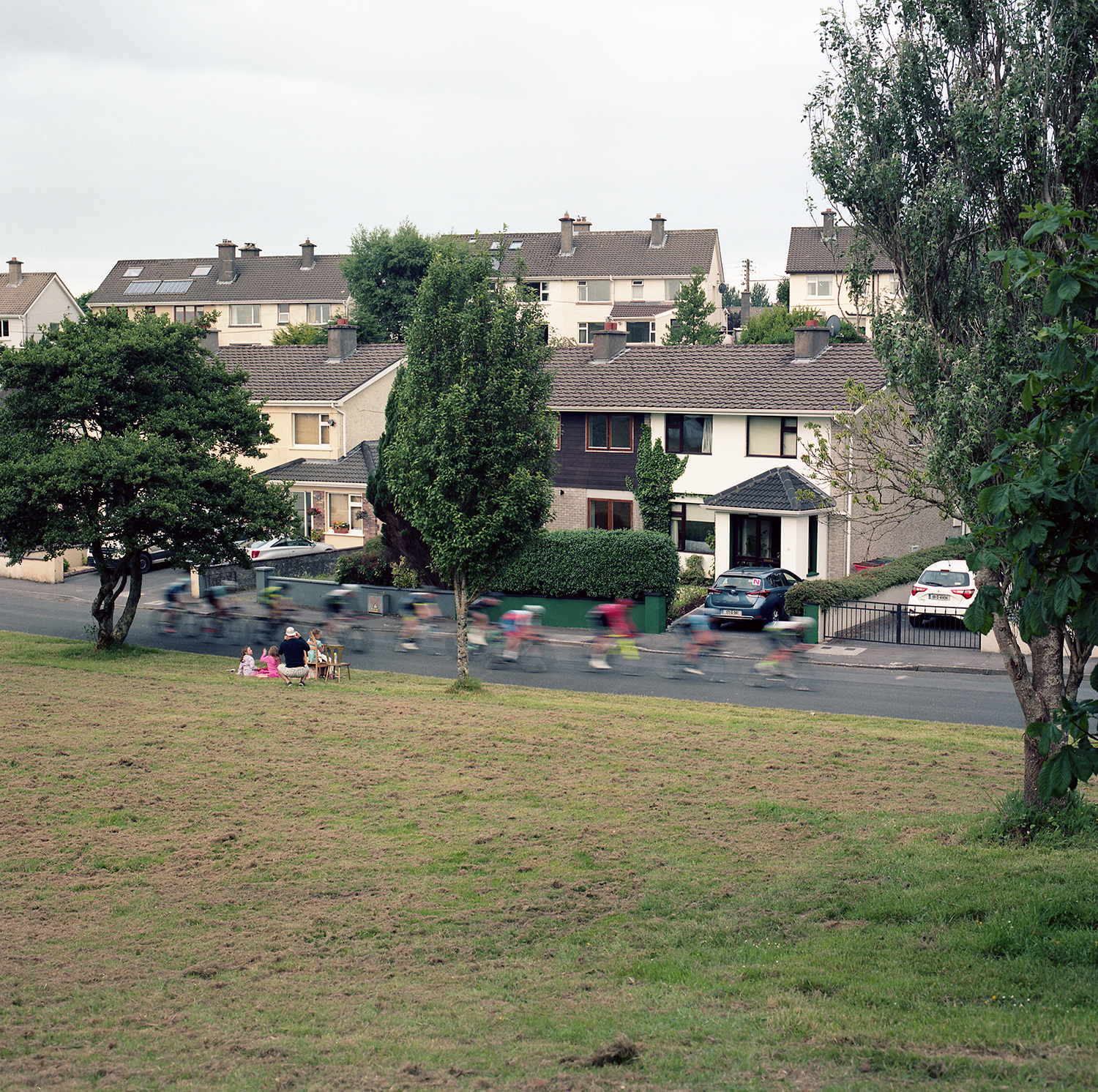
Galway Bay Cycling CLub (GBCC) Criterium racing, Highfield Park, Galway City, Saturday evening, June 9th, 2018.
Dry warm June. Tight clockwise circuit buried in one of Galway’s west side housing estates. Five right handers, two left handers, 2 speed bumps, one drag up, one drag down. Assorted bales of hay.
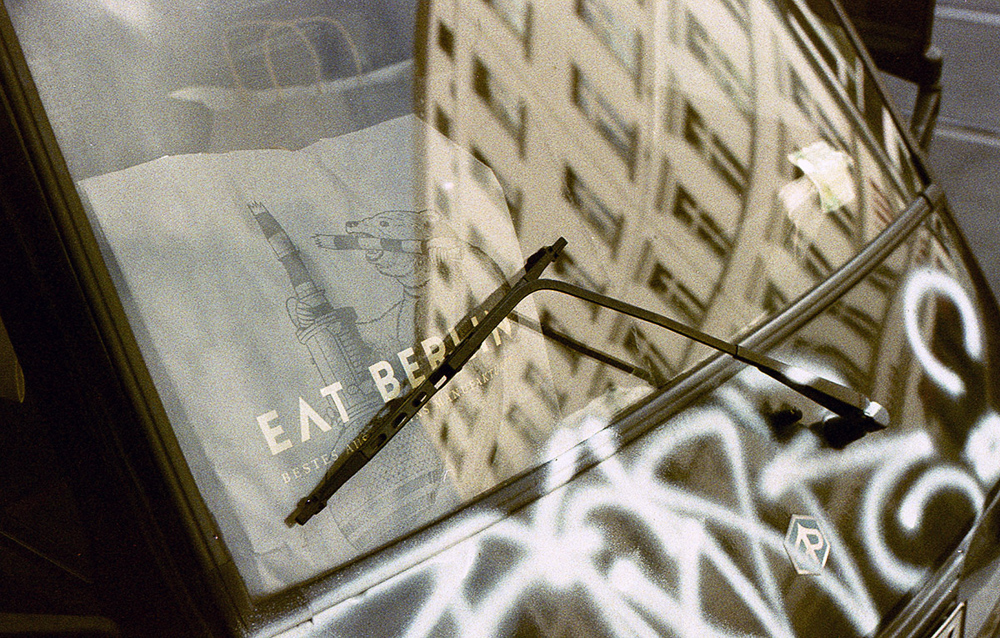
All images Donal Kelly 2018. Cameras/film: Hasselblad 501C with 80mm lens, on Rollei Retro 80S and Portra 160. Olympus Mju-II compact (35mm lens) on Ilford XP2 and Rollei Superpan 200.
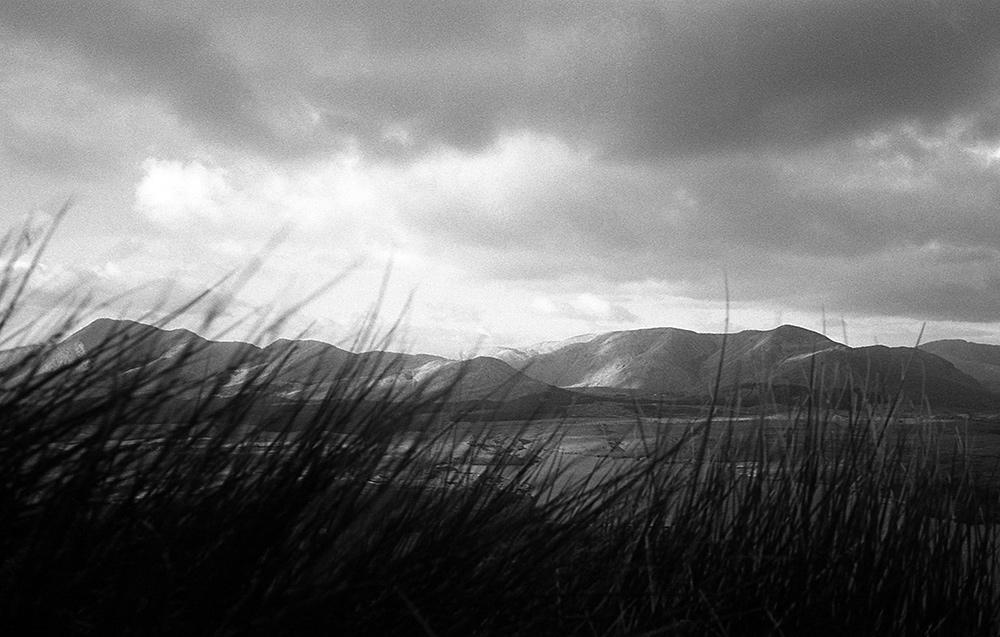
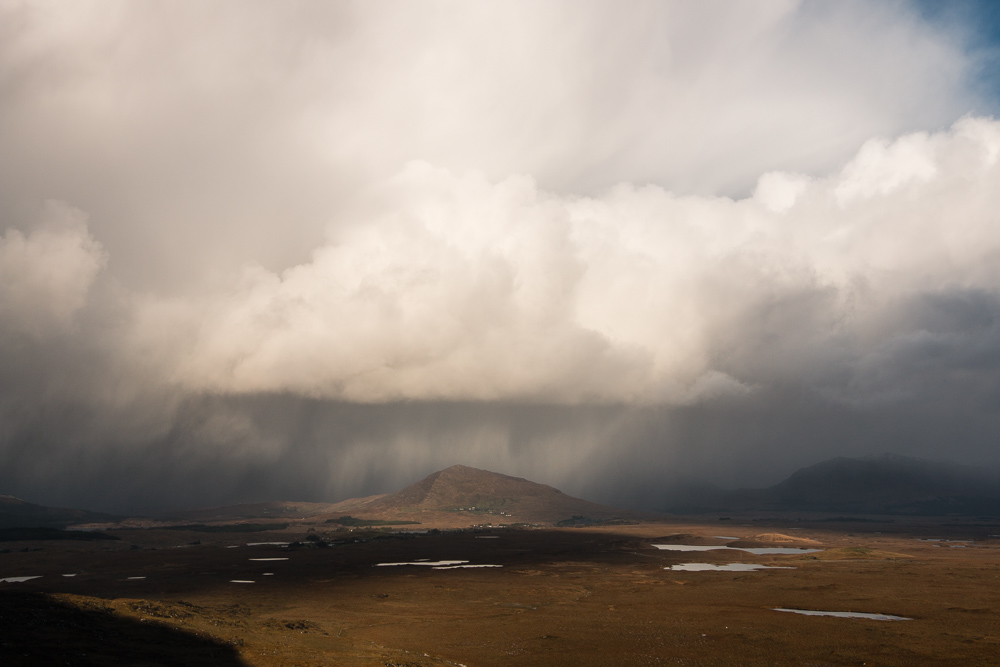
From up on Garraun you can see out along Renvyle peninsula. Glasilaun, Lettergesh, Mullaghloss, and Tullycross somewhere hidden. Names known since I’ve known names.
Distilled summers of wave on wave, collapsing in rushes, scrambling down grassy slopes. The sea so broad and wide below you can’t take it all in. Or in the other direction, up the bogs, soft soft, following rivers, to the Black lake or the Garden lake over Kylemore or Shanabheag in Currywongan where John Joyce has bees. And winter nights sunk in the soft brokenspringed bed with gales whistling eerie tunes on the thick lumpy gable and the ceaseless roar of the ocean behind and below and inside.
And Mweelrae rising behind Letterettrin, looming over Killary harbour. The Atlantic never far away. Sea salt in the veins of air. I watch a tiny distant car trace along the far side of the lake on the potholed road.
Down there Wilde coined a ‘savage beauty’. A literary tourist’s phrase, now a tag painted so often it crumbles under the layers, like any respectable cliche for its marketibility. A pair of rooks, or ravens, circle overhead, black raggedtipped wings against the tumble of clouds.
Out there on the tip of Rosroe Wittgenstein soaked up harassed solitude, grappling with logic and language games. Only hardy sheep and stubborn buckled trees and acid loving mosses and the creases in a grandmother’s hands.
Right below, Lough Fee, and then a river across the hop skip gap to Lough Muck, all part of the Culfin fisheries. Uncle Jackie won his World Masters fly fishing championship down there with a stump of a brownie from one of those banks. Which bank, I wonder?
Following, chasing, alone up here. What am I chasing? I cannot be what I was. I cannot sieve a soul or reburn a boyhood or strip away layers to uncover some mythical burning core. I am the old roar of ocean and a tumble of fresh cloud.
I stop to sit and look south at Inagh. Cumulus humilis and light leaking across the Bens and Maamturks.
A ewe passes with two following lambs. I take another picture.
I can perhaps, chip away on the latest layer, chisel the texture, scrape some grit into the detail, smudge tone in the shadows.
Already I am hungry and clambering back down to the shore of Fee.
I’m hunched down under a little umbrella, my back against a rock face on the mountainside, and through drumming hail sunlight beams from under a turreted and tendrilled bank of Atlantic cloud.
Cold. Fresh. Soft. The loft-frozen pellets hop and bounce down the rock face. Pile into little lines and bumps and begin to whiten the ruddy earth. Bounce and hop but then suddenly seem to turn weightless, replaced by scattering petals of snow. Colder still. And then traditional rain joins in, heavy and steady and wet and I crouch deeper under the little flapping shelter.
Fickle winter weather, and a churning mess of cloudmass from the west in slow waves. I came up from the church car park, up the steep pitch of narrow road to the old graveyard. There the exposed hillside tombstones rest on a much older formation, old enough to be the area’s namesake. This is Cashel, from the Gaeilge An Caiseal, a name for a ringfort. These would have been built in the bronze age, which goes back some 3000 years. But this ringfort now sits under the high Cashel graveyard. Clumps of unmarked stumps mingle with rectangular marble and granite slabs and plastic flowers and crosses and bordered beds of gravel.
I notice a tall narrow headstone with a different style
Coleman Nee
Ireland
PVT 103 Infantry
World War I
May 9 1894
January 26 1970
A full run of 20th Century carnage: in a weathered Connemara hillside graveyard built in a weathered 3000 year old fort, lies a Nee who fought in the American army, probably on some blood and mud dug trench in France in the Great war, during which Ireland itself kicked off an uprising against British rule.
3000 years of cloudchurn and yet so quiet and unperturbed. A herd of small sheep with red and blue markings line up behind a gate watching me in hope of feed. An abandoned big house half submerged in a copse of leafless trees. A line of electricity poles lead from its gable back down the hill, the wires long gone: must have been in use after electricity arrived here in the 1950s. Here is a land with abandonment sewn into its definition. More goings than comings. As basic as the acidic soil where the roots of civilising crops are loathe to tunnel. Leave it to the mosses and grasses and layers of sodden peat. Here lies ties to centuries of roaming and fighting and big thick lines being drawn and redrawn on history maps. And yet just a flock of sheep chewing and staring at a gate under Cashel hill.
Higher up, I think about turning back, but the sun pops out again, and I clamber to the summit. It’s not high, just a little over 300m, but is unobscured and panoramic. Straight east huddle the basket of Bens and south of them over the Inagh valley and Recess, the broad Maamturks, and then beyond that Maam, Derroura, Oughterard, and the Corrib. Lakes pocket the bog. Dense conifer plantations in dark green patches. The higher peaks are dusted white, and over them all a canopy of shifting clouds spilling hail, rain, snow. You can make out distant blades of Cloosh wind mills spinning a little more west, and as you spin further that way, the flatter fragmented bogs and scattered houses of gaelic south connemara, from Carna down to Lettermore, Gorumna, and Carraroe and then on towards Galway, hidden now by cloud or slope or both.
Still turning, now facing into the sun as it approaches the Atlantic lid somewhere over the Aran Islands. Just below, the sea negotiates a series of complex bays and inlets. There’s something Escher-like about the one and the other. Perhaps the bog is the bay and the bay the bog? The ocean is boundary, limit, barrier, but yet passage, potential, murky and laden. Further north, the other lonely sisterpeak of Errisbeg over Roundstone, and past that the clouds sitting thicker and opaque. Another band rolling in.
The wind is howling again and flecks of new hail begin to patter, even while light still pours. There’s no scrap of shelter here, so I don’t wait beyond trying to stick something of the place into a digital sensor. Snappity snap. Then I flee back down towards the sheltered slopes and crouch under another rock face when the soup gets thick. The umbrella buckles. A dial cover is missing from the camera. Losses. I track back down by the graveyard and its layers of stones and story and down the hill to the car across from the church. Its wipers have been acting up, but they twitch into life now first time, and I pull out onto the road for home.
Why climb a hill at all? There might be a point. There might not. Is it not all self serving in the end, and the self not a thing at all?
“We’ll climb that hill, no matter how high, when we get up to it.”
The last ‘proper’ snow here was back in 2010/2011, when things got real cold, as low as -15, and pipes were splitting up and down the country. In Ireland we basically call society off when it goes below -5. Most of us have never seen a snow plough, or snow shoes, or know what snow chains are or how to put them on. What we have is extensive 24 hour reporting and one topic of conversation. We promise we’ll learn all about stuff so we’ll be prepared next time, and then we forget once it melts into brown slush and settle back into moaning about the mild rain.
After a mild autumn this year, the white stuff was suddenly back on the menu after some thick showers snuck in during a cold snap in early December.
I drove up the Shannapheasteen road until the Astra got stuck, wheels spinning in second gear on a bend. I reversed/slid back down to a junction, and went for a hike.
Turns out hiking in snow is awkward. Especially when the it’s on a bog and the bog has big holes in it and slopes up. My boot slipped and I dipped the camera down. It came up white. Crap. Wipe wipe wipe. Two minutes later I did it again. Learn: use the tripod as a walking stick and put the camera in the bag while going up a slope. I still managed to do a third time.
When I got back to the car, a tractor was helping a couple get up the road where I had parked. I was, er, slightly blocking the road. Sorry.
Climate Change, Agriculture and Food Security – where is the cutting edge?
March 24th, NUI Galway
What is CCAFS? In their own words, “The CGIAR Research Program on Climate Change, Agriculture and Food Security (CCAFS) will address the increasing challenge of global warming and declining food security on agricultural practices, policies and measures through a strategic collaboration between CGIAR and Future Earth.” It is a collaborative project that brings together a wide range of research as part of global efforts to understand the effects of climate change on agriculture, and how policy can be changed to imrove and secure the lives of those involved.
“Proclamayssion two yuuroos! Proclamyssion only two yurooos!”
The proclamations are mostly in the plastic bag, but a few are held up to passers by. Outside the G.P.O., under the narrow pin of the Spire, on the wide, fast food epicentre of O’Connell Street, all manner of 1916 goodies are hawked, for the day that’s in it. 100 years ago today, on the twenty-fourth of April, 1916, a band of rebels ‘stormed’ the G.P.O. and other landmark Dublin City centre buildings in an attempt to kick off a national uprising against the British crown. The Empire was busy with that stark abominable war in Europe. Thousands of Irishmen were fighting there, fighting and dying in places like the Somme, where up to one million men were killed or wounded. Meanwhile in Ireland, in a period of cultural revival and a new sense of nationalism through everything from poetry to Gaelic sports, a physical uprising is plotted in secret.
It means many things to many people. As the joke goes, if you believe everyone who tells you they had a great-grandfather in the G.P.O. with one of them clunky rifles that the ‘gallant’ Germans dropped off in Howth, then about half the country must have been crammed inside. Instead, on the day, a ragtag group showed up, and were jeered by a bemused public and later, they were given the hashtags of heroism though the whole thing is still open to healthy debate.
Flags, flags, get yer Ireland flags!
Clarke, Connolly, Ceannt, McDonagh: rising leaders on a scarf outside the G.P.O.
Just before noon on that Easter Monday, Patrick Pearse read out the proclamation from the front of the G.P.O.
The proclamation was signed by seven men, all of whom would be executed (along with others) in the immediate aftermath for their roles. The executions themselves are commonly regarded as a turning point between a controversial insurrection and a national push towards independence.
Thomas Joseph Clarke: a 58 year old tobacconist who was jailed for 15 years for trying to blow up London Bridge. He was born in England but grew up in county Tyrone
Seán Mac Diarmada: a 33 year old Leitrim man with a disability caused by polio, and a close friend of Clarke.
Thomas MacDonagh: a 38 year old poet, playwright, teacher, and teachers trade union founder from country Tipperary
Patrick Henry Pearse: 36 year old poet, writer, orator, teacher, barrister, and activist born on the street now named after him in Dublin city
Éamonn Ceannt: 34 years old, an accountant son of an RIC officer, from county Galway
James Connolly: 47 years old, born in Edinburgh, Scotland, Marxist theorist and socialist leader, esperanto speaker
Joseph Plunkett: 28 years old, poet, journalist, suffered with TB for much of his life, close friends with MacDonagh
A stage has been set up on the wide central strip where Dublin’s protests tend to start or end, and a speaker is already going #fullgas.
“in exasperation no doubt, once remarked, ‘Dubliners are the best and most unmanageable of revolutionaries’. And he devised that notorious 1937 constitution, which ensured that Irish women would be denied access to much of public life, and who…”
In the name of God and of the dead generations from which she receives her old tradition of nationhood, Ireland, through us, summons her children to her flag and strikes for her freedom.
Crowds build outside the G.P.O. one hundred years on.
On the way into the centre, a march, probably unofficial, is starting under the train bridge that cuts across Ballybough Road. A Dublin bus is trying to pull in to pick up and put down its passengers, and a couple of Gardaí on bikes wait along with the compulsory group of bystanders-with-camera phones that have gathered.
A small march beginning in the North Inner City
We declare the right of the people of Ireland to the ownership of Ireland and to the unfettered control of Irish destinies, to be sovereign and indefeasible. The long usurpation of that right by a foreign people and government has not extinguished the right, nor can it ever be extinguished except by the destruction of the Irish people.
In every generation the Irish people have asserted their right to national freedom and sovereignty; six times during the past three hundred years they have asserted it in arms.
Standing on that fundamental right and again asserting it in arms in the face of the world, we hereby proclaim the Irish Republic as a Sovereign Independent State, and we pledge our lives and the lives of our comrades in arms to the cause of its freedom, of its welfare, and of its exaltation among the nations.
In 1916, O’Connell street shops were looted before being blown to pieces later in the week by field guns or burned in the fires that ensued. Some of the poorest people in Europe went into the luxury shops, taking furs, sweets, shoes…. A toy shop’s contents of fireworks were let loose on the street. Characters walked around decked in trendy furs wielding golf clubs. And both sides shot at them. Towards the end of the week after thousands of British soldiers surrounded the rebels, business owners staying put to protect their livelihoods were randomly executed along with some of their boys. Technically, at the time, they were British citizens, as were the rebels themselves, and Dublin was the empire’s ‘second’ city (#disputed).
In the distance, the bulk of Croke Park stands over the low terraces of the North Inner City. The GAA has organized a big hullaballoo of dance and music called Laochra, to take place after the National football league final between Kerry and Dublin. A couple of hundred metres away, a man was murdered in a recent gangland killing, while in one day’s time, in a few hundred metres in the other direction, another man will be shot dead in a pub.
Memorabilia for sale in Summerhill, with Croke Park in the background
Just off O’Connell street, there’s no traffic and no Luas running on Abbey Street Middle, but care is still needed to keep the narrow bike wheels out of the Luas track grooves, and dodge the green-clad people heading towards the din. A bigger more official march will take place later on. The Luas drivers may or may not be on strike today, for a pay rise many deem to be verging on greed, or part of some trade union meltdown. Although the economy seems to be on the up, the real wage for most people is not budging, while many are caught in short term contracts, on the wrong side of some two-tier pay system or other, or in a scheme like the infamous JobsBridge, supposedly to get realworld skills but possibly just working for almost nothing. Meanwhile many groups of public workers like the gardaí, nurses, train drivers, and teachers, are looking to recoup losses from recessionary budgets.
The Irish Republic is entitled to, and hereby claims, the allegiance of every Irishman and Irishwoman. The Republic guarantees religious and civil liberty, equal rights and equal opportunities to all its citizens, and declares its resolve to pursue the happiness and prosperity of the whole nation and of all its parts, cherishing all of the children of the nation equally, and oblivious of the differences carefully fostered by an alien Government, which have divided a minority from the majority in the past.
Until our arms have brought the opportune moment for the establishment of a permanent National Government, representative of the whole people of Ireland and elected by the suffrages of all her men and women, the Provisional Government, hereby constituted, will administer the civil and military affairs of the Republic in trust for the people.
Across from the Four Courts, traffic streams up the Quays. In the River Liffey, a couple of boats are going up as well, negotiating under the many bridge arches in the brightening day. A hundred years ago, Ned Daly’s 1st Battalion took over the building; some of the most intense fighting took place in the area. The Four Courts building survived the rising intact hurrah! but was blown to bits in the civil war in 1922 boo! before being rebuilt again hurrah!
Further South and East, another group of officials and photographers is building outside the Dublin Castle complex. A line of Gardaí stands outside in luminous jackets. One of them shouts my surname. He used to live with my brother. We chat for a few minutes about the wreath laying ceremony that will take place at the gates, and the general low-key events taking place (the official celebrations were held over the Easter weekend), and where the president Micky D, might be. An amphibious yellow Viking tourist truck goes past, with the passengers letting out a big choreographed roar that the locals are tuned to ignore. I don’t go into the castle grounds. The rebels didn’t go in either, even though the place was left pretty much unguarded, and it was one of the key buildings and the main admin centre for the British government in Ireland.
We place the cause of the Irish Republic under the protection of the Most High God, Whose blessing we invoke upon our arms, and we pray that no one who serves that cause will dishonour it by cowardice, inhumanity, or rapine. In this supreme hour the Irish nation must, by its valour and discipline, and by the readiness of its children to sacrifice themselves for the common good, prove itself worthy of the august destiny to which it is called.
Down Dame street, a mass of teenagers in black and carefully torn indie anticulture culture mill around the central bank building with skateboards, and College Green is lined with barriers and railings where the new Luas lines are going down. Whatever about the other lines, these curving tracks that will run along by the front of Trinity college will be an interesting obstacle for bikes. That’s the thing about getting stuck in ruts; there’s a good chance you’ll fall trying to get out.
A few streets down from Grafton Street, more Gardaí are outside Leinster House on Kildare Street, where the Government would sit if there was an actual Government. But the parties and TDs are locked in a strategic limbo, with no party having the required majority following a fractious Spring election campaign, and seemingly unable to agree to disagree, unable to step above dead end party lines, caught in “damned if you do, damned if you don’t” scenario, surrounded by so-called emerging ‘populism’ in the traditional ‘best of a bad lot’ politics. Not many commentators hold out much hope for a durable compromise. Flashpoint issues such as the Irish water saga have created huge points of friction. Shut it down, and it’ll cost a load of money. Keep it open, and it’ll cost a load of money. Are those who paid now seeing themselves solidified as ‘winners’ and those who obliged with the extra tax, ‘losers’? Careful now, or another swell of anger from the taxpayers and naysayers will be set in motion.
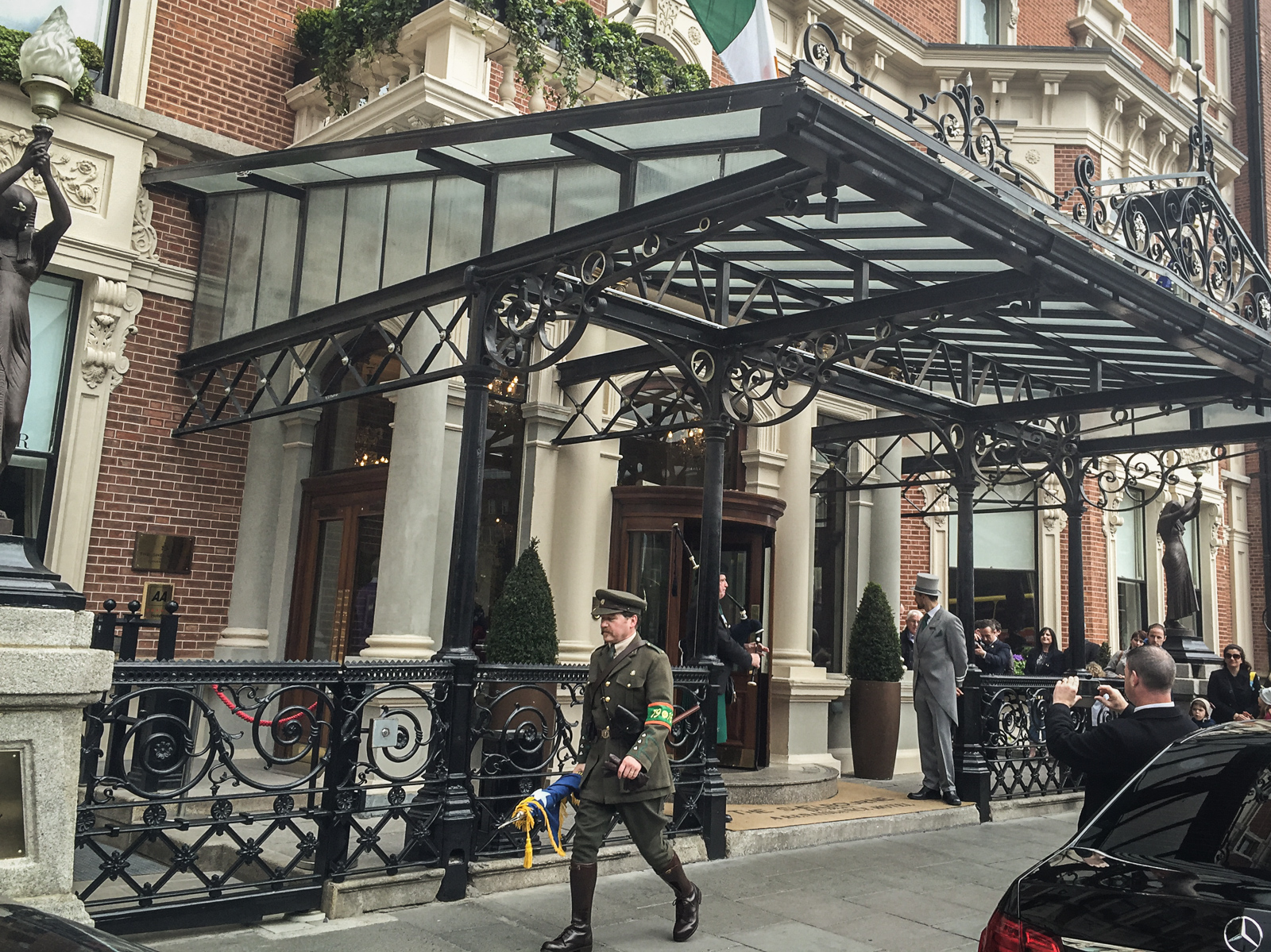
Outside The Shelbourne Hotel, a bagpiper is playing, and a man in a green military uniform from a bygone era is walking down the steps. More camera phones, and a very tall footman in grey with top hat rounds the taxi rank to greet an arriving BMW 6 series.
Across the road, Edward Delaney’s bronze statue of Theoblad Wolfe Tone marks the North East corner of St Stephen’s Green. Inside the park, tulips are in full bloom and ducks, gulls, swans, and pigeons vie for donated grub while above in the trees that are beginning to leaf, a chorus of blackbirds and robins mark their spots and strut their stuff. Selfie sticks and baby carts wander around in the cool morning. While Stephen’s Green was taken over in the Rising, it was in a vulnerable position, as British soldiers could occupy comfortable high buildings like the Sehelbourne and cover the open area.
Further Southeast again, until the Grand Canal appears, and then down past the bridges and locks until Mount Street Bridge. A jogger is stretching against the lock gates. Faded flowers lie against the monument, tucked away from the pavement and busy commuter road. Office buildings stand in a corporate unison over a tour group. This was the scene of one of the bloodiest Rising battles, where a regiment of British soldiers, the Sherwood Foresters, marching from Dun Laoghaire (then Kingstown) were attacked by volunteers embedded in houses near the bridge. Rather than back up, move one street up, and take another bridge, the troops were ordered again and again into the bullets.
The canal continues down towards the Liffey and the sea. A battered old building stands above the tidy marina at the Grand Canal Docks. Boland’s Mill. Eamonn De Velera was stationed here in 1916 but not a whole lot happened as it was an isolated outpost. .It will soon be knocked, renamed as Boland Quay, and have €150 million of digital-dockland-era money into a brand new trendy living space. #gentrification
Whole Liffey-side sections of the city are changed utterly and still changing: development billboards with utopic designs run down both sides of the river as it edges to the sea. A few remaining old buildings look lonely amid the development. A lone canvas currach is being rowed up under the Samuel Beckett bridge.
Farther north again, the crowds are building for the match. Dublin will steamroll to another league win, and the Laochra show will fill the RTE schedule for a few Sunday afternoon hours. Later on they’ll have to fill out the census forms that have been sent out to every address in the country. Under another train bridge, a huge poster for the latest Game of Thrones TV show series is hung next to a dark poster that seems to have an orange on black likeness of Jesus with the words “EQUALITY FOR IRISH MEN, WOMEN, AND CHILDREN; KEEP REPEAL THE 8TH”
Census Time
All photos taken on an iPhone 6. I cycled from location to location in a short space of time to try and get a snapshot feel to the areas.
One day, one camera, one roll of film. Point it at yourself. Try to make it an eye in the sky, a documenter of who you are and where you are and what’s going on one randomly selected day. Dig deeper than a cascade of dislocated snapshots, and use the constraints and width of a full roll of film to frame a day in some way.
Layers of city,
History piled on history
Hills of rubble assembled into calm parks
Segways converging on an Opera square outside Humbolt
Car park treads over Adolf’s final bunker
Trabants and Mercedes and the odd Porsche
The Soviet ambitions of AlexanderPlatz
And down Under den Linden to the Brandenburg;
Don’t forget to book in advance to go up the Reichstag dome,
Then lose the guidebook and get lost
In all those tangled European threads returning to this knot on the Spree
Bringing the charge of the new
Vietnamese noodles, currywurst, MacDonalds, Starbucks,
Streets rebuilt,
Reinvented for the next phase,
The next age,
Brittle skittles for the roll of a Zeitgeist.
Loud of message and graffiti,
And English speaking barristas serving expensive coffees from South America.
All through this canvas of a city
So many have drawn, painted, built, torn,
And yet it still feels unfinished,
Waiting for the next layer to scrawl.
Directly under this well-trodden car park dirt is the bunker where Adolf Hitler lived his last few days in 1945 as the Russians took the city and WW II came to its end
Here it comes, there it goes. The Christmas break, with its long buildup and heavily marketed stature, has already left the building before it seemed to even arrive.
The rains barely paused for breath, though the good winds provided enough breath for all. Under the twinklings of dangling lights blowing in the breezing rain, ’tis the season’ bells barely tinkled before being bundled back into boxes until the next rendition.
We had the lights barely untangled. Plans to untangle the spent year in my brain and my brain to untangle for the year to come fogged up like a stubborn windscreen. Through that foggy glass things seemed no clearer than before. Clarity maybe comes from commitment to some version of events or other.
2015 might be the year of obsessive notification-checking, or the year of film photography, or a year of solidifying yesterness, or less or more of all these things if considering.
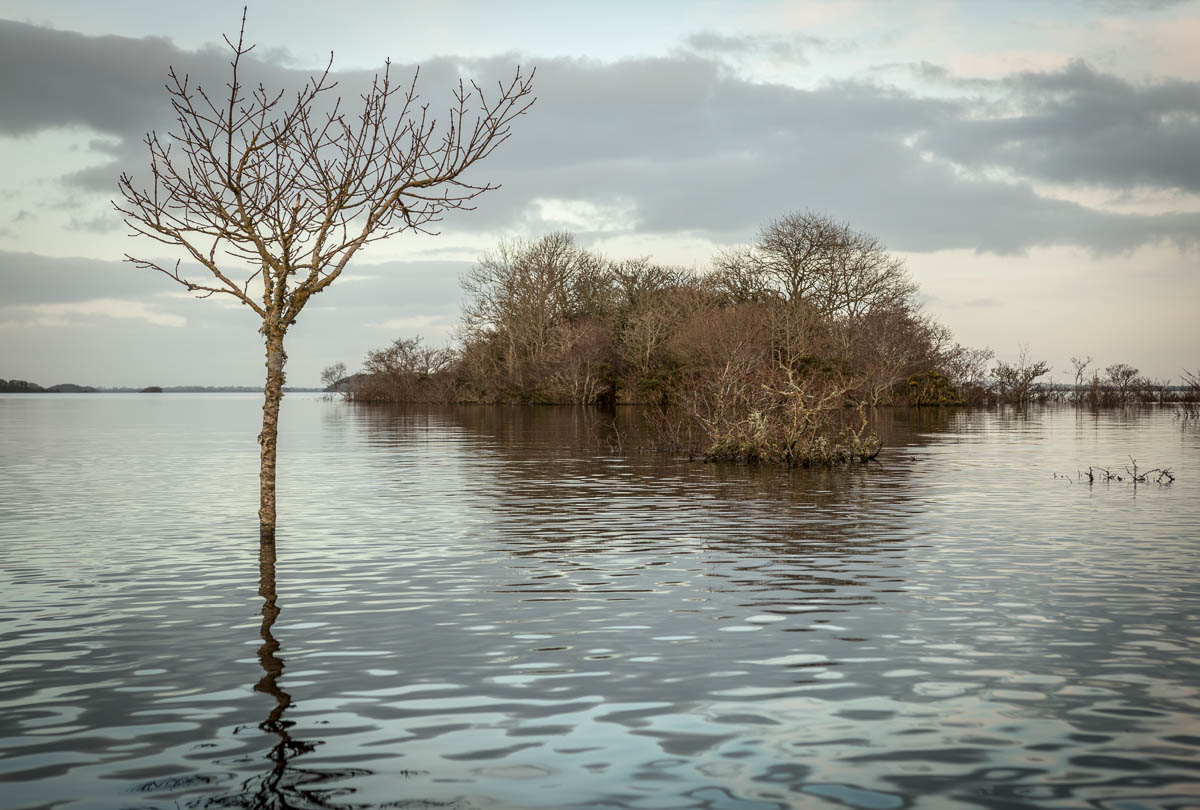
The water levels have broken records, with the shoreline exploring new curves along many a distant acre of field and shrub.
Indoors, in the bubble of days with names, family, television, turkey, and people in every room, time just whips away the last week of the year.
On the only calm clear day I was free, I took a borrowed Kayak to the high waters of the Corrib, with nary another floating human in sight, and rowed two blisters worth from Baurisheen to the head of the Owenriff and up past the boathouse and under the bridge at Eighterard and eventually all the way home in the darkening.
It is a world of
birds disturbed,
hulls upturned,
limbs of leafless tress sketched into the face of the river
To get under the bridge I had to fling myself forward then let my back fall flat onto the kayak hull, and still the bottom of the bridge concrete almost touched my nose. I failed the first time and wondered how safe the idea was with such a rush of water and nobody around and three grand of water-speckled camera gear between my knees, but I tried again.
It is a world of
current and flow,
never the same when you come back,
even if you never go.
In any case, not far after I got tired of battling the strengthening current that tore down in the narrower sections, and I flipped the little plastic boat around. Now it tears back down on the swell.
It happened before, though the levels this time are higher. In 2006, for the first time in the history of a family home built almost a century before, winter waters reached the doors and spilled into the kitchen.
Nine years later, after another close scare in 2009, there are four inches of water from wall to wall on the ground floor of the Connolly’s home. Despite the sandbags, the pumps, and the efforts of the local council workers and incredible neighbours, the waters have risen and risen, creeping patiently across the fields, nudging out onto the road, lapping against the stone walls, inching up the drive. There is none of the sudden drama of a swollen river breaking its banks, no ferocious roar, just the slap and slosh of a lake materializing and the farmland descending to its bottom.
It happened before, and it made some papers then, but nothing practical was done. A few meetings of promises made and then nothing. It might be the lack of drainage, as the water in these areas of porous limestone can take its time to get to the rivers and seas, and follow underground paths and build up in low-lying fields. It might be global warming and the unpredictable weather conditions it exposes Ireland to. Rainfall is more concentrated and monsoony, and as in many areas in the last week, the network of rivers and lakes have problems handling it. In any case, the Connollys were left on their own in 2006 to repair, renovate, and carry on living in their warm welcoming farmhouse, all the while wondering if it would happen again. It has. Most frustrating for the family was how what they had been told was a newscycle’s worth of noise, with no actual policy or provision for what to do in the case of a re-occurrence.
There’s up to seven feet of water along the little road after it passes the Connolly’s entrance. During the week, a woman accidentally drove into the depths of it and had to be rescued by the fire service, after Jimmy heard her tired yells when he went to check on cows. She had been in the water for an hour, and was confused and freezing in the pitch winter dark and heavy cold quiet water.
By the weekend the battle to keep the water out of the house was lost. Just a few millimetres first, in the living room, then a small flow into the kitchen, then more and more. The house’s old foundations are no match for the water’s ability to find its way in. The wooden floors begin to swell. Wooden Doors refuse to close. A smell of dampness begins to rise. Soon it becomes a sharp unsettling odour, almost as unsettling as having to wear high waterproof boots indoors, and hearing the constant slosh and drip of water moving. Pumps were brought in but merely postponed and delayed the steady accumulation. It’s elemental and unstoppable.
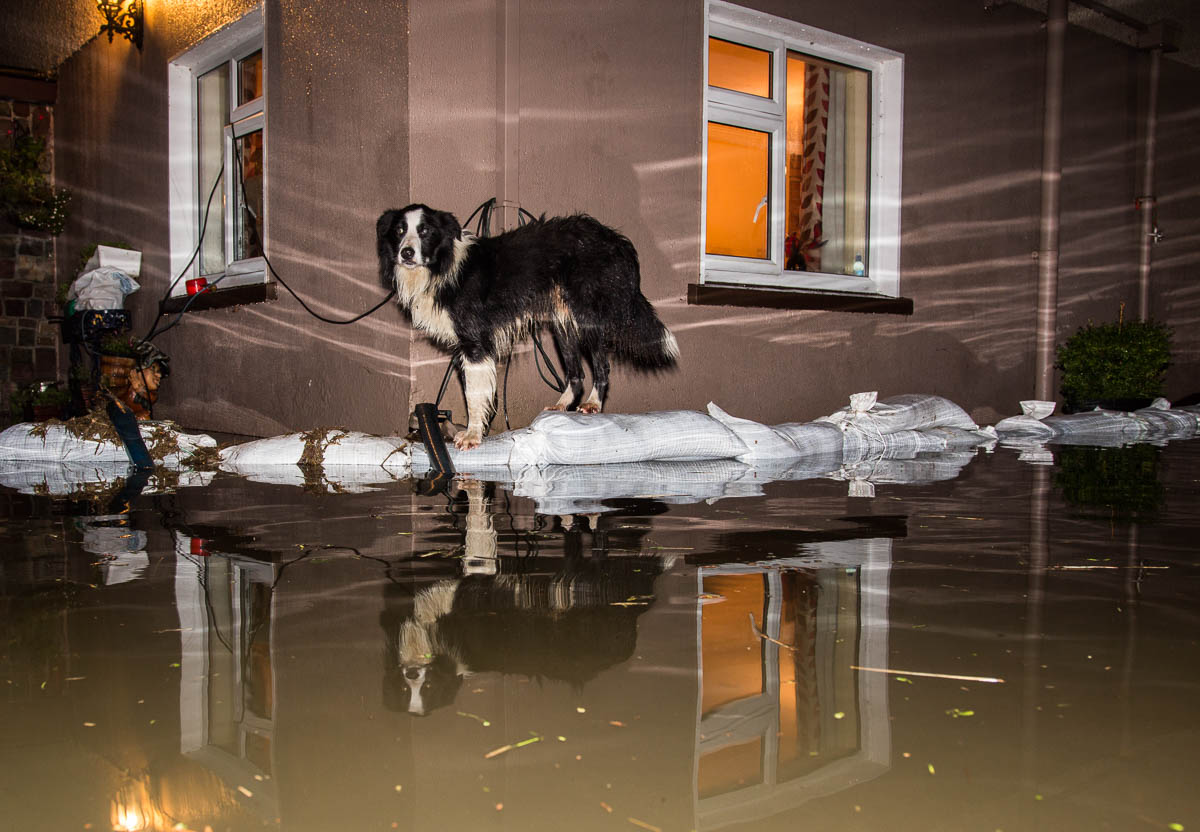
Outside, the driveway is under three feet in spots. Just getting to the end of it is a complicated manoeuvre of wellies, waterproof layers, and a choice of boat, kayak, full-length waders, or a swim. The tractor is refusing to start since it ventured too deep into the murk. The cows are mooing loudly from the shed as the water discovers them too. Sileage, turf, hay, are caught and soaked. Grass, plastic pots, lumps of wood, and random landlubber memorabilia float idly by as though on some adventure. Apples, too; one of the old apple trees has collapsed, its roots released by the softened garden. Alfie, the generally water-loving sheepdog, runs up and down along the banks of sandbags, water on both sides. The cats are hiding on roofs and the tops of walls. One of them has set up residence somewhere in an upstairs bedroom, appearing every so often on the bottom steps of the damp stairs to look at the mess below before retreating.
Indoors, a plastic rubbish bin has managed to float from the kitchen to the living room. The stove there is burning away the briquettes that arrived by boat, just a couple of inches above the surface, and in the corner a TV is showing the latest X Factor finale. She’s singing a cover of Bob Dylan’s Forever Young, but does it not seem so very staged and overly designed? A coffee table on top of two sandbags and loaded with mugs of fresh tea tilts oddly to one side. It seems like the deck of a leaking ship, slowly listing, in a still sea. Hard questions are being asked. Do we stay or leave? Where will the cows go? How long can we stick it out? Where will we go? Is it another ‘once-off’, a once-in-a-century flooding event (9 years after the last one), or a recurring winter nightmare?
(These cows were moved shortly after this photo was taken)Setting up a drone to get an arial view of the rising levels100m ahead the water is up to seven feet deep
The idea of the work getting it all back to normality again, with Christmas two weeks away (sorry soggy Christmas decorations have been moved to high shelves) is best avoided for now, while life is still splash slosh splash slosh. Best to focus on the most urgent of questions. How many pairs of dry socks have we left? Eileen remarks how getting up in the morning has become so difficult; putting on knee high boots upstairs and coming down listening for that slosh while wondering how much it has come up.
The night is calm and the stillness of a midnight lake settles in. At least the lights are still going. Hopefully the switches won’t trip before the morning.
All photos and words Donal Kelly, all December 13th, 2015, Roundfort, Mayo.
Storm Desmond is still battering its way across Ireland and the U.K., having already dumped a month’s worth of rain in some areas. The local radio stations along the west coast have become live feeds of lists of blocked roads, lights out, flooded houses. Rivers have been filled to breaking points and beyond. The Owenriff in Oughterard is no exception, and is currently hurtling down to the rising lake in a white torrent.
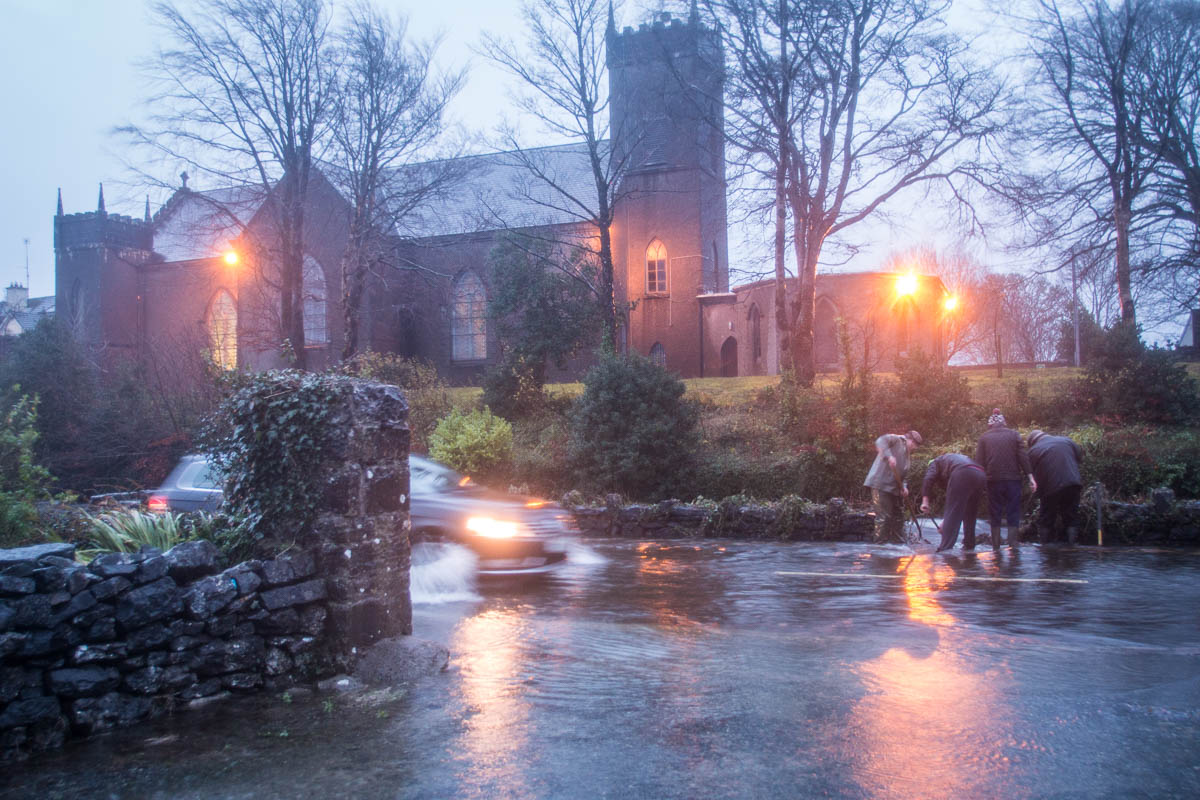
Local men worked on breaking gaps in the wall along the road to let the water on the road exit back into the river. House owners peered anxiously at the rising levels from behind sandbagged doors, as the wind still whipped rain every which way.
Lough Corrib looking rough, wouldn’t be a great day on the dapRoads not the best for driving, or walking evenReverse!
It’s a poor craftsman that blames his tools. But what craftsman has no tools at all? Where would we be, scrawling bison on caves Not that there is anything wrong with that, and indeed your latest work is exceptional and I love how you captured that sabred tooth where it flickers in the firelight.
I decided it would be interesting to list in chronological order the key cameras I own or have owned.
List of key cameras owned:
> Fixed focus, fixed aperture, fixed shutter manual point and shoot, made so much better by putting piece of coloured plastic in front of the lens.
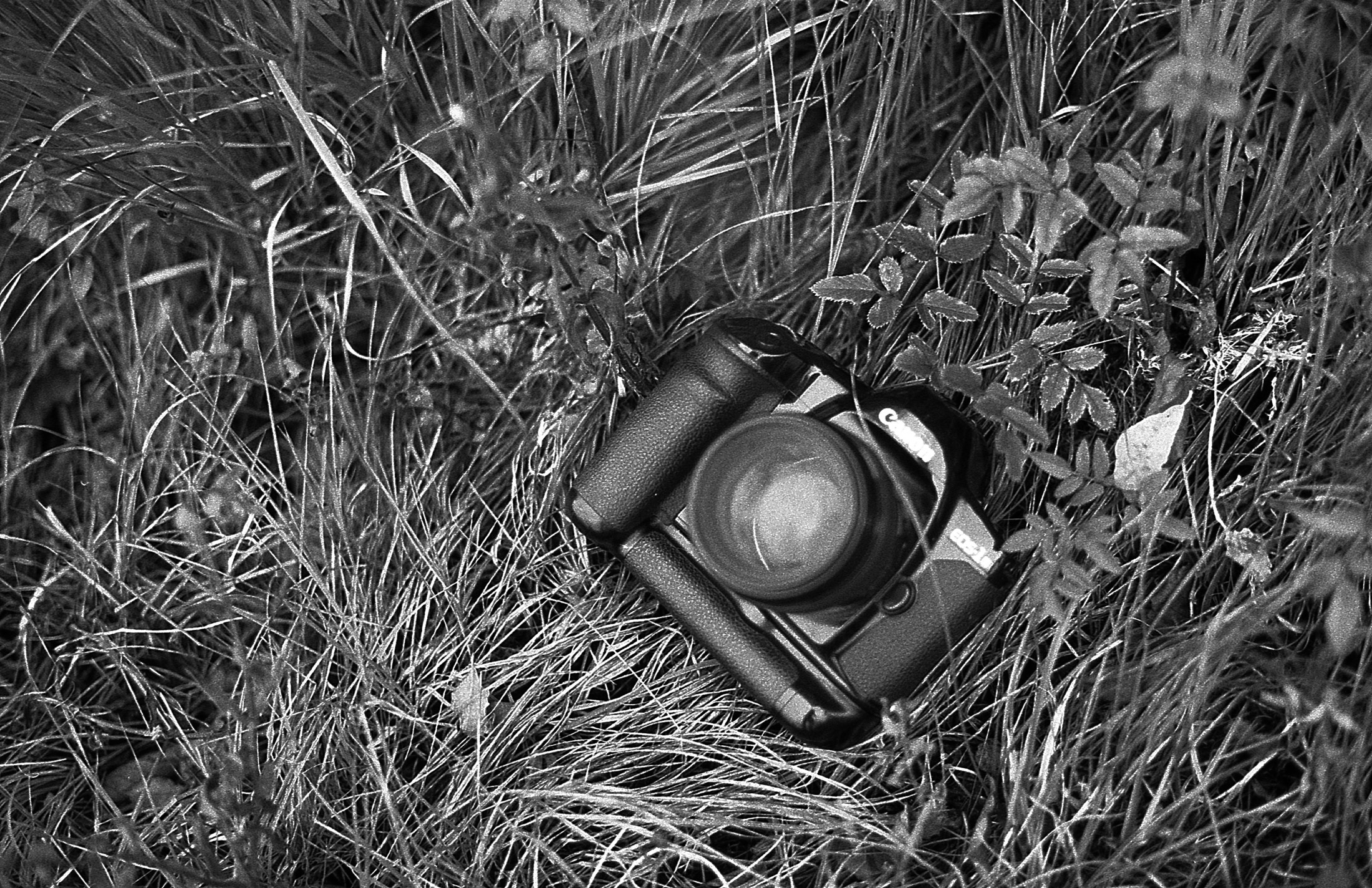
> Canon EOS-1: single centre-focus point heavy SLR, 50mm 1.8 I lens, bought in college but used sporadically
> Canon Powershot A620: flip screen 6MP, probably a mistake, an accessory more than a tool for me, but so much better than nothing and some of those shots have their significance
> Canon 450D: Canon DSLR, step up, standard lens and 50mm, bit small for my hands, broke it by braking to take a left turn while it was on the front seat of the car.
> Canon 50D: Bigger beefier DSLR, more megapixels, but more importantly better ergo, this with a 15-85mm IS lens served me well. Eventually the shutter release button started to fail, and it drains batteries in minutes. Still works though. Bought a 85mm 1.8.
> Canon 70D: Newer, lighter, ‘better’ though I prefer the Magnesium body of the 50D. Nicer with a vertical grip, and the Sigma 18-35mm 1.8 Art lens.
> Canon AE-1 Program: back to basics in an effort to start from the start again, learn the art, slow down and feel the process form shot to shot. 50mm 1.4 standard FD lens, beautiful metal body, great ergonomics though not for verticals.
> Hasselblad 553 ELX: 6*6 120 film, 12 shots per roll, big thunking shutters and AA-powered wind-on, this is for taking slow square photos where the idea guides the angle. 80mm 2.8 Carl Zeiss lens. composing in good light is a fine experience. Have two A12 backs and a Kiev TTL pentaprism viewer, though the TTL seems miles off.
> Canon EOS-1n: The EOS 1 died so this takes its place, five horizontal focus points, very functional pro camera, blue LCD always makes me happy, lovely shutter and wind sounds, big bright viewfinder. Often paired with a 17-35 f2.8 L lens, not a common lens (discontinued) but very nice nonetheless.
Film, workflow, lighting
Film Choice: Kodak T-Max, Tri-X, Portra, Ektar. Ilford FP4+, HP5,Delta 100 Delta 400. Agfa 200 film that expired in 2007-2009, fuji Pro160 and 400.
Film Development: Rodinal developer, Ilford Stop Bath and Fixer. Generally use standard dilutions.
Digital workflow: Adobe Lightroom and Photoshop, previously Canon DPP.
Summer was a long haul of slosh and soakings, and then finally in Autumn dry stretches fuse into a few weeks of easy goings and comings, crunch of leaf underfoot, mudless soles, no winds worth their leaning into. Come November 1st, and the temperature strays above 15 Celsius.
That trip to the Maamturks was long on the list of lists, and given the day that was in it, a Sunday morning after a Hallow’s Eve spent away from the costumed beering, costumed leered and costumed leering, bonfires and bangers and bolt-scared horses, my waking settings conspire towards endeavour. Get up, you lazy lump… drag that dull clump of self from its bedding to wander under some notion’s bidding.
The plan: drive to Mamean valley from the East end and lock a bike where the road gives way to track and drive back to the midpoint of Maam valley and hike over the mountains and use the bike to get back to the car. Simple.
Glutton for the punishment of simple physical effort: do we exercise or exorcise them demons? A mode of distraction that sometimes, somehow, reduces the ignoble noises of life to lost feelings of streamed purpose.
These are barely lumps in the ground to a mountaineer, but to my lowland condition they stress leg and lung. I have a map, or better, a watch that stores a plotted route, sensitive to the beamings of GPS beacons, some 20,000 km above the pale Blue.
Trig stations mark fixed points for geographical surveying
It’s a little bit of dark, a little bit of chaos, a lot of imagination, and a stick to shake at the arriving winter. Dwell in the dark, take refuge in the symbols, there is energy and density in the bulbous, the twisted, the animal, and the shadow.
The first set of black and white photos were taken with a Canon AE-1 program with a 50mm f1.4 FD lens on Ilford FP5 Plus ISO400 film, developed with Rodinal (8 mins, 25:1) and scanned on an Epson flatbed.
The second set were taken with a Canon 70d, Sigma 18-35mm f1.8 lens, mostly at ISO 800, some at ISO1600. A 430 EX II flash was used via Yongno ETTL wireless triggers.
All pictures by Donal Kelly. Do not copy or use without my permission: they take a lot of time and energy, yet I don't like how watermarking or tiny images are simple crap to look at.
It is the last race of the road season for me, but I don’t know it.
I don’t know it until halfway through stage 2 when the bunch is going down a straight descent into Dungarvin. A rider comes down somewhere in front on the left, and a dominoes game of falling cyclists begins. Given the speed there isn’t much that can be done. I swerve round a few bikes and riders and water bottles, then a white frame bounces up in front of and bang.
So instead of getting a kicking on the last two stages, I take some photos instead. I brought along my Canon eos 1n that’s almost as old as myself, and a couple of rolls of Kodak Tri-X. Before going to wartch the finish of the last stage atop the Nire, I added a roll of Kodak Gold 200 courtesy of Boots.
STAGE 1: GETTING THERE (+100km with hills)
Stocking up on suppliesClassic wheelsArchitectural Triumph?Derek ready to roll; the stage start was delayed by 20 minutesPost stage 1, eating pasta with a plastic spoon.Selfie after stage 1, finished in the bunch, lots of guys ‘up the road’Gear drying after a rinse. It was still wet the next morning.Clonmel, though this is actually in Waterford on the South bank of the SuirThe River Suir got some fancy bridges with flood-proofing and snippets of literatureSuir Island, West WardClonmel Rooftops, home to pigeonsClonmel Window display, flowers and curtains
Stage 2: LUMPY ROAD STAGE
5 hours in Clonmel A&E clogging up the place with other guys who came down in the spill on the descent into Dungarvin after less than 40km.
Stage 2 didn’t go exactly as planned (Samsung S2 + Instagram filters).
Stage 3: CRITERIUM; WET WET WET
The criterium is neutralized for GC due to monsoon rain. Riders only have to complete 20 minutes to stay in the race, and most choose to pul out after this.
Finishing straight for the critThe streets are wet and shinning in the rainThe strong riders figure out the best lines early on and stick to them lap after lapUCD rider walks back after falling on a bendPaidi O’ Brien, centre here, is in the front split, while most other riders pull outJLT Condor’s Luke Grivell-Mellor gets a gap in the last few laps and goes on to win comfortablyRiders had to complete 20 minutes to stay in the overallRonan closing a gapDaire Feeley putting the power downMurky night for racingFast pace despite the monsoonLined out at the frontGetting back to shelter after the finishLicence to SellThe Ice Cream ConeHotel EntranceInterior, post raceClonmel Rooftops at nightSuir Island at night
STAGE 3: THE VEE AND THE NIRE
Window View of ClonmelMorning Self(ie)Open SpaceMy 19th Century airbnb home for the weekendRiver SuirPre-race chatAidan gearing upDerek heading to the startReady to rollRace Start
Clonmel Streets on a Bank Holiday Monday
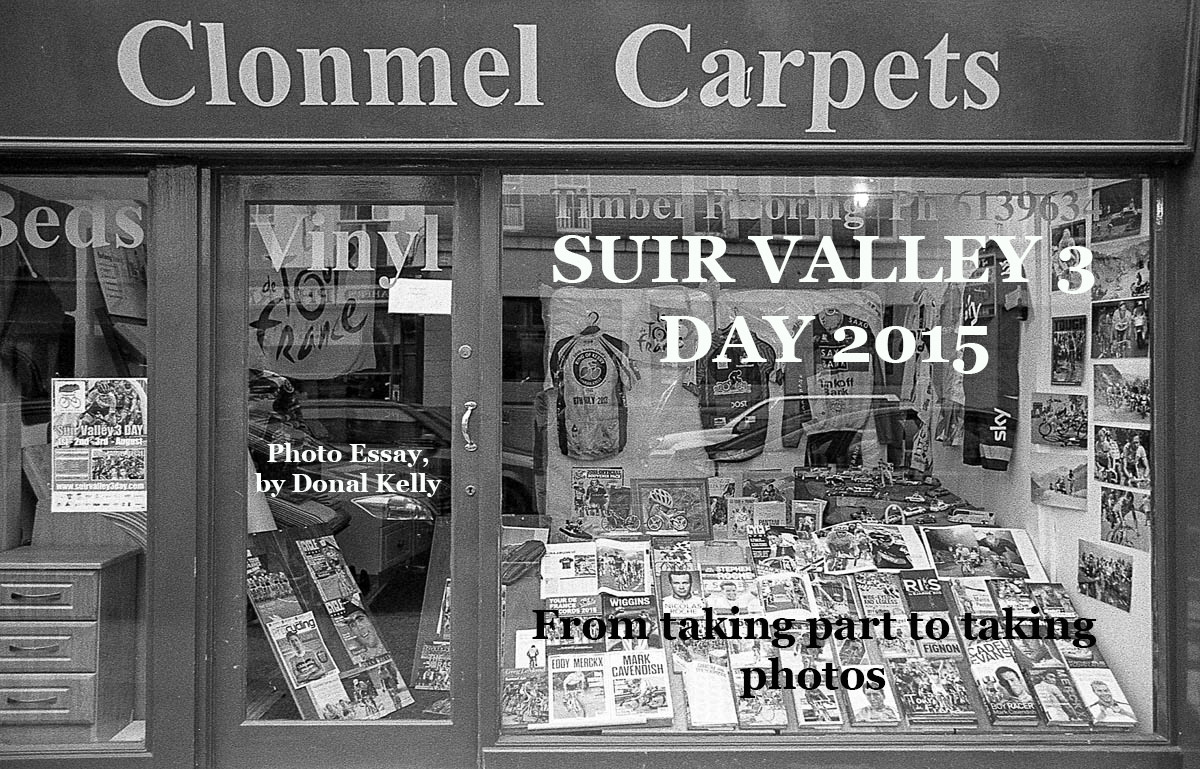
Abbey StreetTown Hall12 W. MagnerWindow DisplayExpensive facade and bell towerChampionRight onlyR. O’Donnell Select BarNo collections to the right of this signWindow reflectionRyan’s Butchers 1Ryan’s Butchers 2; closed after 109 yearsButler’s BarHouse of Lourdes (spot the cat)Liam DalyLe JardinPower & Co.The Men of ’98The Golden Harp, LoungeClonmel Carpets window displayClonmel CarpetsKOM Start on the race-finishing Nire ClimbOn the Lower SlopesTeam CarEd Laverick (JLT Condor) reachs the top with a minute over the nearest rival, winning both stage and overall.SecondThird, the wearer of the leader’s jersey at the start of the stageEoin Morton from UCD finished well on the climbDaire FeeleyNational Champion Damien Shaw (Team ASEA) rode aggressively on the final stage to try and get clear before the climb but was hauled back before the Nire climb by the teams of the other GC ridersRonan finished strongly on the 10km climbFinishers arrive in ones and twosDerek after crossing the lineAidan after the stageThe Recovery beginsPrize giving pub
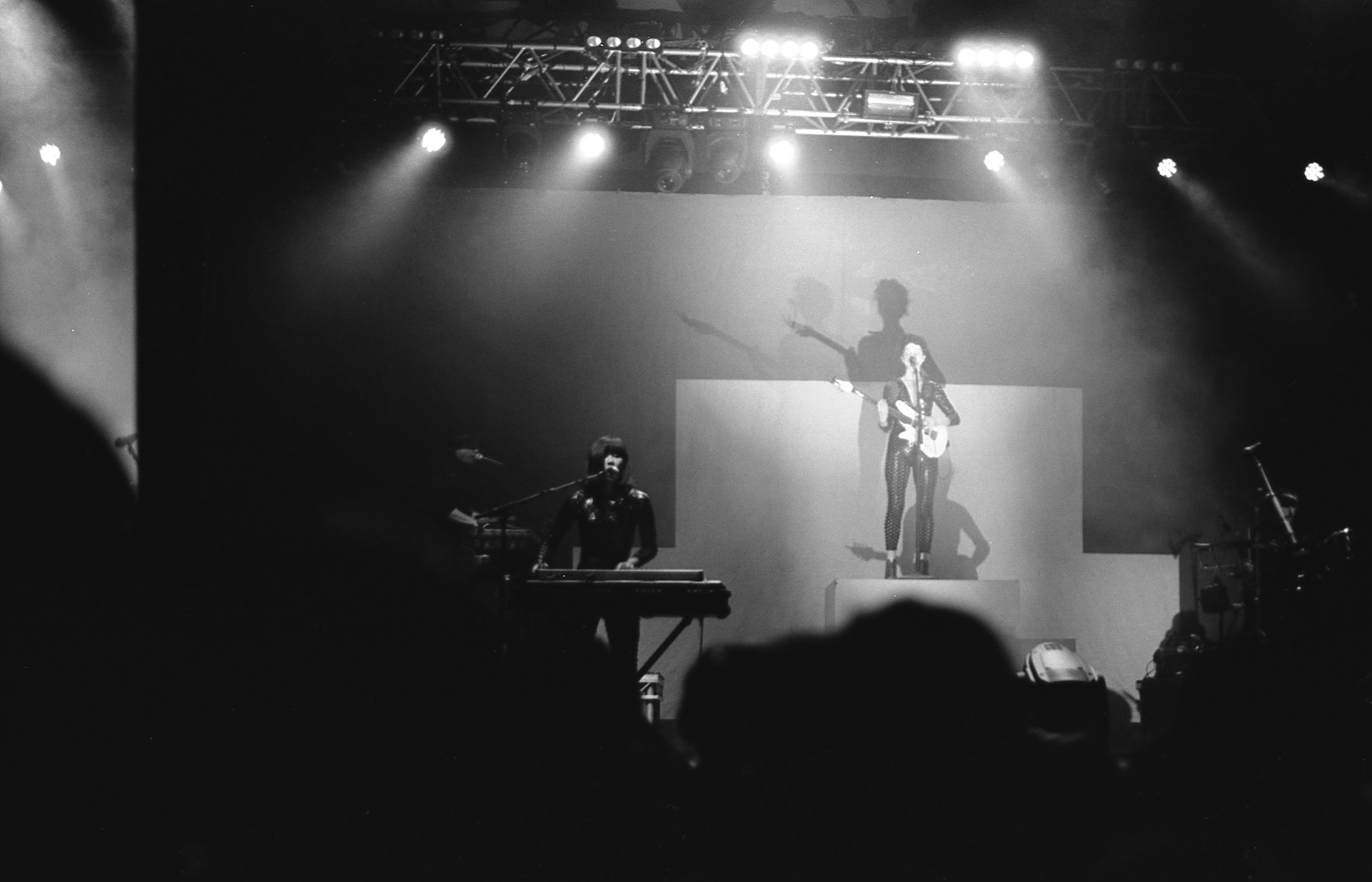
A big blue tent, in a grassy field, between a cathedral and the River Corrib, July 2015. The Little Green Cars open for St Vincent’s Digital Witness, the feature preeesentation. For a change it’s not raining, though it’s not exactly balmy. Good enough! On with the gig, and better than good enough.
You know it’s your neglect
Is the reason I’m so obsessed with you
Little Green Cars (artist), The John Wayne (song), Absolute Zero (album), 2013
People turn the TV on and throw it out the window, yeah
Get back to your stare
I care, but I don’t care
Oh oh, I, I want all of your mind
Give me all of your mind
I want all of your mind
Give me all of it.
St Vincent (artist), Digital Witness (song), St Vincent (album), Digital Witness (tour)
I went on a whim, with the Canon eos-1n, 50mm 1.8, and a half-cooked roll of Kodak's lovely t-max 100. I shot in Av, at 2.8 outside and 1.8 inside, with spot metering and mirror lock inside to try and get something useable. But I mostly tried to enjoy the music, and only lifted the camera a few times. Did some spotting, re-sizing, and "Flip Canvas Horizontal" in Photoshop after scanning (along with tons of dust) on an Epson v550.
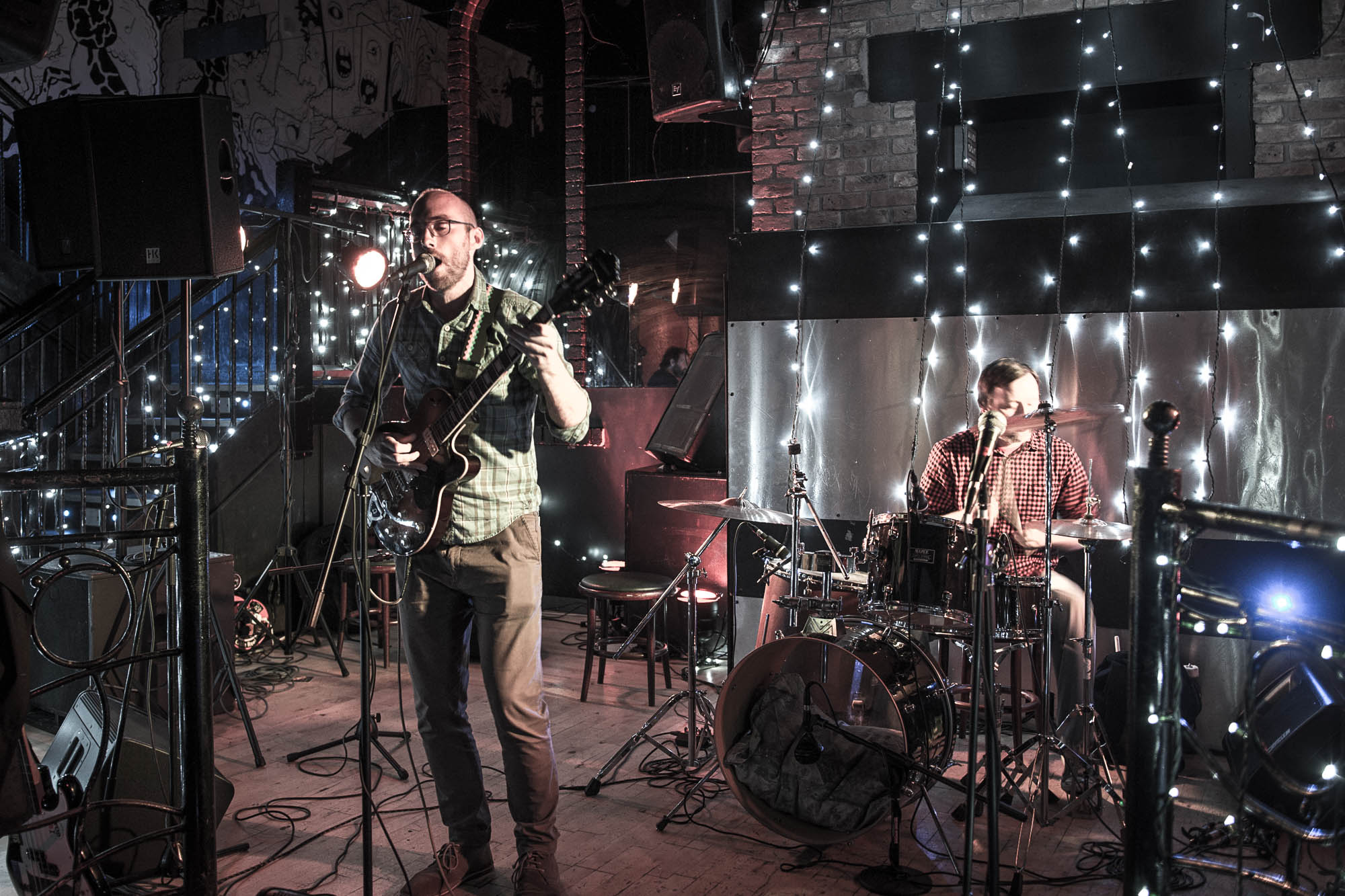
Kennedy’s Bar, Galway, July 2015, during the Galway Arts Festival.
But this isn’t the official Arts Festival. This is the low budget tagalong sibling, raised on handmedowns and shorn of ‘big’ names: the Galway Fringe Festival. Smaller venues, smaller fuss, more variety: trade your big top tent and big-rig logistics for a dark backbar stage where the hit-and-miss of the up-and-coming brew their storms?
The Mountain Man band kick up a big swell for a two-piece outfit. Born and raised in the wild west of Ireland with Gaelic as language no. uno, they nonetheless rock up a bluesyriff thick sound that seems to have done a few laps of the US and come back for a holiday… or a vacation, depending on your ken.
Baby Please Don’t Go
I stuck my Zoom H2n on a stool near the stage, where it decided to nosily listen in on ambient bar chatter, but obliged to also notice the stage output fair square (I had to push out the audio’s intro to avoid a man loudly saying “Red wine is the worst” just as the guitar starts to get into its groove). I started to record, then after a minute the Canon runs into that beloved error: MEMORY CARD FULL
Unsure of whether or not I had definitely definitely uploaded everything lately to the laptop from the jammed 16Gb card, I began to delete old photos, cursing myself for not being thorough. Come next song, I hit record again.
Baby, Please Don’t Go, is a standard so standard that its origins are as smoky as an Irish bar at 2am before the smoking ban. You might know it from Lightnin’ Hopkins, or Van Morrison and Them, or Big Joe Williams, or John Lee Hooker. The Mountain Man Band hit it from the pre-Them slower tempo, but via a moody-muddy electric direction. It’s laid back and jagged.
Now don’t you call my name, you got me way down here, on a ball and chain
Guitarist and vocalist, Declan Keane, has spent a long time working on getting good tones. For this track, he used a De Armond M75T guitar (humbucker pickups), paired with a Laney VC30 210 amp, played through the clean channel (tones low, mid/bass raised a few notches) via a Boss BD-2 pedal providing some overdrive crunch.
[nggallery id=6]
I had the Canon 70D stuck at ISO 1600, and the Sigma at 1.8 in Av, and used a focusing ‘trick’* to get a focused shot or two, and did but a quick edit in Windows Movie Maker for the video. Movie Maker didn’t quite play ball, though, and after exporting had managed to unsync the audio and video tracks slightly. A few tweaks and exports later and… same thing.
I ran the photos through Lightroom, and levels that I had been trying out of late. The temperatures of lights in a gig need some kind of ‘interpretation’; I never really take to how the camera handles them first.
To do them justice I should have captured their original songs; maybe ‘Move to the City’ or the lean and mean ‘I Swore’.
I swore that I’d never leave you; you swore that you’d never break my heart
Them’s the blues indeed…
----------------------------------------------------------
random tip #106
----------------------------------------------------------
* (How to get shots at f1.8 and slow shutter speeds in low low light with Sigma 18-35 when the autofocus is meh)
Turn on Live View
Tap screen to focus and shoot (this must be enabled): this gives better accuracy than standard AF at f1.8! (on my gear anyway, based on mine own tests)
Switch to Manual focus withough lowering the camera (or changing the subject/camera distance)
Switch off Live View
Shoot a bunch of photos in continuous mode, being as still as possible (no IS on this lens)
Delete the crap, keep the good uns (the ones you like, not necessarily the sharpest!)
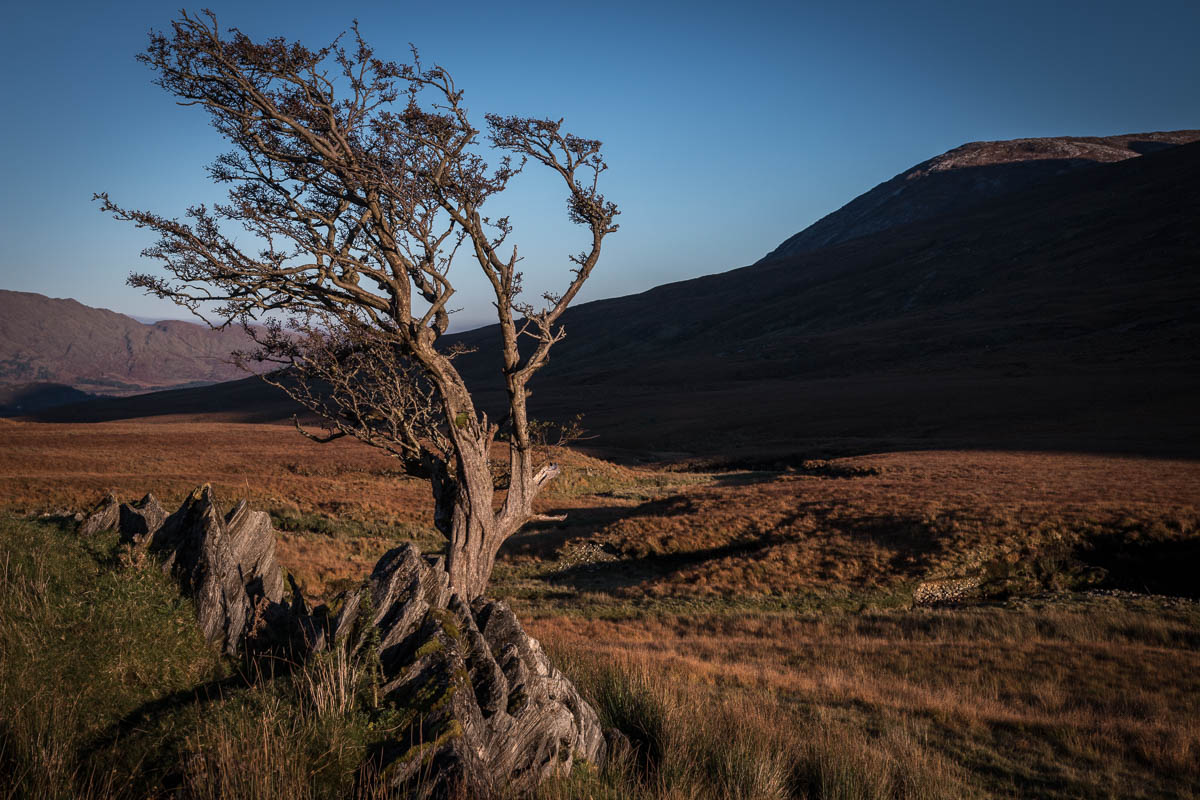
According to legend, St. Patrick blessed Connemara from a well at the top of the pass, and slept there (“Leaba Padraic”=”Patrick’s bed”), though to my limited knowledge there was stuff going on there before that too. There is now a little chapel next to the well and mounds of stones marking the stations of the cross. It is a remote rocky outpost where winds seem to gather, and stone in so many forms fill up to the changeable sky.
On Máméan
On Mountains of Máméan stone
Mounds of stones
lead up to the chapel on the Pass of the Birds
Wearied by the winds that funnel through the reeks
by ‘leaba Padraic’
We follow the pilgrim path scratched up the slope,
A journey distilled, to resonate like a lone string,
With all the other journeys,
Tracing the same strewn line,
That never seems to change
Until it is suddenly gone forever.
Names of the dead are scratched on scraps of slate
Scattered on the alter dug into the rock
And left to mark the passings by those who pass
Tracing a path back to the pagans
To a well’s water as deep as the will to drink
In sacred places.
And most of us,
When we reach a summit
Add another stone to the stones
That mark the summit,
Of the mountains
And the Gods or the absence of Gods
That the mountains themselves
Are scratchings of.
On the Pass of the Birds
The grand scheme of things,
Is momentarily reduced
To one foot in front of the other
On a winding path of white shards
Where we lean into the Mámean wind.
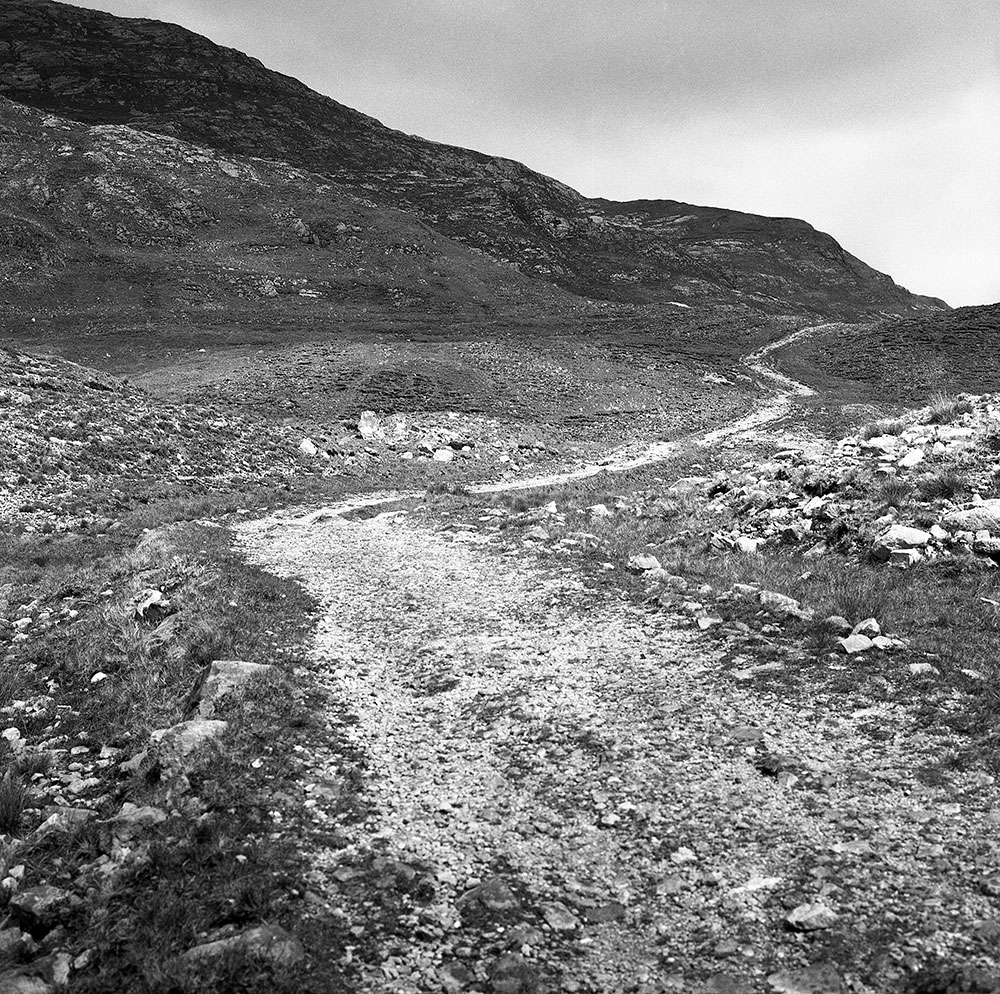
Photos were taken on a Hasselblad 553 ELX, and a Canon AE-1 Program (first and last images) Ilford Delta 100 film, developed using Rodinol (1+25). There were, unfortunately some streaks on the film after developing. This is the way of film I suppose.
The Glann road follows the western edge of Lough Corrib from Oughterard towards Maam, ending close to the foothills of the Maamturk mountains. The lake narrows towards its Northwestern corner, with peninsulas like the Hill of Doon coming within a few hundred metres of the opposite shore.
The Ends of Glann
A stonestrewn shore below bogsoft hill,
And its grey ruins where lives once ran down,
Slopes furrowed still by lazybeds,
From the brows of Corrán Mór,
Where the Corrib narrows to northern bays,
In two irregular scoops of Cornamona and Maam,
Of mines mined beyond the ends of roads,
And beginnings of Maamturken peaks,
That rake the rustlings of a fresh westerly,
Bitter through the teeth of Hen’s Castle,
Teaching a tune to grass and wave,
To fall beneath a footfall’s weight,
On bare elements borne in ice to a rugged place,
Wearing lost seasons and souls with rugged grace.
(April/May 2015)
****************************************************************** All pictures and words by Donal Kelly. Copyright is mine and the sweat of my brow; do not copy or use without permission.
Technical: A Hasselblad 553 ELX with a Carl Zeiss 80mm Planar T* lens, Ilford Delta 100 film, developed with Rodinol 1+25, scanned using an Epson V550.