Posted on

Something special: Tokyo Story’s cinematography

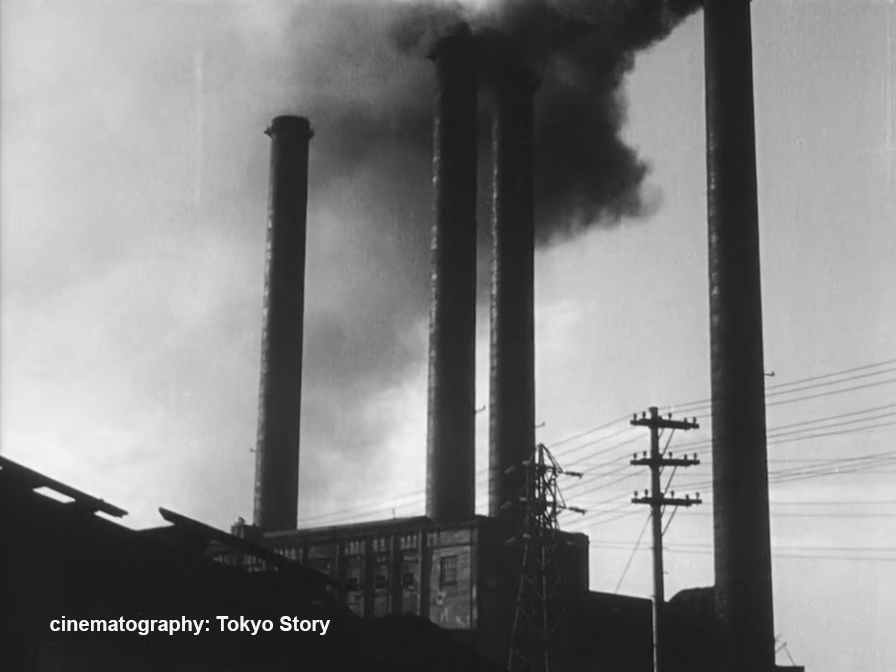
I compiled a small gallery of stills from the 1953 Yasujirō Ozu film, Tokyo Story.

I simply took screenshots when the camera stayed put on some detail or setting, free from dialogue.

These shots are simply but beautifully framed and together would not be out of place as a photobook or exhibition.

The cinematography of this film is something special. The camera moves once only, in a scene in Ueno park where the elderly couple who have made a long trip to Tokyo essentially hang out because they have nowhere to go. Their adult children are too absorbed and too busy.

Every other shot is static. The camera lingers on the simplest of things: trains passing, smoke rising from stacks, rooftops dropping down towards a harbour.

Every frame is carefully chosen, and in each the world is given freedom to move. The plot is not hauled along at every step. It emerges as one aspect of the film, slightly disengaged, unhurried, naturally, profound. We get to settle into the sights and sounds of the city as we learn about the family of characters and their stories. We see lanterns bob in a breeze and hung clothes flap dry.

By the end of the film you are comfortable in this busy 1950’s Japan. The abominable war is very recent memory and a great rush is underway to industrialise. It strains traditional rhythms of living. Children grow distant in absorbing city lives defined by work and its roles. Parents that aimed at traditional status question the value of their efforts. Now they are old, they protest at their own inconvenience.

“I don’t want to be a burden.”

Do we not resonate with this? We live in another age where each generation leapfrogs its previous, and we buy into ideals of each being both the lead character and director. And then we inevitably end up being leapfrogged ourselves. So it goes.

How many films are brave enough to let a shot linger on an entire train rumbling by, or reveal to us that the changes of life are by their nature, inevitable and disappointing. We grow up, we grow apart, we fail, disappoint, and regret. It is not so simple as spotting good guys and bad guys and expectorating justice as the plot rumbles in a straight line to a finish line. There is no checkered flag.

Kyoko:

Isn’t life disappointing?

Noriko:

Yes, it is.

The camera is normally low but sometimes peers out of windows down at a passing train, sometimes at eye level looking up at the steel infrastructure of progress. Edges of buildings and rooftops anchor compositions. Strong lighting creates a sense of depth and drama. There is an incredible consistency and realism.

Both photographic and filmic, the camera stops but elements of the scene move. This movement is often in a particular plane, such as a little group moving diagonally past a school, a group of students crossing a hallway, or a bus passing between buildings in the middle distance.

Locations are repeated, building up a familiarity and setting scenes in a contemplative mood. The same rooftops, the same harbour: but if you look closely you can see that the light has changed, and the sun has moved. However, the same line of clothes might be blowing on the line.

It is interesting to consider how these long static shots affect the pacing. If one or two were used, they might disrupt the flow, as the viewer would read a lot of significance into the act. “Why is the camera staring at this? Is it part of the plot?” But when established early on the pace becomes clear and the effect meditative. The viewer does not scramble to tie the shot into the plot. There is a careful minimalism at play, and a visual progression that could stand as an independent documentary photographic project. There is also something of Monet’s haystacks or Notre Dames paintings, of impressions of light on the same subject at different times.

Tokyo Story stills:

Cinematographer: Yūharu Atsuta
Director: Yasujirō Ozu
Writers: Kōgo Noda and Yasujirō Ozu
Released: 1953

[ngg_images source=”galleries” container_ids=”17″ ajax_pagination=”0″ gallery_height=”400″ order_by=”sortorder” order_direction=”ASC” returns=”included” maximum_entity_count=”500″ number_of_columns=”6″ display_type=”photocrati-nextgen_basic_thumbnails” ]

Posted on

Poem: Breaking News

people in dublin

This poem is called Breaking News

This is it guys
It’s happening
Clear the decks
This is breaking
I want pictures
Get the victim names
Find them on Facebook
Cross reference with LinkedIn:
We need names, faces, stories, now

Quick guys, quick
Stay ahead of the curve
This is the A&E
Not brain surgery
Find the hashtags
Twitter, Instagram
What’s trending?
What’s going on out there?

We have to be first with this
Video guys, we need video
Is there video?
Get on it
Draft up analysis
Open it for comments
See what it stirs up
We need his story
What’s his story?
Why did he do it?

Where are our headlines guys?
Massacre? Carnage? Bloodbath?
Get me a thesaurus
Is it enough?
Numbers people,numbers
This is happening
It’s big
It’s now
Get me some real numbers
What’s happening?

We don’t need all that stuff
It’s taking too long
Nobody cares
We can’t afford to wait
Go back to it next week
Get me tweets from world leaders
Get this on our Most Read

Be ready for the second wave
Are we getting hits?
Don’t forget the advertising slots
Review that linked content and suggested articles
How are the stats looking?
Are we up?

It’s too quiet
We have to seed the sharing
Or we will be lost
Can we get some comments going?
Get the ball rolling
Reaction guys, we need a reaction

Where are the damn headlines?
What’s going on?
We have to
Tell the people
What’s going on.

This is it guys
It’s happening
This is breaking
Clear the decks
Update the homepage
I want to see pictures
One with both politicians together?
Quick guys, quick
We have to
Stay ahead of the curve

Donal Kelly, Summer 2016

Posted on

Videos Lie

There’s little to match the potential incrimination of video footage. A camera sensor cannot lie; it offers a view so much more objective than the darts of our biased theorizing eyes as they read scenes and situations by projecting out a lifetime of fears and expectations.

The camera is a grid of light-sensitive pixels that has no opinion either way. Imagine a court case where one word against another is the order of the day, until late in the day a snippet of CCTV footage comes to light that exposes one of the parties in raw honest frames.

Social platforms have embraced the video format. Facebook crams your newsfeed with the cute, the curious, and the crazy, recorded on whatever is to hand.

No matter the scene, no matter the location, if there are people present, there’s probably a recording. When we hear of an incident now we immediately want to see the footage. Many ‘news’ sites package up the footage, bookend it with stock intros, and stuff the rest of the page with advertising. Jaded web users will tend to do two things: block all ads, and get to the source. There’s just too much noise in the signal.

The bandwagons mobilize so fast, keyboard warriors, torches fuelled, scanning the video with that highly adapted mind. When it comes to videos of people, every gesture and expression are read almost instantly, intentions measured in a millisecond somewhere behind our eyes, filtering through into a proposition (of guilt or innocence) and a cool wind or warm blast of anger.

But, how much faith should we put in a video? Is it enough to hang-draw-quarter, or vilify freely in the comments box?

An example from sport

The 2015 All Ireland Semi-final between Dublin and Mayo was a tense, tight, physical game. Tackles were hard and scuffles broke out repeatedly. At one point it appeared that the Dublin defender Philly McMahon gave Mayo’s Aidan O’ Shea a headbutt. Here’s the footage:


Exhibit A: No buts about it, McMahon headbutts Aidan O’Shea

The video was a big hit in the post-match chatter.It clearly shows intentional head thrusting, even if it is light and doesn’t seem to do any damage.

Aidan O’Shea himself confirmed that he was indeed headbutted: http://www.irishtimes.com/sport/gaelic-games/gaelic-football/aidan-o-shea-yeah-i-was-headbutted-alright-1.2334160

Calls were made for the head of McMahon, or at least a ban for the replay.

A day later, another angle appeared.


Exhibit B: BUT, McMahon’s head simply falls against Aidan O’Shea’s face

From this new angle, a very different interpretation is allowed: McMahon was slightly off balance and was carried into O’Shea by accident. There seems to be no intentional movement forwards, only a falling movement.

Now, it is still possible to argue intent, or, even without the second video, argue none. Either way, the confidence of our quick judgements made on the basis of a single video, or even two, needs to be qualified.

Of course, Aidan O’Shea would hardly have been in a position to see the event clearly, and both videos are consistent with his view that a headbutt happened, but without the intent seemingly shown in the Exhibit A video, it simply doesn’t matter.

Our brains are designed to make really fast calls about the intentions of others. This rapid judge-respond action may be rational and useful in many circumstances, but is it a good approach when there are so many spaces to vent and comment and bicker and chant?

Posted on

National Rubbish Burning Night declared a limited success

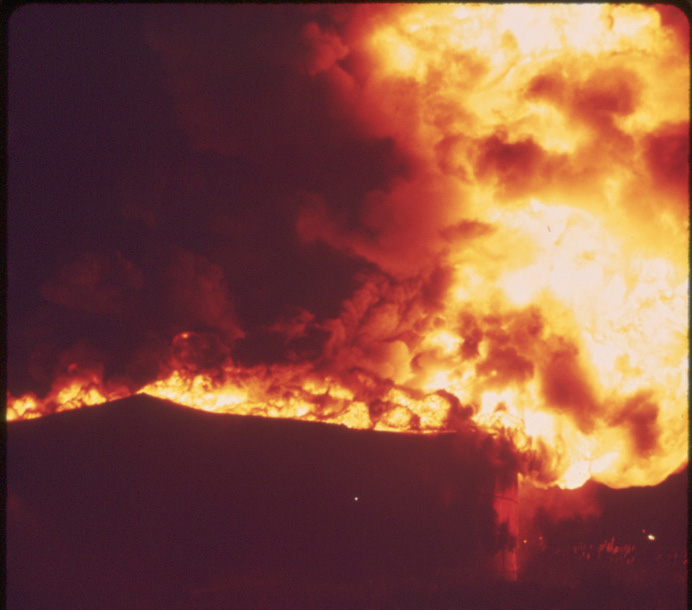
June 23rd: with little to no rain and generally no wind, conditions were perfect for this year’s National Rubbish Burning Night. Despite a downturn in the tradition over recent years, there was still a large turnout all over the country, particularly in smaller communities where specimen rubbish items tend to be hoarded away in old sheds and unused rooms and attics.

As reports came in from across the nation, it became clear that despite the midgets, the general ethos of “if you build it, they will come, carrying bags and boxes to burn” attracted huge numbers of both spectators and participants.

According to John McHale, in a small village in the midlands, this year’s event was one of the best in recent times.

“It’s the biggest yet since the crash of 2008. You can see donations improving year on year as people upgrade and throw things out. We had four mattresses ourselves left out back since Christmas, and we cleared out the crap from the renovations last year. They were a bit damp but burned away grand, and we gave a few old tires for the sake of tradition, and sure they throw up grand black smoke.”

His two sons John and James were likewise satisfied, having donated their collection of mostly empty deodorant cans to the colourful blaze, along with the old desktop and monitor and two broken printers and old redundant cables.

“The printers took a while to go, ” said John. “I suppose it was the metal parts. But the cans were class, they were flying out all over the place. One of them landed right next to me. I even burned my jeans.” John lifted his leg to show me where the skinny jeans had been burned away.

Meanwhile, in a smaller fire in the west of Ireland, local man Seamus Scully explained that the organisers aimed for a balance between tradition and innovation.

“Well, we had a bunch of old crates and tyres, lots of cardboard and a few tins of petrol to get it going, and we cut down a few trees to give it a more organic feel… but we also had some great modern additions, like batteries, broken phones, boxes of Lidl and Aldi newspaper supplements, books, fat TVs, fencing, bottles, broken toys, used cosmetics… we even had a couple of armchairs and a cracked Ikea wardrobe. It was full of awful clothes!”

Seamus pointed out though, that the younger generations have forgotten about the core meaning of the day.

“The young people aren’t interested really. They only come down to drink a few cans on the sly and let off fireworks and burn things just because… they don’t care about the tradition or the occasion at all at all. Sure my young fella wouldn’t even help me drag in the old setee and dishwasher, but he was quick enough to run down with the tins of flammable paint wasn’t he? Sure that paint was still good!”

His wife Feidelma thoughtfully added.

“I suppose it’s always the way, us adults thinking that the youth of the day have lost the plot. But this was always a family day, where you’d get together to collect for the fire and enjoy a night outdoors, and the way that different materials burn and the blast of heat to keep the flies away. Sure now they’re too busy shnapchatting selfies to get involved.”

As the fire burned away, slowly stripping the generous donations into ash and charred metal, the small crowd dispersed back to their homes, the site for the fire being outside any wifi and known for notoriously poor 3G signals.

Filed under satire
fire (flickr commons)

Posted on

L’Étranger: Alone and aloof in a blind benign universe.

flowers against the evening sky

“I laid my heart open to the benign indifference of the universe”.

To feel the incongruity of the book’s situation, you have to feel what Mersault seems to refuse to: empathy. With a reader’s empathy you follow his thought and actions with a sense of understanding, and allow yourself to be as confused and blinded by the heat and sun as the he is, actively reaching out to see through his passive spectating eyes.

Mersault is a passenger, a non-judgemental observer who immerses himself in the present, in his senses, in the patterns of people and the play of light, but perhaps disassociated from the simple moral stories that give structure to social life; that give events the satisfying structure of a moral tale with winners, losers and sharable explanations. He is as indifferent as the universe. Why one thing, one choice, and not the other?

In the courtroom officials take over, imposing a moral interpretation to the hapenings. A man is dead, though we never get to meet him; he remains a distant, obscure, knife-wielding Moor. We hear more instead about the heat, and the overpowering sun, and flow of sensation. Mersault is accused of having a callous nature, of abandoning his mother and showing no grief at her death, and for cruelly firing four shots into an already limp body near the rock and cool stream on the beach. Yet we as readers were there with him; did we notice this despicable nature? We were exposed to his thoughts from the funeral to the killing; did it jar out moral senses and provoke disgust and anger?

It is hard not to rebel against Mersault at times, when a response wells up and his behaviour seems to be missing some aspect of human nature. Does he really not recognize the relations and expectations of the situation he is in? Does he not have a desire to please the court’s need for repentance and guilt? Does he really feel indifferent enough to never slip into an acceptance of human behaviour? At what level does he connect to others? It seems like it is on the level of a role player who is overly conscious of his act. It is hard to imagine him following the funeral from the retirement home and only seeing the beads of sweat and the sun and the efforts of Thomas Perez to keep up by taking short cuts. Would he not become immersed in feelings of loss? Perhaps… but perhaps this is another ingrained expectation. Or perhaps he is an incomplete construction of a human character.

Is there no meaning then, in Mersault’s life, as he sits in his prison cell awaiting execution with a fatalistic acceptance? There is the hole in the cell through which he can see the sky. There are his memories of his life outside, his intricate memories of his apartment and rooms. Perhaps the problem is that there is too much meaning, too much awareness of the condition of being this person here right now in this place in the universe of senses and caught up in a human world compatible only with a particular subset of interactions?

He decries the lack of hope in a process where the guillotine will simply be reset if it fails. His liberty has been removed, and after the surreal arguing in the court now comes a concrete unavoidable route to the end. Liberty then has worth.

The chaplain is horrified by this atheist man who refuses to profess guilt and regret in the face of doom. His message of God pushes no buttons and generates no interest, though his persistence to implant an idea of divine hope in suffering eventually triggers a rage. Like the Court Prosecutor, he is interpreting Mersault and judging his subjective experiences as if he can see them and understand them more clearly himself.

Mersault is carried along without saying what people want to hear; the assurances and protocols of interactions are just another aspect of the universe to be observed and experienced. Yet his liberty is denied, he is judged to be someone or something else, and the I the reader am left frustrated at his inability to sacrifice this passive journey and engage in the human interactions with the emotions that will give him back that limited liberty. Yet then am I, are we, simple actors and players in a world where meaning and value are an application of an accepted process that is on some ways an arbitrary mechanism to an open mind?

In any case, coming out of such a book with more questions than answers makes more sense to me.

Posted on

The Price of Rights… Killings in Connecticut.

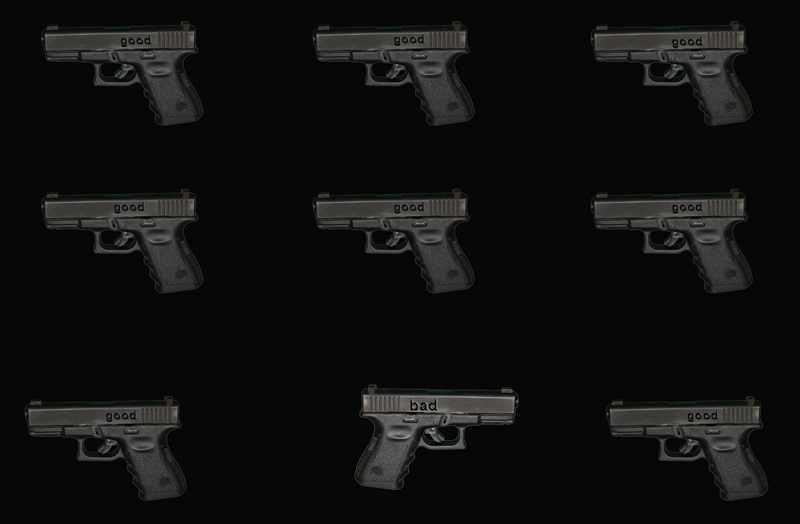
Good Gun Bad Gun

Is the need for people to be secure not undermined by their right to buy guns?

It is happening again. Another unhinged slaying of innocents. Another school, another young man unleashing a shocking expression of hate and anger. A scarily familiar news story emerging in its horrible details that resolve from vague guesses to real names and a score of small coffins. It is another addition to an ever-growing list of public shootings that result from the personal issues of a tiny minority.

In Sandy Hook Elementary School, Newtown, Connecticut, things will never be the same. Like Columbine, like Virginia Tech, like Aurora. As a foreigner the place-names are learned through their tragedies. Why does “school shootings in the US” have its own Wikipedia page?” ((http://en.wikipedia.org/wiki/School_shootings_in_the_United_States))

Coming from a country (Ireland) where the police rarely carry guns and where the scars of past violence help sustain a peace from ‘troubles’ (the Omagh bombing in 2008 killed 29 people, and was the worst single atrocity of the decades of turmoil((https://en.wikipedia.org/wiki/Omagh_bombing))), the regularity of public shootings in the US is shocking. These men, real people like any of us, in their moments of crisis, responding to bullying or some internal breakdown, their anger swelling out, knowing no innocence, can reach out with little effort and fill their hands with guns, their minds with precedent, their Internet history with gung-ho videos about guns and gunning. And after each event the society is cocked and primed for the next. So many triggers; so many fingers.

A well regulated militia being necessary to the security of a free state, the right of the people to keep and bear arms shall not be infringed

(US Constitution, 2nd Amendment) ((http://en.wikipedia.org/wiki/Second_Amendment_to_the_United_States_Constitution))

To those who own or use guns, there are arguments of security, and arguments of rights. Are you more secure with a loaded weapon permanently to hand? In the few moments in life where you might ever feel the need and justification to point a weapon at someone, does having it actually improve your chances of surviving? On a battlefield or video game, sure. In a ‘domestic disturbance’ or a robbery, or in your kids’ school? Raising a gun dramatically increases the odds of you being shot. Having access to guns means having other people access guns. After the shooting in Aurora earlier this year there was a surge in gun purchases in the area ((http://www.bbc.com/news/world-us-canada-18980974)). In parts of Texas teachers can be armed, as can students in some Universities (concealed no less). It sounds more like the wild west than a modern state with a secure society. Yet if your neighbour were robbed at gunpoint, it would be hard not to feel the need for a personal gun, unless you could guarantee that others had none.

In Killing Them Softly, a 2012 film where failed and failing criminals engage in an unromantic battle under the backdrop of the 2008 presidential election, Brad Pitt’s character sums up his attitude at the end of the film:

This guy wants to tell me we’re living in a community? Don’t make me laugh! I’m living in America, and in America you’re on your own. America’s not a country, it’s just a business… now fucking pay me! (Killing Them Softly, 2012)

If you’re on your own, then you don’t just have a right to defend yourself, you have a need to. Again, it sounds like a lawless state of affairs. Killing Me Softly has a setting far removed from an Elementary school in Connecticut, but the price of the theoretical right to defend yourself includes the cost of others being able to express themselves in bullets and blood. Would you not defend yourself and your children more by taking guns out of reach of those who may one day use them maliciously?

This guarded right to carry arms is a core part of the national identity and concept of free individuals. It’s enshrinement in the constitution guarantees huge commotion when questioned. Is it related to the ideas of liberty, that it is acceptable to do something as long as it is not causing others to suffer? Do a breed of Libertarian principles push the perspective of society into the that of an isolated individual: a cowboy riding solo with only wits and a six-shooter between freedom and death? Or is it as a bastion of a personal freedom, constantly infringed by big government? Given that every gun has its inherent deadly potential, and given that fighting for the right to bear one is also fighting for the right for unstable individuals to obtain them, how wise is it to regard this right as something that cannot be sacrificed for the sake of a safer society?

Congress shall make no law respecting an establishment of religion, or prohibiting the free exercise thereof; or abridging the freedom of speech, or of the press; or the right of the people peaceably to assemble, and to petition the Government for a redress of grievances.

(US Constitution, 1st Amendment) ((http://en.wikipedia.org/wiki/First_Amendment_to_the_United_States_Constitution))

The right to bear arms, the second amendment, is surely not built from the same stuff as the first. They are not built from the same foundations or aspirations. The right to free speech protects and encourages in any society and will always be a goal: diversity is healthy; necessary. Guns kill people. They are life-ending objects, much more than sticks and stones. It’s not that names can never hurt, but although some things are hard to listen to you don’t have to agree. The brutal argument of a bullet cannot be questioned. Having an armed population prepared to defend their right to defend their right with an anti-society device is hardly something to aspire to. It is not a goal.

Times change, societies change, and how a person act always needs to consider this. It is no longer 1791. The right to own and the decision to buy guns has powerful externalities: the ability of those who are consumed by intentions of harm and separated from the world by alienation and anger and a sense of injustice, to arm themselves and aim. In a dense interconnected world where we are always in a public domain, we have to have some trust in the social system. When we get on an airplane or in a taxi we have to assume that the pilot/driver is not drunk or high. We have no choice but to have faith in strangers, trust in others, while accepting the destructive potential of human nature. Our money is a number on a computer, our economies are constructs of confidence. Yet modern identity is based on knowing your own mind, making your own choices, and acting as an individual. These are not shopping cart choices though; these are the choices we make about how society works. And when the result of these choices is a situation where gruesome scenarios and public killings repeat themselves, new choices need to be made.

Modern society has countless rules that accept the potential failure of individuals. If everyone was an ideal human then there would be little need for law. What fully rational, empathetic socialized person would, for example drive recklessly on a public road? Every group of people has to balance the individual island with the social whole, balance rights with duties, and safeguard where possible against the threat of violence or corruption. If the system has too much power/responsibility there is no freedom. If the individual has too much there is a danger of chaos. In computer science it is commonly said that a very secure system is unusable, while a very usable system is insecure. There is a trade off between what users can do and how safe they are. There is a trade off between individual freedom and social stability. Where would we be without society?

And the life of man, solitary, poore, nasty, brutish, and short (Thomas Hobbes)

There are those that will be waiting for the powerful gun lobby to raise its vested voice loud above the affected and angry. Default behaviour of apathy and the reluctance to take on a well oiled set of arguments deployed by well positioned arguers and with the backing of a profitable business facilitate the next public shooting. It has happened too many times to allow everything to carry on as before.

Guns don’t kill people. People kill people.

This snappy return is fallacious. It relies on the flexibility of the verb ‘to kill’, which sometimes implies an intentional agent/subject ( a killer), and sometimes an indiscriminate cause of death. The ambiguous implication can be removed by rephrasing: Guns don’t intend to kill people (1), or ‘People are not killed by guns’ (2). Of course, only one of these is true. Of course people are killed by guns. The original argument implies that the only important factor is the intent to kill- that there is a murderous actor, which of course has to be a person. Switch ‘gun’ with ‘bomb’, a more indirect killing device, and it makes no sense any more; ‘Bombs don’t kill people. People kill people.’ ‘Drugs don’t kill people. People kill people’. This is not an argument at all, it is simply stating that guns do not intend or purposefully kill people, just like cars, or drugs or bombs. it tells us that if we are killed by a gun, that gun must be fired by a killer. Does this mean we should not notice or consider how or why the gun is in the picture? Should we simply look past it to the mind behind the finger on the trigger? The responsibility of not killing you is resting on the twitch of an enraged finger.

Go out onto the street, flag down a car, preferably driven by a tough-looking young man. Jump on the hood, kick the windscreen, insult the driver, his mother, car, children, religion, race, beliefs, job, and anything else you can identify. When you are sure he is utterly incensed, offended and enraged, hand him a loaded gun with the safety off. Has the situation changed? Has introducing a gun into this moment of rage raised the bar? Have your chances of waking away unscathed remained the same? Are you safe because the gun will not fire itself with its own subjective purpose? There is only the slightest squeeze of a finger between you and your death. No argument or situation is the same when participants are armed and guns are pointed. Introducing guns escalates the issue to a life/death situation with only the slightest of movement.

Some polar opposer of the gun lobby will likewise vent from a biased position (though probably one with less influence), and decry the whole apparatus of American society. Here, a country steeped in war and a history of warmongering, too heavily invested in the production of war machines for profit to be interested in negating the promotion of gun ownership. Points that need to be made, but it is important that this does not become a battle of extremes where the central majority ends up doing nothing. Lots of countries produce and sell guns, and no society is perfect. Many markets and products are loaded with incentives to not use them. Consider that in Australia cigarette packets are now completely de-branded, while in other countries they are splattered with abrupt messages along the lines of ‘you will die if you smoke these’. On top of that we have the laws and social norms that allow life to function in the first place, from road signs to bank regulations. When they fail, they must be addressed and altered.

Does the US have a history or principle or special status that make it different enough to warrant more liberal gun laws? Coming from a country that has been wracked repeatedly by invasion, oppression, partition, civil war, and modern terrorism, it is hard to imagine. What country carries no history of shots fired, blood shed? As for unique rights; the whole notion of a modern democracy involves that of personal freedom. Yet anarchy is not endorsed, as it is generally acknowledged that there are those that will not act in their own best interest if given the chance. That is why drugs are illegal and alcohol restricted by age. Levels of restriction should be based on the levels of danger. Is it not strange that liberal gun laws are associated with conservatism?. The dual nature of a gun as defender and aggressor is divisive. When we are all armed we are in danger of separating everyone, from neighbours to nations, into aggressors and defenders. I have a brother who is a policeman, and he rarely carries a gun. I don’t take pride in many aspects of Ireland but I take a certain pride in that. Surely this should be the goal?

Some defenders of the right to be armed argue that more guns are required, not less; that the teachers should all be armed, that the students should be taken and trained in the use of automatic rifles in case they might have to save their friends with an act of heroism in a firefight. Here is the wild west dream again, alive and kicking. Flood the country with more and more guns, and rely on the judgement and aim of strangers to save the day when the calm is upset by a crazed killer (or an annoying driver breaking the lights). Can you really feel safe when every person you meet is four seconds or less away from moving their hands to their pocket, raising them, and squeezing a finger? This power requires responsibility: you must now rely on every person you meet every day of your life to be responsible, reasonable, and in control of their emotions and behaviour.

All that is necessary for the triumph of evil is that good men do nothing. (Edmund Burke)

It is near impossible to make a black and white distinction between ‘good’ and ‘evil’ people in order to discriminate between them when it comes to gun control. Immediately we have to rephrase the targets to ‘probably good’ and ‘potentially capable of evil acts’. And it gets muddier: most of the savage killers have been young men with issues, perhaps quiet or aloof, distant and withdrawn, perhaps bullied or shunned. How many kids are aloof or bullied or shunned or distant? Surely a few in every class, and many in every school? Will identifying and targeting their isolation then restricting their behaviours serve any positive purpose? Would it not be better to aim to reduce their isolation and try to create conditions whereby an act of murderous intent would be hard to implement? Would simple paperwork and clear regulations not cut through the fantasies that burden those who may not have the wherewithall to discard angry thoughts of destruction.

In any case, time spent searching for errant individuals to monitor and control while at the same time promoting certain individual freedoms are at odds with each other. Surely it should be vital to make it very difficult for anyone, regardless of character or history to carry out these horrendous acts in the first place. It is obviously not enough to rely on moral character. It is impossible to identify potential suspects. Why isn’t there a trail of disincentives and obstacles to owning and using weapons specifically designed to kill?

It is deeply upsetting and profoundly unsettling to be continually faced with episodes of slaughter that could have been prevented. It is not possible to prevent all of them or remove their possibility completely, but changes have to made, and questions asked again and again.

Insanity is doing the same thing over and over again but expecting different results

History, psychology, science, anthropology, and simple people-watching all teach us that humans are fragile complex beings with a nature both social and selfish, docile and dangerous, caring and yet capable of irrational madness. In the tumult of debate and emotion, the desire to stem these events has to involve clear thinking and focus from all sides. Bias should be exposed, ‘rights’ should be questioned, and the core values of a ‘society’ held up in the spirit of amendment 1 to see the weakness of amendment 2. In nay case, if it was perfect first time round, it wouldn’t have been amended at all.

In a quiet town in Connecticut small coffins will be buried along with the hope and ideals of those affected. Parents, friends, brothers, sisters, teachers and students. Things will never be the same again here. But if no actions are taken, things will be the same again somewhere else. And again and again.