Posted on

Essay: What does irony taste like?

A shallow meandering attempt to understand irony

Here’s a fun way to generate a headache. What’s the definition of irony?

Is it when you write a song called ‘Ironic’ that lists examples of irony but which aren’t technically ironic?

First, here’s how a movie can get a definition to lodge in your memory.

Exhibit A: Reality Bites. Ethan Hawke, Winona Ryder, 1994, written by Helen Childress.

“It’s when the actual meaning is the complete opposite to the literal meaning”

Ok, so irony is an opposition. I say X and X, taken literally, means X. But the actual meaning, in the context is -X, the very opposite. So… sarcasm? The words “Well done!” taken literally are an expression of praise, like “Nice work” or “Good job”. But If you drop the vase and it shatters into a gazillion fragments and I say it slowly in an exaggerated tone with my eyebrows raised, then it means the very opposite. Its literal translation, without context or tone, might be “You idiot!”

But this seems incomplete. Irony is used in more ways than to indicate only a clash between literal and intended meanings. It hints at other forces. Dark ones. Good stuff just doesn’t seem to be as ironic. And this definition includes the word “literal”. Literally. Oh God, a word that gives my brain indigestion. They seem akin, do they not?

The way people use the word “literally” is literally ironic.

Is it not interesting that these concepts are often seen together? Irony plays with literal meanings versus reality (whatever that is). ‘Literally’ itself is used to add adjectival force while also keeping it ironic. Despite its own literal meaning. Maybe because of it. You can get mad as hell and not take it anymore or accept that language changes even if its use requires rules and coordination.

Moving onwards. Or backwards. Sideways?
Exhibit B: a divisive list of coincidences that may or may not be ironic or whose lack thereof may itself be intentional or otherwise a case of irony.

  • Dying the day after winning the lottery at a grand old age
  • A black fly floating in your beougeoise glass of white wine
  • A death row pardon arriving 2 minutes after the execution is carried out
  • Rain on your wedding day
  • A free ride offered after you’ve just paid for one
  • Good advice that you ignored
  • The one time you confront your fear of flying, and the plane really does crash
  • Getting stuck in a traffic jam when you’re already late as hell
  • Going out for a cigarette break only to stand under a No Smoking sign
  • Looking for a spoon and finding all knives
  • Meeting the person of your dreams, then meeting their partner

Also 1994! Alanis Morissette.

Bitterly has this divided the west, into those that hum along and the rest, who call foul, foul!: “NOT IRONIC! (how ironic)”

But switch on your ironometer and consider: You live in the west of Ireland. Rain is a natural state of being. Aha, you declare, not on my damn wedding day. You organise your big day out in the Atacama desert, where it hasn’t rained in years and years. You joke about escaping the shite weather at home. Most people decline the invitations: why the hell are you going so far away? Do you know how much it costs to get there? And then of course it rains. In the Atacama. And back in Ireland, blazing sun. Is there not here the sweet taste of irony?

Now, you may argue that this is just plain old misfortune- a regular-sized portion of coincidence. Ketchup?

Exhibit C: So what do dictionaries have to say?

Definitions of Irony seem to list a few bases. Here be three:

  1. Using language where the intended/suggested meaning is opposite to the literal/straight interpretation of the expression, often used as wit
  2. When something happens that is contrary to expectations
  3. When an audience knows something that a character in a play doesn’t (dramatic)


Definition from https://dictionary.cambridge.org/dictionary/english/irony

Seems plausible. Look at the last example though: “The irony is that his mistake will actually improve the team’s situation.” Did he intend the mistake?

The examples have it, but does the definition itself describe how that taste arises, that ‘delicious’ irony that might be ‘gotten’ like a joke. In what direction are the roots?

Like a joke, irony seems to involve reversal and revelation. It also seems to require some kind of jarring juxtaposition or incongruity: a clash between what is expected or literal, and what is actual. Now, if I use sarcasm, it could be argued that the intended, sarcastic meaning implied by tone and context, is itself the expected/intended, even the literal meaning (see, it can always go meta). But there is still a clash here, a use of language to indirectly express a meaning, a usage that includes “I intend the opposite to what the words add up to normally” that is immediately revealed as it is said.

So, getting closer, maybe. Maybe not. There is a contrast. But also, a connection, a… drumroll… symmetry. For example, here’s a non-ironic rain:

  • It rains on your wedding day in the west of Ireland

.
And here, an ironic rain.

  • It rains on your wedding day in the Atacama after you travelled there from Ireland specifically to avoid rain. Meanwhile there’s a grand dry day at home

Ok, you can protest. See, you can always protest about the effect of ingredients. But what was added to make it seem much more ironic? I declare that it was this polar symmetry: a link, connection, that the brain immediately recognises and appreciates on a narrative level, the level where we ascribe intention and blame and significance. It satisfies us; resolves like a joke can. Intentions and outcomes, or even different aspects of an event are linked in some tasty way, or on some plane of expression or meaning.

Here’s another example: Not ironic

  • You crash your car

.
Oops. That’s unfortunate. You weren’t hurt though; it was a hypothetical crash. Now, add something that gives it a taste of irony

  • You crash your car on the way to attend a safer-driving lesson

Hmm, can I add some more?

  • You crash your car on the way home from a safer-driving lesson

yes, yes, getting there

  • You crash your car on the way to teach a safer-driving lesson

Mighty, it stinks of irony!

  • You crash your car, distractedly commenting on an article about dangerous driving, while driving to teach a safer-driving lesson.

Interestingly, while this seems strongly to taste of irony, you can still contest. Contesting levels of irony is fun. There’s a website called http://www.isitironic.com/ that allows you to vote on whether something is or is not ironic. Currently, popular results include:

Exhibit E Things whose ironic quality is popularly voted on, on a website dedicated to exactly this sort of thing:

Paul walker, actor from fast and the furious, died in a fiery car crash? 54% taste irony
Bears are actually hairy? Bear- Bare: 32% taste irony
If you have a phobia of longs words you have to tell people that you have Hippopotomonstrosesquipedaliophobia? Ooh 92% taste irony

So, irony is difficult to pin down in a way that will cleanly cut the ironic from the non-ironic. It’s almost like asking to split jokes into funny and not-funny. Count the laughs? It also shows that some stuff is more ironic than other stuff. At some point most of use will taste it, at another very few of us. It cannot boil down to strictly looking for black flies in (white) Chardonnay, or saying ‘good’ when you mean ‘bad’.

I propose to explain it as I have been using it here, as a taste that is affected by a bunch of things and which may be argued about until the cows come home and listen to Miles Davis while drinking hot chocolate until 5 a.m. But deep down what we are looking for most of the time, at least according to current use, is some satisfying connection or symmetry on some level, plus a conflict or jarring incongruity, and generally misfortune. The conflict/contrast/clash needs to be related in some way to the similarity.

A stab at an alternative definition:

Irony is a quality attributed to expressions or situations involving some revealed intersection of incongruity and symmetry.

Let’s say I say X but mean -X, i.e. sarcasm. There is an incongruity between the literal and actual meanings. Where’s the symmetry? Well, there’s a polar symmetry to opposites, as in black and white or great and awful. The polar symmetry of using opposties intersects with the conflict of saying something that seems to be untrue.

Let’s say I’m in a group trying to organise where to eat, and we go on and on and nowhere will get enough consensus. “Great to see such agreement :-)” I post. I indicate irony with the smile/tone. There is a literal/actual disparity. There is a symmetry of these opposites. It’s not the same as saying “Sad to see such disagreement”. Consider how you might react to it.
Us (loads of texts): Arguing
Me (text): “Great to see such agreement :-)”
You (thought 1): Ok, he said it’s great to see agreement.
You (thought 2): But there is no agreement!
You (thought 3): Ooh, is he doing sarcasm?
You (thought 4): Look, he used a smiley face: yes, definitely sarcasm
You (taste): irony feels?
The irony is used as a device of wit. What does that do? It points out the disagreement without attributing blame, without challenging the actors. If I say “Jeez, why can’t we agree, it’s simples” people might get defensive. The tone is different. Language that tastes of irony can be a useful tool used with nuance. Wit can allow you to say stuff without directly challenging people. Suggestion not force.

Going back up to the car crash example: You crash your car on the way to teach a safer-driving lesson. Hee hee. You end up doing exactly what you teach people not to do. This symmetry is where irony seems to be very strong.

And the bear/bare? just a pun? But see the contrast between ‘bare’ and ‘hairy’ and then the connection/symmetry between ‘bear’ and ‘bare’. They intersect at bare/bear. It is the opposite (bears are hairy) to the meaning of another word that sounds the very same (bare is NOT hairy)

How about posting this comment: “I think you’ll find its ‘their’ not ‘there'”. Ah the sweet irony of a grammar error in a post deriding a grammar error. What has happened? Message 1: “the grammar be bad”. Message 2 (revelation): Message 1 has bad grammar. Symmetry: the mistakes are the same. And it’s self referential to boot. Irony and its kin contain within the urge to eat one’s own tail. When it appears, is recognised, language loses transparency, shows its mechanics, and a game may begin. Must begin- as when a pun is made and conversation dissolves into competitive pun compositions until everyone gets tired of being meta and language drops back into the service of pointing at things.

Dramatic, Socratic, and Cosmic Irony
In dramatic irony, an audience knows something important that a character doesn’t. In these cases there is still a disparity: the characters will say and do things that have a titillating symmetry with that audience knowledge. Hamlet will play mad, then Polonious interprets it in a totally different way. The audience sees both. When Polonious talks about the madness they feel that symmetry and the incongruity/discomfort of knowing it. “You fool” you want to shout, “you’ve got it backwards!”. “It’s behind you!” “In the curtains!”

With Socratic irony, Socrayts plays dumb and pretends not to know the meaning of supposedly basic words like, er, justice. Pfffsh! who doesn’t know what that means? “Tell me Thrasymachus, since I haven’t a clue myself, being but a fool- what does this word ‘justice’ actually mean?” In this case, we are the audience and we know that Socrates is feigning. And there it is, the very taste, as he exposes Thrasymachus’s concept of justice as being dumb by himself pretending to play dumb. Educational dramatic ironying?

‘Cosmic’ irony is like dramatic irony and close to the feel of a joke, except the joke is being played, by the universe, on you. This generally involves something bad happening to you that you didn’t expect, and in fact, seems to indicate dramatic irony at your expense where someone or something else knows your situation and does something very specific to screw you up. For example: you haven’t been pulled over by the police for years. Today is the very first time you’ve driven your car without a tax certificate, and boom, you get pulled over, and fined. What are the chances? This is an unfortunate coincidence, but it also draws on expectation-vs-reality and symmetry. The more effort you put into avoiding getting caught for tax, the more irony generated when you do. There is a symmetry and a surprise: the very specific thing that could happen, does happen. Yet it is not simply coincidence. “What can go wrong, will go wrong.” Sod’s Law. Murphy’s Law. It’s a coincidence to bump into a friend on the street. It is ironic if you met him while specifically taking that route and going well out of your usual way, to avoid him. And he is doing the very same thing! You can argue that it is still technically coincidence and therefore not ironic because irony does not equal coincidence.

Wouldn’t if be funny if… ?

Going back to the idea of jokes and a cosmic joke being played. The situation can often be framed in the question form: “Wouldn’t it be delightfully funny if X happened?” , says the Universe itself. An implied human mind at play. Our minds are designed to find this agency everywhere, like seeing faces in towels or rocks or clouds or worn on the front of heads.

  • Look, he has gone to all this specific effort today to clean his car today- wouldn’t it be funny if a gaggle of gulls cover it in guano?
  • Hmm, she has traveled halfway round the world to make sure it doesn’t rain- wouldn’t it be especially funny if it pours (for the first time in a decade)?
  • Ooh, it’s a list of supposedly ironic things. Wouldn’t it be funny if they weren’t ironic at all?
  • heehee, he’s writing about how he hates splling mistakes. Wouldn’t it be funny if…?
  • He’s walking down the street. Wouldn’t it be funny if a car ran him down?

See how the last one is not the same? Where’s the irony? Where’s that peculiar symmetry between what is going on and what could happen and what actually happens,
to the view of a cosmic doer of do’s? Humour being what it is, and language being what it is, and isn’t, some people will find the poor guy getting run down funny (it’s ok, he didn’t get hurt too bad and doesn’t exist), and some could probably find irony too.

I don’t see this “wouldn’t it be funny…” format as being a pure reversal of expectation. I see this as a symmetry and opposition between plans, intentions, expectations, normality, and actuality. For a person, as cosmic irony, it is taking your plans and intentions and flipping them. They are read and understood by the universe and then deliberately inverted. Such fun! Your thoughts can be heard and they directly impact the future. Santa can hear. Jesus, too. And your parents and partners and kids and friends. And that guy in the office. The world is listening and it reacts. We try to cull those “wouldn’t it be awful if…?” thoughts as they arise spontaneously inside. Don’t even think that. Superstition (writing’s on the wall) Interestingly, this is like dream life, where merely the suggestion of something going horrible when asleep after gobbling a full platter of cheese can make it so. I hope these wings don’t melt… oh darn. I hope that car doesn’t grow teeth and look like my old teacher… shoot! Not a reversal of expectation but a reversal of a feared outcome that you might have worked hard to avoid (the harder you work, the crueler the twist). And in the symmetry between twist and intention, what looks like the hallmarks of intention.

Pics or TLDR

Here’s what the taste of irony might look like: a commons image taken from Wikipedia’s irony article (research depth 1)

This seems like a paradox, like the verbal one ” I am a liar; everything I say is a lie, including this”. It is a STOP that has been defaced by a message saying “STOP defacing Stop signs”. This can be put in the “wouldn’t it be funny… format”: wouldn’t it be funny if a sign to not do X was itself an example of x? This could be a coincidence, or ‘cosmic’, or it could be arranged by the writer of a play, or it could be the way that you cope with the absurdity of existence.

I did some more cutting edge research by searching twitter for #irony and making screenshots of ones that I understood; that I tasted irony in (I didn’t get lots of them).


1: A sign where the word ‘QUALITY’ is itself broken. The intention is to express ‘quality’ but this intersects with the brokenness of the actual sign, which suggests the very opposite.


2: Posting on social media that you hate social media. Now, this also seems to taste of hypocrisy, where there is a clash between what you say you will do and what you do… but hypocrisy also suggests intentional inconsistency for some personal gain, i.e., it’s nasty.


3: Following a campaign talking about how the US has tons of problems and so much is wrong and how there’s a giant swamp that needs draining, Trump now swivels to saying “if you have a problem with things here, just leave”. This seems much closer to the strong aroma of hypocrisy. Hypocrisy certainly seems to also contain the ingredients for irony. But whatever. Use it to attack a group of black women senators to energise your racist base. If it angers the liberals, then great- success! Maybe that’s most of the aim, not a side effect? It’s actually not racist, it’s just trolling. This whole thing is about the innards of the big whole of voters and one baiting the other. The direct targets are not even part of it, and that’s just the way it is. Reality, see? Oh dear.


4: We spend our lives trying to get to some happy place, but the journey itself takes up our whole life. A similar example might be spending all your free time reading books on what to do in your free time. But the whole ‘life is a journey’ thing is moot. Do we really dedicate our lives to reach some specific point? Do we have to stop all goal-based-behaviour completely to really live? Where does one draw the line?

The symmetry that seems to be at the nub of irony is often ‘meta’, in that it can be on a different layer or form, or can feed on itself like that coiled snake gnawing its own tail. Here the taste of irony might become a quest, and the quest immediately starts hitting loops, where everything is meta, everything is seen as part of a search to expose irony, and irony is found everywhere, in every bush in town. This state is akin to the general ironic stance mentioned above. A style of language is used to keep fixed descriptions of reality at a distance, while there is always an urge to turn this on itself, to treat this ironic distance itself in an ironic way, to flip in and out of actual sincerity and try to impress or deride strangers on the internet and urge each other to meta meta meta. It can seem that irony itself is an endless loop of no return. There is a whole aesthetic of irony online.

Irony it seems can be a ‘way of life’.

It’s perfectly possible to take a long term “ironic stance” that becomes a hallmark characteristic of your youness. You float off into parody and deflective language, and abandon sincerity having judged all efforts to form systems of meaning to be lacking. Take nothing I say or do at face value as I no longer believe in systems of face value. In the way that so many things can be labelled as ironic, perhaps a whole life or period of life or of civilisation can evoke that taste.

This might be plain old cynicism. If your world view is cynical, you might not maintain the notion of a framework to validate or categorize in terms of a big Truth or a patchwork of little ones. You might start seeing and injecting irony everywhere. But is it pure insincerity or cynicism? Perhaps it is itself a sincere reaction as a stance on the lack of reliable truths or Truth from experience?

Irony here now seems to morph into a blend of self reference, cynicism, and possibly a hint of asparagus… I mean fatalism. Is everything meta or meta-meta or more ironic? If an expression includes a reference to itself as expression, is this irony?

Here’s a final artefact from the world’s wild web: a look at David Foster Wallace on Irony… well, a look at a video that looks at Foster Wallace on Irony but mainly talks about TV shows. Actually I don’t like video essays any more. Is that just me? Maybe I’m jealous. It looks at a shift back towards sincerity and away from irony, where irony is being meta, “Hi, I’m an actor doing an ad… yadda yadda yadda… buy buy buy!” and being cynical and mocking society and your own format.

Exhibit Z A video essay (and I don’t like video essays anymore and I’m not even sure why but I did watch it twice):

And here’s the top comments. Enlightened, much?

Will you now start seeing irony everywhere, or nowhere? Do you already pepper your pronouncements with it? What percentage of the language you use do you reckon is less than literal?

This ‘essay’ started as a ten minute effort to jot down the guts of what irony is in one of those pretentious notebooks. It morphed into this sprawl that yet defies a conclusion. Irony is rich and invasive, circular and evasive. Hopefully I can come back to this and straighten out a thought or two.

Posted on

Videos Lie

There’s little to match the potential incrimination of video footage. A camera sensor cannot lie; it offers a view so much more objective than the darts of our biased theorizing eyes as they read scenes and situations by projecting out a lifetime of fears and expectations.

The camera is a grid of light-sensitive pixels that has no opinion either way. Imagine a court case where one word against another is the order of the day, until late in the day a snippet of CCTV footage comes to light that exposes one of the parties in raw honest frames.

Social platforms have embraced the video format. Facebook crams your newsfeed with the cute, the curious, and the crazy, recorded on whatever is to hand.

No matter the scene, no matter the location, if there are people present, there’s probably a recording. When we hear of an incident now we immediately want to see the footage. Many ‘news’ sites package up the footage, bookend it with stock intros, and stuff the rest of the page with advertising. Jaded web users will tend to do two things: block all ads, and get to the source. There’s just too much noise in the signal.

The bandwagons mobilize so fast, keyboard warriors, torches fuelled, scanning the video with that highly adapted mind. When it comes to videos of people, every gesture and expression are read almost instantly, intentions measured in a millisecond somewhere behind our eyes, filtering through into a proposition (of guilt or innocence) and a cool wind or warm blast of anger.

But, how much faith should we put in a video? Is it enough to hang-draw-quarter, or vilify freely in the comments box?

An example from sport

The 2015 All Ireland Semi-final between Dublin and Mayo was a tense, tight, physical game. Tackles were hard and scuffles broke out repeatedly. At one point it appeared that the Dublin defender Philly McMahon gave Mayo’s Aidan O’ Shea a headbutt. Here’s the footage:


Exhibit A: No buts about it, McMahon headbutts Aidan O’Shea

The video was a big hit in the post-match chatter.It clearly shows intentional head thrusting, even if it is light and doesn’t seem to do any damage.

Aidan O’Shea himself confirmed that he was indeed headbutted: http://www.irishtimes.com/sport/gaelic-games/gaelic-football/aidan-o-shea-yeah-i-was-headbutted-alright-1.2334160

Calls were made for the head of McMahon, or at least a ban for the replay.

A day later, another angle appeared.


Exhibit B: BUT, McMahon’s head simply falls against Aidan O’Shea’s face

From this new angle, a very different interpretation is allowed: McMahon was slightly off balance and was carried into O’Shea by accident. There seems to be no intentional movement forwards, only a falling movement.

Now, it is still possible to argue intent, or, even without the second video, argue none. Either way, the confidence of our quick judgements made on the basis of a single video, or even two, needs to be qualified.

Of course, Aidan O’Shea would hardly have been in a position to see the event clearly, and both videos are consistent with his view that a headbutt happened, but without the intent seemingly shown in the Exhibit A video, it simply doesn’t matter.

Our brains are designed to make really fast calls about the intentions of others. This rapid judge-respond action may be rational and useful in many circumstances, but is it a good approach when there are so many spaces to vent and comment and bicker and chant?

Posted on

The Price of Rights… Killings in Connecticut.

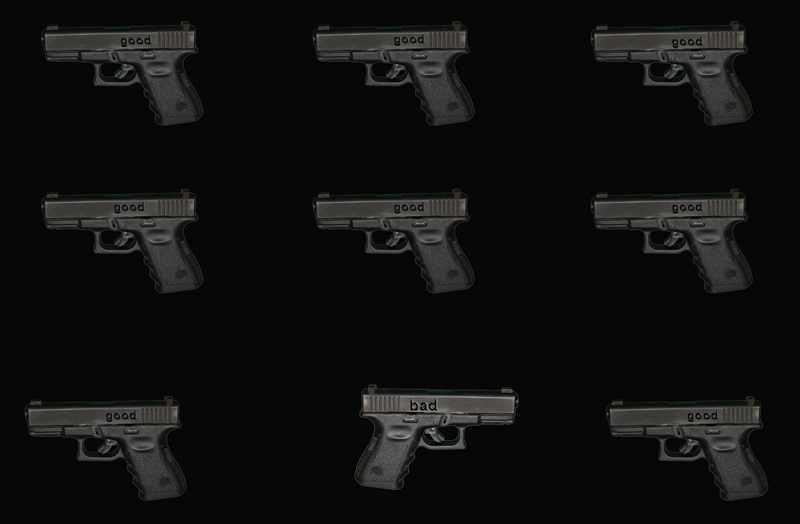
Good Gun Bad Gun

Is the need for people to be secure not undermined by their right to buy guns?

It is happening again. Another unhinged slaying of innocents. Another school, another young man unleashing a shocking expression of hate and anger. A scarily familiar news story emerging in its horrible details that resolve from vague guesses to real names and a score of small coffins. It is another addition to an ever-growing list of public shootings that result from the personal issues of a tiny minority.

In Sandy Hook Elementary School, Newtown, Connecticut, things will never be the same. Like Columbine, like Virginia Tech, like Aurora. As a foreigner the place-names are learned through their tragedies. Why does “school shootings in the US” have its own Wikipedia page?” ((http://en.wikipedia.org/wiki/School_shootings_in_the_United_States))

Coming from a country (Ireland) where the police rarely carry guns and where the scars of past violence help sustain a peace from ‘troubles’ (the Omagh bombing in 2008 killed 29 people, and was the worst single atrocity of the decades of turmoil((https://en.wikipedia.org/wiki/Omagh_bombing))), the regularity of public shootings in the US is shocking. These men, real people like any of us, in their moments of crisis, responding to bullying or some internal breakdown, their anger swelling out, knowing no innocence, can reach out with little effort and fill their hands with guns, their minds with precedent, their Internet history with gung-ho videos about guns and gunning. And after each event the society is cocked and primed for the next. So many triggers; so many fingers.

A well regulated militia being necessary to the security of a free state, the right of the people to keep and bear arms shall not be infringed

(US Constitution, 2nd Amendment) ((http://en.wikipedia.org/wiki/Second_Amendment_to_the_United_States_Constitution))

To those who own or use guns, there are arguments of security, and arguments of rights. Are you more secure with a loaded weapon permanently to hand? In the few moments in life where you might ever feel the need and justification to point a weapon at someone, does having it actually improve your chances of surviving? On a battlefield or video game, sure. In a ‘domestic disturbance’ or a robbery, or in your kids’ school? Raising a gun dramatically increases the odds of you being shot. Having access to guns means having other people access guns. After the shooting in Aurora earlier this year there was a surge in gun purchases in the area ((http://www.bbc.com/news/world-us-canada-18980974)). In parts of Texas teachers can be armed, as can students in some Universities (concealed no less). It sounds more like the wild west than a modern state with a secure society. Yet if your neighbour were robbed at gunpoint, it would be hard not to feel the need for a personal gun, unless you could guarantee that others had none.

In Killing Them Softly, a 2012 film where failed and failing criminals engage in an unromantic battle under the backdrop of the 2008 presidential election, Brad Pitt’s character sums up his attitude at the end of the film:

This guy wants to tell me we’re living in a community? Don’t make me laugh! I’m living in America, and in America you’re on your own. America’s not a country, it’s just a business… now fucking pay me! (Killing Them Softly, 2012)

If you’re on your own, then you don’t just have a right to defend yourself, you have a need to. Again, it sounds like a lawless state of affairs. Killing Me Softly has a setting far removed from an Elementary school in Connecticut, but the price of the theoretical right to defend yourself includes the cost of others being able to express themselves in bullets and blood. Would you not defend yourself and your children more by taking guns out of reach of those who may one day use them maliciously?

This guarded right to carry arms is a core part of the national identity and concept of free individuals. It’s enshrinement in the constitution guarantees huge commotion when questioned. Is it related to the ideas of liberty, that it is acceptable to do something as long as it is not causing others to suffer? Do a breed of Libertarian principles push the perspective of society into the that of an isolated individual: a cowboy riding solo with only wits and a six-shooter between freedom and death? Or is it as a bastion of a personal freedom, constantly infringed by big government? Given that every gun has its inherent deadly potential, and given that fighting for the right to bear one is also fighting for the right for unstable individuals to obtain them, how wise is it to regard this right as something that cannot be sacrificed for the sake of a safer society?

Congress shall make no law respecting an establishment of religion, or prohibiting the free exercise thereof; or abridging the freedom of speech, or of the press; or the right of the people peaceably to assemble, and to petition the Government for a redress of grievances.

(US Constitution, 1st Amendment) ((http://en.wikipedia.org/wiki/First_Amendment_to_the_United_States_Constitution))

The right to bear arms, the second amendment, is surely not built from the same stuff as the first. They are not built from the same foundations or aspirations. The right to free speech protects and encourages in any society and will always be a goal: diversity is healthy; necessary. Guns kill people. They are life-ending objects, much more than sticks and stones. It’s not that names can never hurt, but although some things are hard to listen to you don’t have to agree. The brutal argument of a bullet cannot be questioned. Having an armed population prepared to defend their right to defend their right with an anti-society device is hardly something to aspire to. It is not a goal.

Times change, societies change, and how a person act always needs to consider this. It is no longer 1791. The right to own and the decision to buy guns has powerful externalities: the ability of those who are consumed by intentions of harm and separated from the world by alienation and anger and a sense of injustice, to arm themselves and aim. In a dense interconnected world where we are always in a public domain, we have to have some trust in the social system. When we get on an airplane or in a taxi we have to assume that the pilot/driver is not drunk or high. We have no choice but to have faith in strangers, trust in others, while accepting the destructive potential of human nature. Our money is a number on a computer, our economies are constructs of confidence. Yet modern identity is based on knowing your own mind, making your own choices, and acting as an individual. These are not shopping cart choices though; these are the choices we make about how society works. And when the result of these choices is a situation where gruesome scenarios and public killings repeat themselves, new choices need to be made.

Modern society has countless rules that accept the potential failure of individuals. If everyone was an ideal human then there would be little need for law. What fully rational, empathetic socialized person would, for example drive recklessly on a public road? Every group of people has to balance the individual island with the social whole, balance rights with duties, and safeguard where possible against the threat of violence or corruption. If the system has too much power/responsibility there is no freedom. If the individual has too much there is a danger of chaos. In computer science it is commonly said that a very secure system is unusable, while a very usable system is insecure. There is a trade off between what users can do and how safe they are. There is a trade off between individual freedom and social stability. Where would we be without society?

And the life of man, solitary, poore, nasty, brutish, and short (Thomas Hobbes)

There are those that will be waiting for the powerful gun lobby to raise its vested voice loud above the affected and angry. Default behaviour of apathy and the reluctance to take on a well oiled set of arguments deployed by well positioned arguers and with the backing of a profitable business facilitate the next public shooting. It has happened too many times to allow everything to carry on as before.

Guns don’t kill people. People kill people.

This snappy return is fallacious. It relies on the flexibility of the verb ‘to kill’, which sometimes implies an intentional agent/subject ( a killer), and sometimes an indiscriminate cause of death. The ambiguous implication can be removed by rephrasing: Guns don’t intend to kill people (1), or ‘People are not killed by guns’ (2). Of course, only one of these is true. Of course people are killed by guns. The original argument implies that the only important factor is the intent to kill- that there is a murderous actor, which of course has to be a person. Switch ‘gun’ with ‘bomb’, a more indirect killing device, and it makes no sense any more; ‘Bombs don’t kill people. People kill people.’ ‘Drugs don’t kill people. People kill people’. This is not an argument at all, it is simply stating that guns do not intend or purposefully kill people, just like cars, or drugs or bombs. it tells us that if we are killed by a gun, that gun must be fired by a killer. Does this mean we should not notice or consider how or why the gun is in the picture? Should we simply look past it to the mind behind the finger on the trigger? The responsibility of not killing you is resting on the twitch of an enraged finger.

Go out onto the street, flag down a car, preferably driven by a tough-looking young man. Jump on the hood, kick the windscreen, insult the driver, his mother, car, children, religion, race, beliefs, job, and anything else you can identify. When you are sure he is utterly incensed, offended and enraged, hand him a loaded gun with the safety off. Has the situation changed? Has introducing a gun into this moment of rage raised the bar? Have your chances of waking away unscathed remained the same? Are you safe because the gun will not fire itself with its own subjective purpose? There is only the slightest squeeze of a finger between you and your death. No argument or situation is the same when participants are armed and guns are pointed. Introducing guns escalates the issue to a life/death situation with only the slightest of movement.

Some polar opposer of the gun lobby will likewise vent from a biased position (though probably one with less influence), and decry the whole apparatus of American society. Here, a country steeped in war and a history of warmongering, too heavily invested in the production of war machines for profit to be interested in negating the promotion of gun ownership. Points that need to be made, but it is important that this does not become a battle of extremes where the central majority ends up doing nothing. Lots of countries produce and sell guns, and no society is perfect. Many markets and products are loaded with incentives to not use them. Consider that in Australia cigarette packets are now completely de-branded, while in other countries they are splattered with abrupt messages along the lines of ‘you will die if you smoke these’. On top of that we have the laws and social norms that allow life to function in the first place, from road signs to bank regulations. When they fail, they must be addressed and altered.

Does the US have a history or principle or special status that make it different enough to warrant more liberal gun laws? Coming from a country that has been wracked repeatedly by invasion, oppression, partition, civil war, and modern terrorism, it is hard to imagine. What country carries no history of shots fired, blood shed? As for unique rights; the whole notion of a modern democracy involves that of personal freedom. Yet anarchy is not endorsed, as it is generally acknowledged that there are those that will not act in their own best interest if given the chance. That is why drugs are illegal and alcohol restricted by age. Levels of restriction should be based on the levels of danger. Is it not strange that liberal gun laws are associated with conservatism?. The dual nature of a gun as defender and aggressor is divisive. When we are all armed we are in danger of separating everyone, from neighbours to nations, into aggressors and defenders. I have a brother who is a policeman, and he rarely carries a gun. I don’t take pride in many aspects of Ireland but I take a certain pride in that. Surely this should be the goal?

Some defenders of the right to be armed argue that more guns are required, not less; that the teachers should all be armed, that the students should be taken and trained in the use of automatic rifles in case they might have to save their friends with an act of heroism in a firefight. Here is the wild west dream again, alive and kicking. Flood the country with more and more guns, and rely on the judgement and aim of strangers to save the day when the calm is upset by a crazed killer (or an annoying driver breaking the lights). Can you really feel safe when every person you meet is four seconds or less away from moving their hands to their pocket, raising them, and squeezing a finger? This power requires responsibility: you must now rely on every person you meet every day of your life to be responsible, reasonable, and in control of their emotions and behaviour.

All that is necessary for the triumph of evil is that good men do nothing. (Edmund Burke)

It is near impossible to make a black and white distinction between ‘good’ and ‘evil’ people in order to discriminate between them when it comes to gun control. Immediately we have to rephrase the targets to ‘probably good’ and ‘potentially capable of evil acts’. And it gets muddier: most of the savage killers have been young men with issues, perhaps quiet or aloof, distant and withdrawn, perhaps bullied or shunned. How many kids are aloof or bullied or shunned or distant? Surely a few in every class, and many in every school? Will identifying and targeting their isolation then restricting their behaviours serve any positive purpose? Would it not be better to aim to reduce their isolation and try to create conditions whereby an act of murderous intent would be hard to implement? Would simple paperwork and clear regulations not cut through the fantasies that burden those who may not have the wherewithall to discard angry thoughts of destruction.

In any case, time spent searching for errant individuals to monitor and control while at the same time promoting certain individual freedoms are at odds with each other. Surely it should be vital to make it very difficult for anyone, regardless of character or history to carry out these horrendous acts in the first place. It is obviously not enough to rely on moral character. It is impossible to identify potential suspects. Why isn’t there a trail of disincentives and obstacles to owning and using weapons specifically designed to kill?

It is deeply upsetting and profoundly unsettling to be continually faced with episodes of slaughter that could have been prevented. It is not possible to prevent all of them or remove their possibility completely, but changes have to made, and questions asked again and again.

Insanity is doing the same thing over and over again but expecting different results

History, psychology, science, anthropology, and simple people-watching all teach us that humans are fragile complex beings with a nature both social and selfish, docile and dangerous, caring and yet capable of irrational madness. In the tumult of debate and emotion, the desire to stem these events has to involve clear thinking and focus from all sides. Bias should be exposed, ‘rights’ should be questioned, and the core values of a ‘society’ held up in the spirit of amendment 1 to see the weakness of amendment 2. In nay case, if it was perfect first time round, it wouldn’t have been amended at all.

In a quiet town in Connecticut small coffins will be buried along with the hope and ideals of those affected. Parents, friends, brothers, sisters, teachers and students. Things will never be the same again here. But if no actions are taken, things will be the same again somewhere else. And again and again.