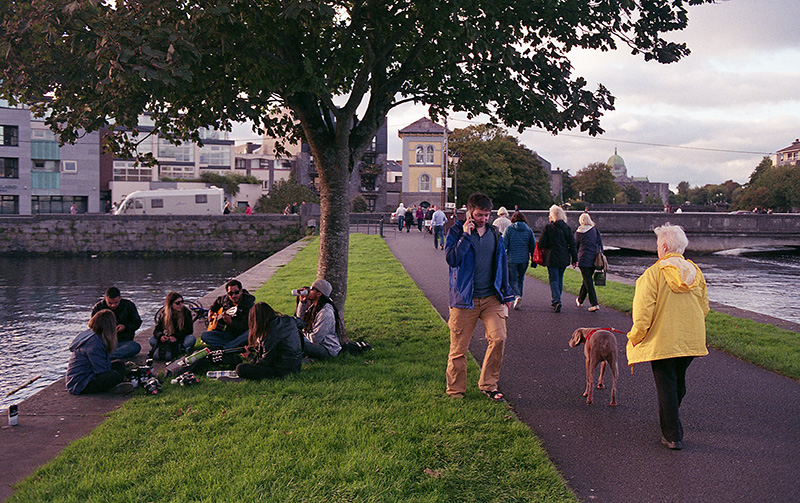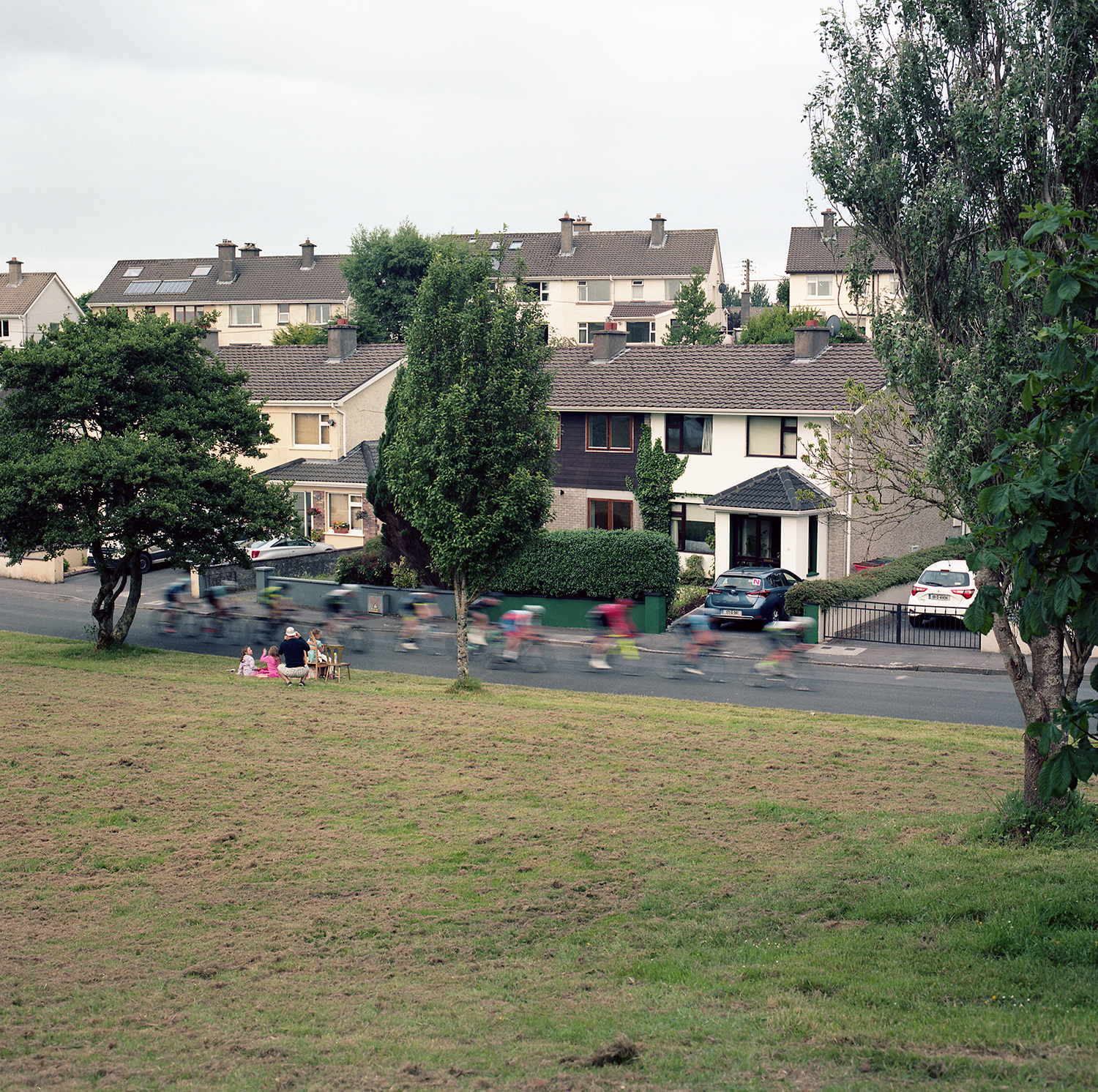
Galway Bay Cycling CLub (GBCC) Criterium racing, Highfield Park, Galway City, Saturday evening, June 9th, 2018.
Dry warm June. Tight clockwise circuit buried in one of Galway’s west side housing estates. Five right handers, two left handers, 2 speed bumps, one drag up, one drag down. Assorted bales of hay.
All images Donal Kelly 2018. Cameras/film: Hasselblad 501C with 80mm lens, on Rollei Retro 80S and Portra 160. Olympus Mju-II compact (35mm lens) on Ilford XP2 and Rollei Superpan 200.
The Dark Half. If you were to cut a year down the middle, right through the belly, it would make sense (in the northern hemisphere at least), to choose the time of Halloween.
This is when Daylight Savings Time is cut from the clocks and autumn cedes to winter. It’s a transition from light to dark, from long summer days to long winter nights. Yadda yadda yadda.
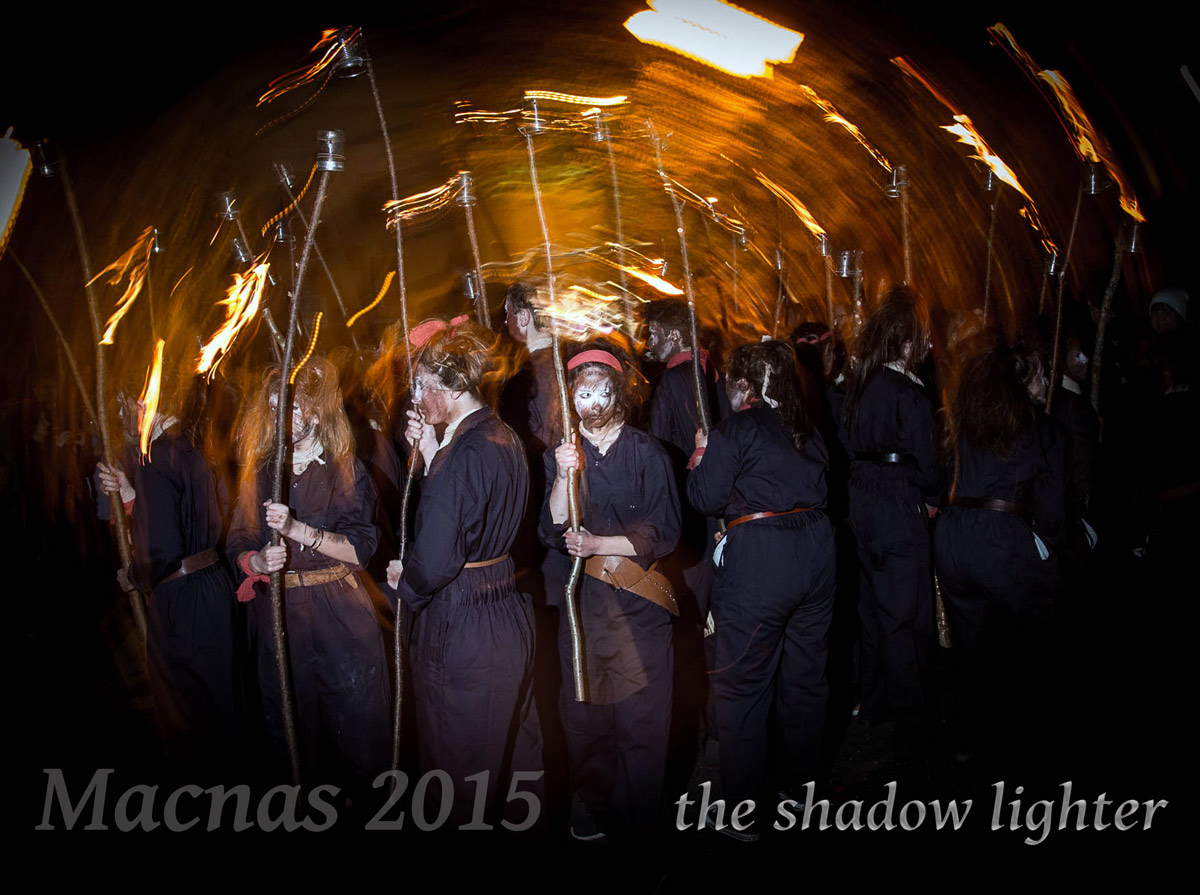
On the edge of things, comfort and definitions are tested. Hallow’s Eve was a point when the souls of the dead were able to mingle with the living. To confuse them, we, the living, put on masks of them, the dead, and danced a hooley. We marked an indistinct edge between light and dark, life and death, growth and decay, here and not here.
This is where Macnas aims to tread, on the edges, crafting primal energy into a fling with moderated chaos.
Leaves still cling on for dear colour in the university trees. The whole parade is lined up outside the quad and doing its final prep. This is probably the first time it has assembled in full, costumed, made-up, skipping with wait, ready to roll.
It can’t go overboard. It can’t become the objects of menace that it hints at. But it can resonate with and fill the spirit, and throw a bone to the pagan within.
I’m not sure about being there. I’m an imposter, a parasite, a camera-appended outsider, an invasive specimen.
If you’re in traffic, you are traffic.
If my view is blocked by a photographer’s head, then I’m blocking someone too. I can’t be invisible. To measure, interferes, and to record, is never truly unintrusive. We change when watched. Yet here I have a DSLR and a bag of lenses and here I join more reputable media and here I try to not be there but be there all the same. I’m not sure what I’m trying to get exactly. Just going from one shot to the next, clickity click, aperture down, ISO up, and wishing I could absorb and become the energy.
I sometimes think that in these situations empathy becomes a communal wave, and the social animals within align. Do we need to commune with a spiritual herd, every once in while?
But crowds are tough, and 40,000 is a lot of bodies to cram along narrow Galway streets. So many faces, so many reactions, and all so unique and aware and real. Imagine how the parts of your brain that work on face recognition are right now, zooming from figure to figure in the dark. It can’t keep up; it dissolves and quits. Someone yells at me and it takes me three or four goes to see Morgan there with his family.
Contorted-but-elegant masks. Bangs and belts, thumps, and rumbles. Music and singing and voices over the din. Clapping and roaring.
The crowd must become ones, must interact, react. The audience is part of the show. Et unum pluribus.
Some fill in the blanks with imagination and find fear- yelp and roar.
“Wooooooahh!”
“Aaaaagh!”
“It’s an allllliieeeen!”
Others push out from inside a comfort zone, grimace and grin back, assured that they are solid and correct.
“You’re not scary!”
“Raaaaaaar!”
Some have lost it altogether or never arrived.
“I wanna go hommmmmmmme!”
Tweenage girls notice looks and costumes
“Oh my God she’s so pretty!”
Excited parents ride on the innocent connections of their children.
“Look at the ship Annie! Look at the big dog!”
And then there is the mediation. The extensions. These are our holy digital devices, which we layer between our senses and the world, like necessary appendages. Maybe they form another enormous inter-connected social brain where we extend our empathy. Or not. We haven’t figured it out yet. Too new. Our digital appendages greet us when we wake and lull us to our sleep. We manage our own parade on the edge of being there and not being there. Life, mediated.
What is the most THERE you can be? I mean, in the world. I’m trying my best. Engaging the senses. Using my camera to stare, and hopping along between a group shaking sheets of wobbling loud metal, and a beautiful singing lady with a silver ship for a hat and her own trailing lighthouse. A woman with a smoke-making device keeps pace, and every few dozen metres fires it off. Such a smell! My left eye is still seeing green squares from when I stupidly fired the flash into it at point blank range earlier. I guess now I’ll find out if it really does damage the retina. And all the time I feel I shouldn’t be there, and should be grabbed and flung out. Am I in the moment? Clickity click. Shutter speed too slow, ISO too high, Av, manual, back to Av, autofocus just not on point at f1.8. Where am I?
I shouldn’t be there, in the body of the parade, but once I make the transition from the preparations to the streets, which seems to happen with no border (was I expecting a starting pistol?), it seems like there’s no way out. There isn’t a single chink in the buzzing wall of people from NUIG all the way through town to the Claddagh. Left across the Salmon Weir bridge, right onto Eglinton, right onto Shop Street, down the cobbles to Mainguard, across Cross into Quay, on over the Wolfe Tone bridge, and left off Fr. Griffen to the Claddagh.
The entire city seems to be wearing a costume and has transformed, and stepped into a gap (mind the gap, mind the gap) between by-the-book routine and what-the-hell chaos. It’s a touch Mad Max, with more dancing and less Rocky Horror, with uproarious noise and balls of fire and smoke and masked dancers. There is a beauty, and a grace, bulbous contortions, sudden leaps, intense pauses and frantic swivels.
And then, it ends, like it began, with no distinct finish line or checkered flag, only a gradual breaking up. I’m frazzled as hell and have filled a 32Gb memory card and am a bit drunk on being-there. Still feeling guilty, too. Still wishing I had a lanyard and a title and a tag to give me a bulwark against the idea of me-as-parasite, showing up, tagging along, soaking it in, adding nothing. I assume my pictures will be mediocre.
And I’m thinking about the way we put devices between ourselves and the world or if the devices are just more of the world. I’m wondering if we can fully immerse or if we could ever fully immerse or if the noise is just noise and we need to remember that we can tune out and see that the country is richer than it ever ever was. That the sense of foreboding is itself an indulgence. I’m somewhere on an edge under a squadron of diving thoughts. Feckers. One of them is that all witnessed things need to be given space, and put on a pendulum not a pedestal, not held up as pure, atomic, definitive episodes, only nudges to a scales. Hyperbole. Hyperbore.
The water in the Claddagh quay is calm and still. The roads are back open to cars again. The city has dropped the costume into the River Corrib or the Atlantic (where does one end and the other begin?). Buskers return to the streets. It’s still not raining, but grows cool then cold. 40,00 people need to be fed. It is a full-house Bank Holiday Sunday night.
We have gone to an edge, signposted, planned, and policed, and now return back to the safe routines. But we will go edgewards again, one way or another.
Is it here yet? We are plugged into radio, tv, boards.ie, facebook, twitter. RED warning. refresh, refresh, refresh. Cork’s getting a hammering. 169 km/h way down at Fastnet Rock. Waterford. Tipperary. The eye is tracking up the west coast. Is this it? Now?
Lough Corrib is churning. It’s raining full pelt. Up in the high bogs the clean new cloud-scraping windmills continue to turn. Water whips from the blades. Trees bicker and bend. Bend and bicker. but they do not fall. Midday and then beyond. The skydome rotates; gales suddenly flip from South East to South West. That means the centre has moved north?
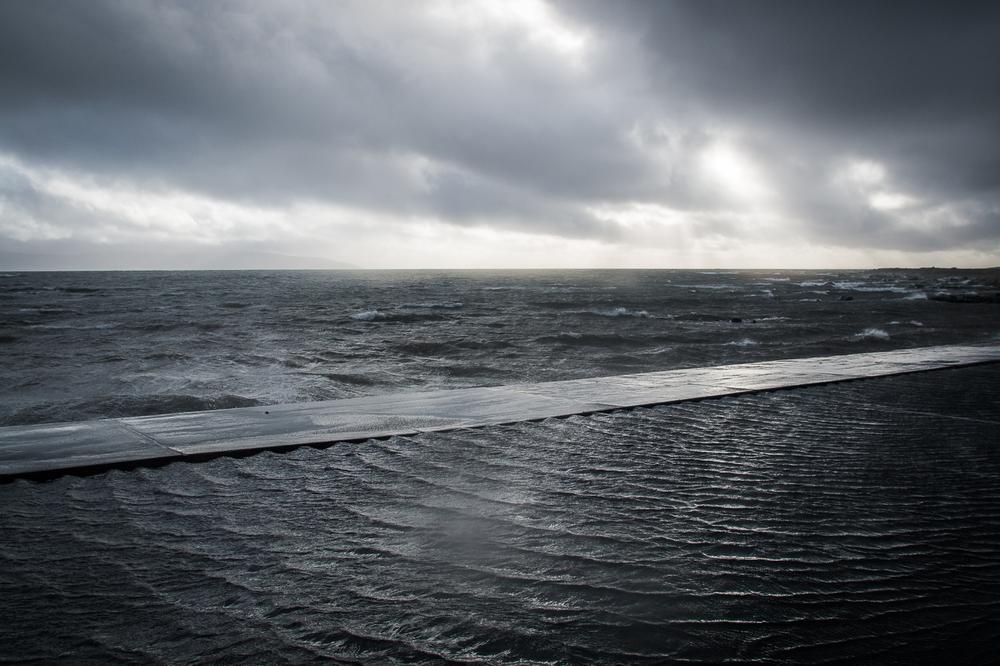
So, have we escaped the worst? The trees flail but don’t fall; rattle but don’t collapse. Safe enough to venture out? Out to the coast. The sea is amok amach, and high tide has already passed. Rossaveal, Inverin, Spiddal, Barna, Salthill. Seaweed strewn.
Thousands of dead worms near the prom. The car park has been flooded again. Giddy teenagers kick balls, soak each other, bounce, record. Everyone is recording, on phones and cameras. Me too, me too. Updates, updates, updates. Is it done?
It has been moving north. Darkness falls. Seems windier in the dark. News again. Three people dead up the country, where trees did buckle and split and crack and fall. The real deal. Three hundred thousand homes without power. Thirty-five Lime trees knocked in Centre Park road in Cork. Would we complain if nobody are hurt? Why are we so angry at those who went swimming, surfing?
All images and text copyright Donal Kelly. Don’t use without permission.
I’ve just left Temple Cafe in the Corn Store, and their grilled chicken sandwich on sourdough bread. Two old ladies, walking slowly in conversation along St Augustine Street. A man on the opposite side of the street, going the other way. The building next to the library is in the process of being torn down. Is that where the dole office was? You can see through a hole in the wall where inside the ceiling has crumbled down in angles of downed beams. It looks like something exploded in there.
Old lady 1: “What’s going on there?”
Old man across street: “Ha? Apartments, they’re building a load of apartments.”
Old lady 1: “Ah, they’re for them.”
Old Lady 2: “Who are they for?”
Old lady 1: “For them, the Syrians. They’re for them. For them. They won’t do anything for our own.”
I turn left up Buttermilk Walk. I can hear her swearing. The F word. Was that the C word? She repeats it again, “They’re for them!”
A man is daysleep or thickdrunk or drugstrungout in a doorway across from The Augustinian church. St Augustine of Hippo, patron saint of brewers. It’s a long way from Hippo. Where is Hippo anyway? Oh, Algeria, and now called Annaba. The old ladies do not seem to notice him.
“I dreamed I saw St. Augustine
Alive as you or me
Tearing through these quarters
In the utmost misery
With a blanket underneath his arm
And a coat of solid gold
Searching for the very souls
Whom already have been sold”
Why do we so easily generalise a mass of people into a simple attribute or feeling? Who are ‘them‘? Why would you think apartments are being built for ‘them‘? I can sense maybe a rising of simple spite in her, inelegant but vigorous, easily tempted into growth, easy on the tonguetip, satisfactory to the radar of agency and the foil of blame.
-- Old Lady 1 system log 2137892472.log
-- THREAT IDENTIFIED: IMPENDING. APPROACHING. ASSUME DEFENSIVE MODE.
-- log signal id #43574, type a, description "change detected"
-- log signal id #43575, type c, description "building being knocked"
-- log inference id #43576, type m, description "they're for them", sub-inference general theorum "Foreigners want to come here and take over", sub-inference trigger memories, array[], description "memories of headlines about terrorist attacks, refugees crowded like massedrodents in an old boat in a sea somewhere, refugees chanting in a crowd, funny clothed crowds in cities with white and strange sounds."
US and THEM and how groups you don’t identity with get judged as one giant TYPEthing
Consider a habitual driver of 1000kg+ mostly metal fossil fuel driven vehicle, used for commuting, male.
Toyota ad: “Think you can’t afford a new car?” yes of course I can’t afford a “Think again” THINK think THINK think
Case 1: The driver+car are stuck waiting for pedestrian lights to change. A cyclist rides by up the inside and direcly through the lights, not a care in the world, looking neither left nor right. The driver+car thinks… “Sonofabitch! Cyclists are idiots. Who do they think they are? Do the laws not apply to them at all?”
Case 2: Same driver+car, at the next junction. Another driver+car swings out from a side road in front, blocking his way. “Sonofabitch! That’s my lane- you cut me off jerk! Idiot! Why do you think you can just drive right out like that?”
In case 1 the driver+car is generalizing from an incident to all cyclists, as a group, mass noun, balamable object of agency, atomic and unjust. Cyclists (in this fabricated example) are them. In case 2, the driver sees the other driver as a specific idiot, a human-who-happens-to-be-a-driver doing idiot unfair driving stuff.
NOT SAFE TO DRIVE
The Astra is back in the garage, struggling to get through the annual NCT challenge again. Sixteen years old now. Last year it failed on headlight alignment, twice. Money money money. The engine keeps going though, in its oilburning way, with the warning light flashing and the wipers stopping midway after each stroke. Right now it only needs some brake hose on one side but when the mechanic calls things have deteriorated. “I can’t let you take it out. Wouldn’t be safe.” The brake pads are a sliver’s liver wide and he can’t figure how they didn’t spot it in the Text centre. A money racket, he reckons. You might pass and break down on the way home.
Think you can’t afford a new car? No I can’t afford a new fucking car Toyota, give me a fucking break. Not an ad break. A break from ad breaks.
And What We Read Without The Brave New Trumpeting World?
Here it comes, there it goes. The Christmas break, with its long buildup and heavily marketed stature, has already left the building before it seemed to even arrive.
The rains barely paused for breath, though the good winds provided enough breath for all. Under the twinklings of dangling lights blowing in the breezing rain, ’tis the season’ bells barely tinkled before being bundled back into boxes until the next rendition.
We had the lights barely untangled. Plans to untangle the spent year in my brain and my brain to untangle for the year to come fogged up like a stubborn windscreen. Through that foggy glass things seemed no clearer than before. Clarity maybe comes from commitment to some version of events or other.
2015 might be the year of obsessive notification-checking, or the year of film photography, or a year of solidifying yesterness, or less or more of all these things if considering.
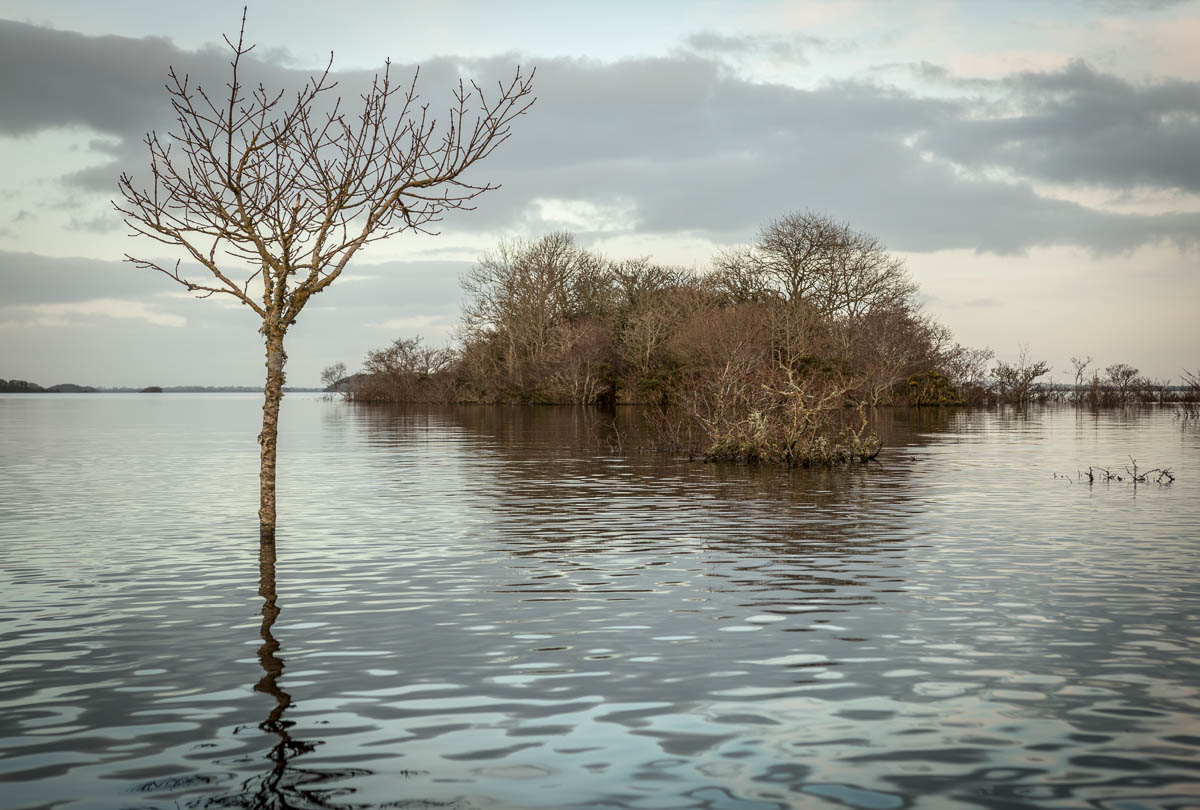
The water levels have broken records, with the shoreline exploring new curves along many a distant acre of field and shrub.
Indoors, in the bubble of days with names, family, television, turkey, and people in every room, time just whips away the last week of the year.
On the only calm clear day I was free, I took a borrowed Kayak to the high waters of the Corrib, with nary another floating human in sight, and rowed two blisters worth from Baurisheen to the head of the Owenriff and up past the boathouse and under the bridge at Eighterard and eventually all the way home in the darkening.
It is a world of
birds disturbed,
hulls upturned,
limbs of leafless tress sketched into the face of the river
To get under the bridge I had to fling myself forward then let my back fall flat onto the kayak hull, and still the bottom of the bridge concrete almost touched my nose. I failed the first time and wondered how safe the idea was with such a rush of water and nobody around and three grand of water-speckled camera gear between my knees, but I tried again.
It is a world of
current and flow,
never the same when you come back,
even if you never go.
In any case, not far after I got tired of battling the strengthening current that tore down in the narrower sections, and I flipped the little plastic boat around. Now it tears back down on the swell.
It’s a little bit of dark, a little bit of chaos, a lot of imagination, and a stick to shake at the arriving winter. Dwell in the dark, take refuge in the symbols, there is energy and density in the bulbous, the twisted, the animal, and the shadow.
The first set of black and white photos were taken with a Canon AE-1 program with a 50mm f1.4 FD lens on Ilford FP5 Plus ISO400 film, developed with Rodinal (8 mins, 25:1) and scanned on an Epson flatbed.
The second set were taken with a Canon 70d, Sigma 18-35mm f1.8 lens, mostly at ISO 800, some at ISO1600. A 430 EX II flash was used via Yongno ETTL wireless triggers.
All pictures by Donal Kelly. Do not copy or use without my permission: they take a lot of time and energy, yet I don't like how watermarking or tiny images are simple crap to look at.
W.B. Yeats visited a public school in Waterford in 1926, and there, as an ageing man among the young children, his mind wanders, first to Maud Gonne, to youth, and in an unexpected way, to something universal and beautiful: Among School Children
How can we know the dancer from the dance?
The poem is an incredible journey from the bustling school room to pithy metaphors of being. The words need to be read and heard, as they flow with such energy and ability.
My effort does little justice, but it is a poem that should be heard.
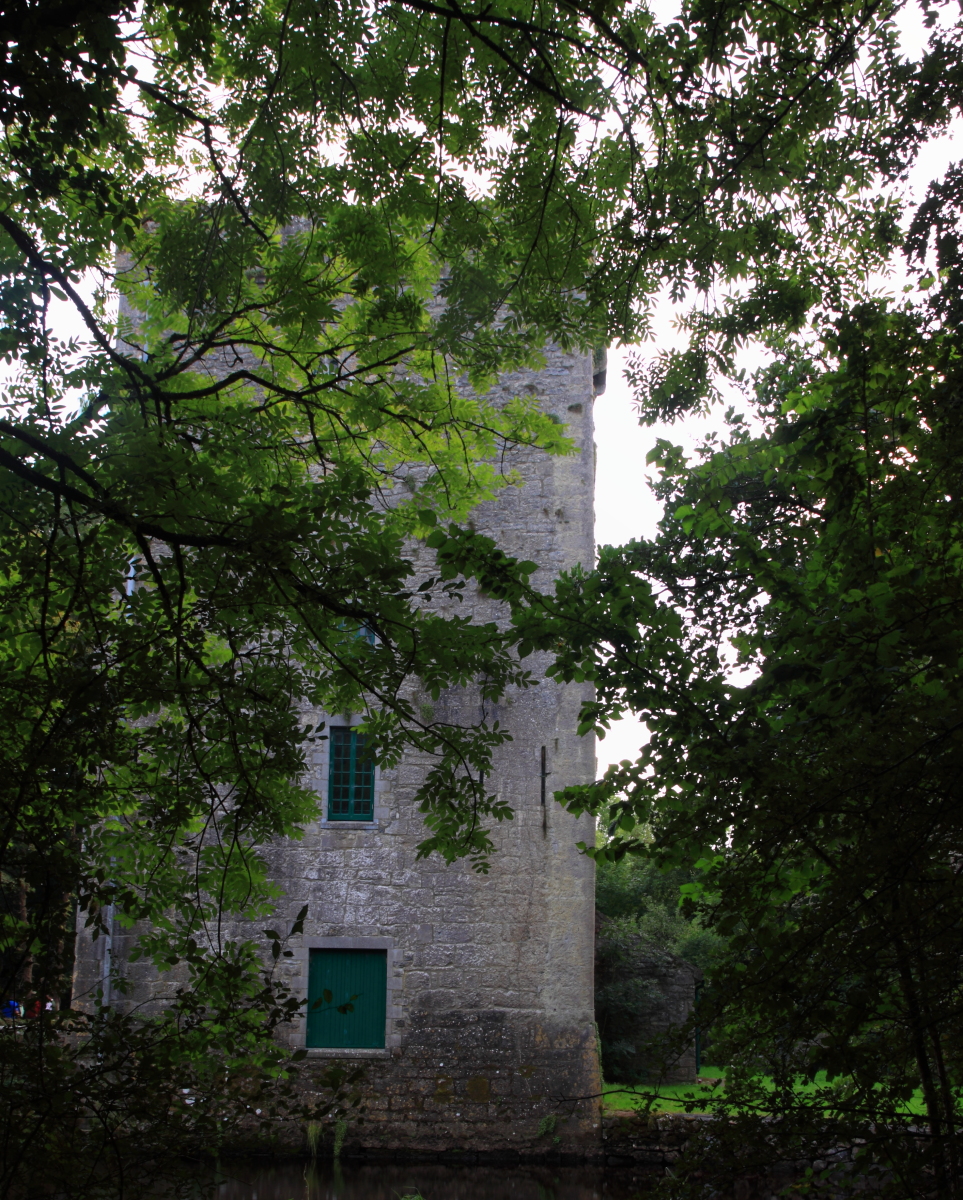
The poem comes from the Tower, published in 1928, and named after Thoor Ballylee, in Gort, Co. Galway, which Yeats owned from 1916/17 to 1929.
Audio W.B. Yeats bought it for £35 in 1916 or 1917
Words Inscription in the Tower wall by W.B. Yeats.
I
I walk through the long schoolroom questioning;
A kind old nun in a white hood replies;
The children learn to cipher and to sing,
To study reading-books and histories,
To cut and sew, be neat in everything
In the best modern way — the children’s eyes
In momentary wonder stare upon
A sixty-year-old smiling public man.
II
I dream of a Ledaean body, bent
Above a sinking fire, a tale that she
Told of a harsh reproof, or trivial event
That changed some childish day to tragedy —
Told, and it seemed that our two natures blent
Into a sphere from youthful sympathy,
Or else, to alter Plato’s parable,
Into the yolk and white of the one shell.
III
And thinking of that fit of grief or rage
I look upon one child or t’other there
And wonder if she stood so at that age —
For even daughters of the swan can share
Something of every paddler’s heritage —
And had that colour upon cheek or hair,
And thereupon my heart is driven wild:
She stands before me as a living child.
IV
Her present image floats into the mind —
Did Quattrocento finger fashion it
Hollow of cheek as though it drank the wind
And took a mess of shadows for its meat?
And I though never of Ledaean kind
Had pretty plumage once — enough of that,
Better to smile on all that smile, and show
There is a comfortable kind of old scarecrow.
V
What youthful mother, a shape upon her lap
Honey of generation had betrayed,
And that must sleep, shriek, struggle to escape
As recollection or the drug decide,
Would think her Son, did she but see that shape
With sixty or more winters on its head,
A compensation for the pang of his birth,
Or the uncertainty of his setting forth?
VI
Plato thought nature but a spume that plays
Upon a ghostly paradigm of things;
Solider Aristotle played the taws
Upon the bottom of a king of kings;
World-famous golden-thighed Pythagoras
Fingered upon a fiddle-stick or strings
What a star sang and careless Muses heard:
Old clothes upon old sticks to scare a bird.
VII
Both nuns and mothers worship images,
But those the candles light are not as those
That animate a mother’s reveries,
But keep a marble or a bronze repose.
And yet they too break hearts — O presences
That passion, piety or affection knows,
And that all heavenly glory symbolise —
O self-born mockers of man’s enterprise;
VIII
Labour is blossoming or dancing where
The body is not bruised to pleasure soul.
Nor beauty born out of its own despair,
Nor blear-eyed wisdom out of midnight oil.
O chestnut-tree, great-rooted blossomer,
Are you the leaf, the blossom or the bole?
O body swayed to music, O brightening glance,
How can we know the dancer from the dance?
The Castle was built in the 15th or 16th centuryLocal youths playing with a hurley by the tower during ‘culture night’ in 2013
Symphony for the Restless: Let the Night in, let the night out
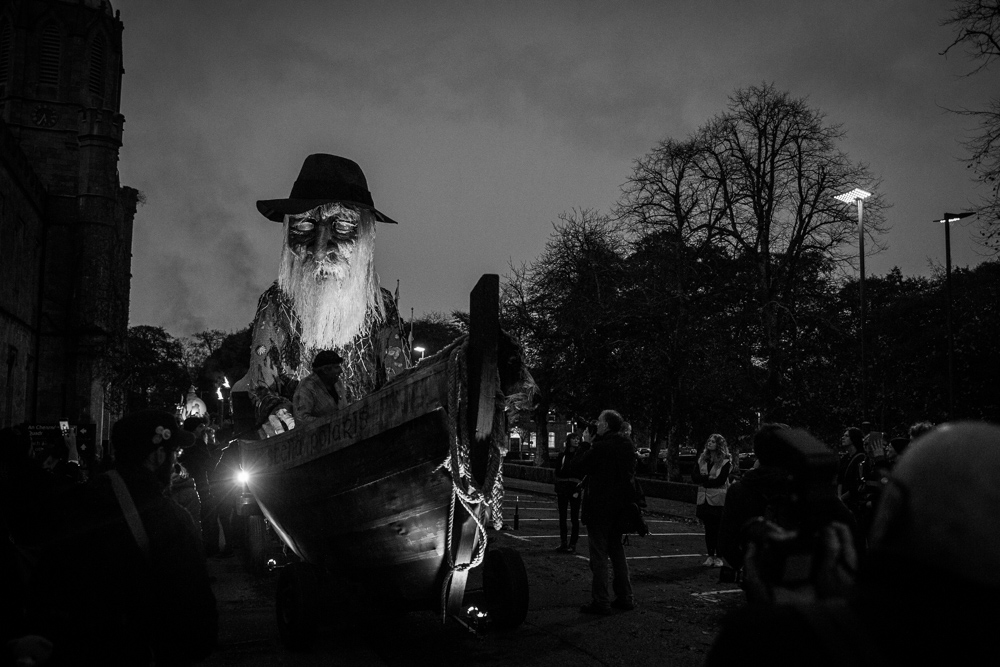
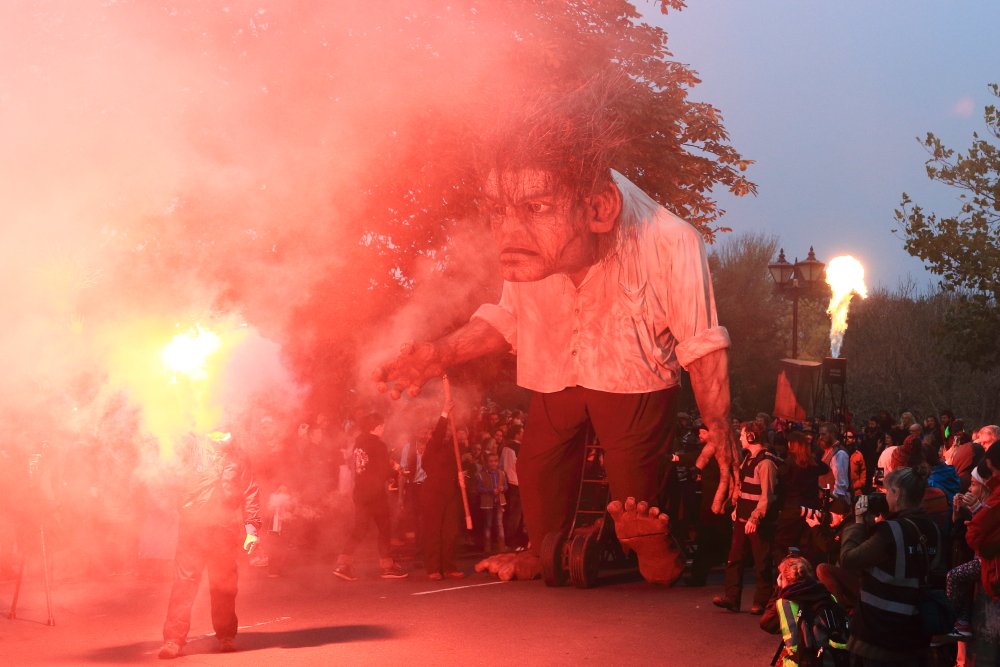
It moves slowly, eerily, growing from a small blob to the right of the cathedral, into a more distinct giant head as it crosses the Salmon Weir bridge. With hollering and boom, behind the brassy siren of a high-perched saxophone, under a darkening gull and crow wheeled sky, comes a troll with a head as big as a house, and it’s slowly scrolling eyes peering at those who have gathered to watch.
Macnas have the streets now. The troll is on the ascent, ambling up Eglinton Street, turning right down Shop Street, then onto High street.
Onwards, onwards, yell he, we must be born before the sun has risen
Kids are waiting everywhere, waiting, impatient, then mesmerized as the manic energy sweeps by: fuel for a thousand nightmares; seeds for a thousand imaginations. It’s an edgy racket, leaping and lurching along in the darkening, a chaotic meandering of distorted faces, fumes and snap-spit-cracking bangers, fire and light, light and dark, dark and dance. Skulls, horns, hair woven from a thicket of worn branches.
The little city under a dark siege, a muscular madcap spree of invention, the Macnas spirit and inventory emptied onto the old roads. The troll abides, jaws opening and shutting wordlessly.
Rise, rise, elemental eyes
Open ye to the night, to the underside of the circle’s flight, to the bare bones buried there.
The darkening season in the week of Halloween, on the Western rain-pecked edge of Europe, is a fitting setting.
Hear it, the long night of winter rising!
It gets stuck somewhere down narrow Quay street, and darkness has settled in well before the first bellows emerge again from the buildings. There are not that many floats, but this is not a long green St Patrick’s Day parade in Spring. This is a primal gathering with helpings of sinister and hues of dark mystery, more original brothers Grimm than modern eareasy versions with the elemental stripped out.
Fear the dark. welcome the fear.
The long night where lies, them lurking traces of buried eyes
The parade heads of across the Wolfe Towne bridge to its end on Fr. Griffin Road. The crowds begin to disperse into the night, a wave dissipating inside into cars and buildings. Normality begins to seep back in. The madness is buried. Until next time.
All photos and words by Donal Kelly. Do not use without permission. I used my Canon 70D with Sigma 18-35 1.8 and 430 exII flash in slave mode being triggered wirelessly by the pop-up. The changing light conditions were interesting; I tried to hold the flash far from the camera to avoid the on-camera flash look and maybe add some shadows. I stuck to Av and manual, and struggled a bit with focusing accuracy at f1.8. I used from ISO 400 to ISO 1600 as the light faded.
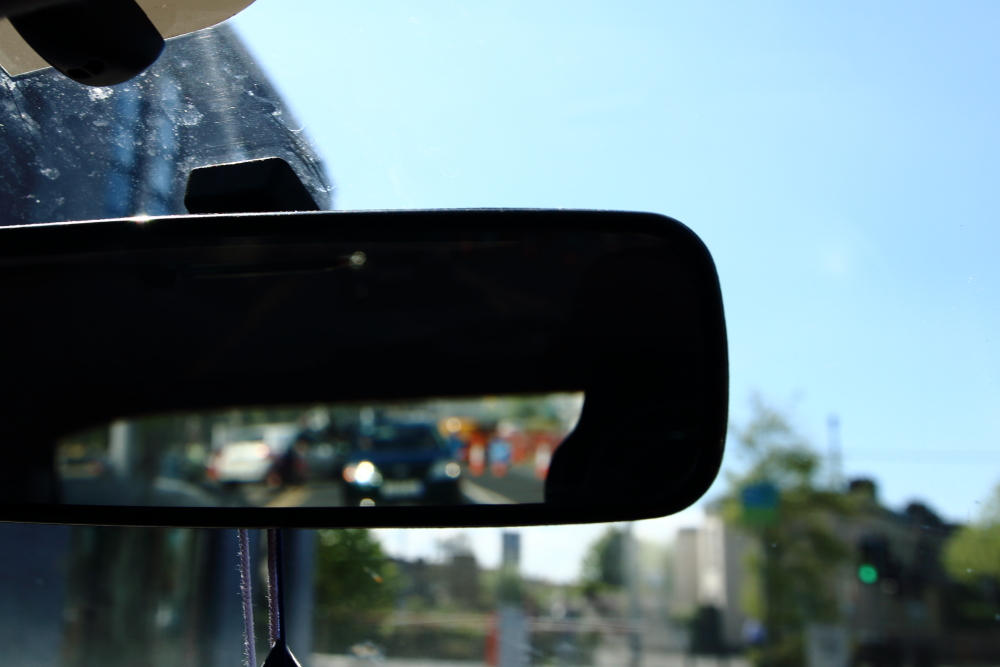
Wasn’t like the daydreams at all. They chased me up Taylor’s street and left down St. Kilda’s Avenue and over the grassy wall into Finny Park where the trees were just beginning to leaf and for a change nobody was walking a dog. I had my heavy work shoes on and had to drop my hipbanging Macbook-holding bag and it was too soon since I ate. In my daydream I would happen to have my sleek running shoes on and would toy with my pursuers, leading them on a merry urban dance, always a step ahead and in control through the winding streets. How could it be captured best? A helicopter view perhaps, a wide angle shot from above, tracking while zooming slowly as it overtakes me, panning, with me always in the frame, and rising thumping music to thicken the drama. Me, the narrow lanes, and the two dark demented chasers. But in the real-life here-and-now what-the-hell-is-happening pursuit I couldn’t quite catch my breath, and my gammy knee buckled in with every stride, and my jeans chafed, and when they caught me they hauled me to the ground and after a good breathless kicking dragged me back onto the street and into an arriving old green Nissan Primera that then sped off.
It wasn’t like the nightmares either. There was too much rushing detail and no time for foreboding and too many clear bouts of sudden pain as I took the punches and my head flapped back and forward. It was hot in the car and I was sandwiched between the two chasers. I tried to yell and managed to swear and shout out “what do you want?” but I was winded and my jaw felt like it had just been borrowed from someone else and I had to speak through a newly brokentoothed gap.
It was hard to tell the two apart. Brothers maybe, with red uneven faces and close eyes and short cropped hair. Left had an old scar over an eyebrow and more stubble. Right had a cotton shirt. Old? Hard to tell. They looked vaguely familiar. The twentysomething woman driving looked familiar too. She kept glancing back in the rear-view as she drove us jerkily north out of the city towards the coast.
“Whaddaywant? Whaddefuck?” I tried, bloodily said, bloodily ignored.
A few blows later, left said something.
“You’re gonna pay!”
Right added.
“The judge can’t protect you now!”
The twentysomething woman looked back. Approvingly. That was nightmarey for sure. Sudden unexpected malevolence, deep disturbing grip. But no waking, no waking, and stabbing pains in my cheeks and chin and abdomen.
“What? What judge? What are ye talking about? Let me go!! Wrong person! Wrong person! Stop the fucking car!”
So it wasn’t quite a nightmare then, or one of the idle stories that could often waft across my brain on a whisper of wind. A “first-rate fantasist,” Divilly had called me once. I was dribbling and it was hard to think and panic surged and I shivered but I was held down and we had left the city and nobody had noticed. Nobody noticed at all, through three sets of lights and a roundabout and along the prom in a line of traffic. I tried to send my focus deep down into the nail of the small toe on my right foot. But we did not evolve the ability to ignore panic and pain. It is too useful. I could only slump under the weight and the blows went away.
A least when we pulled up with a sliding jolt at the end of the dark drive down the tiny grassy road near the sea there was some alignment, some control. As I might have imagined it: I pushed hard against right after they pulled me from the car, then swivelled on my heel to get my arm up with force and my fist into left’s stubbled jaw. His mouth clicked nicely and his head pitched back and my hand burst into pain and I was already expressing my knee with vigour into right’s cottonshirted stomach. Then I was running and over a stone wall and into a lumpy field of Atlantic edging bog.
But but but, the wrong shoes, the wrong pants, overfed on office lunches and submerged in sticky pain, my foot caught the soggy lip of a brown bank and the rest of me followed forward in a collapsing arc, down into the boggy ground where the weight of three crushing bodies soon arrived on my back. Water in my mouth, no air, no air.
“Don’t fucking move” said left, who was now on my right. A kick, or a punch. Nobody around for miles.
“He let you walk.”
“Let’s see how far you get now!”
Right was to my left now, as I pulled myself up enough to gasp air with the bogwater. He had a long lump of wood in his hands. The woman was behind him. Crying. The wooden lump was raised. A seagull patrolled the salty sea breeze above it. I could see the field stretch down and give way to black craggy rock and mutely glinting surf and in the distance the karst cliffs of Clare with the lights of Kinvara beginning to twinkle.
“Wait!” I yelled. “No!!” “This is a mistake!” “Don’t do something stupid! You’ll be locked up for life! You have the wrong person! Check my wallet!” “It’s a mistake!”
“This is for what you did.” he said.
“To Emily” she said.
“For Emily” he said.
I shouldn’t have killed Emily.
*************************Donal Kelly, May 2014
This is based on a recent news story about assailants getting minor community service sentences for being involved in an assault where a man was killed, and a strange experience driving to work one day last month where it seemed that a man in the car behind was being punched by two others. It got mixed up of course in some ideas about a possibly unreliable narrator and the violence of justice and the collision of fantasy and reality and the hills of Clare in their stony western march on the far side of Galway bay in early summer.
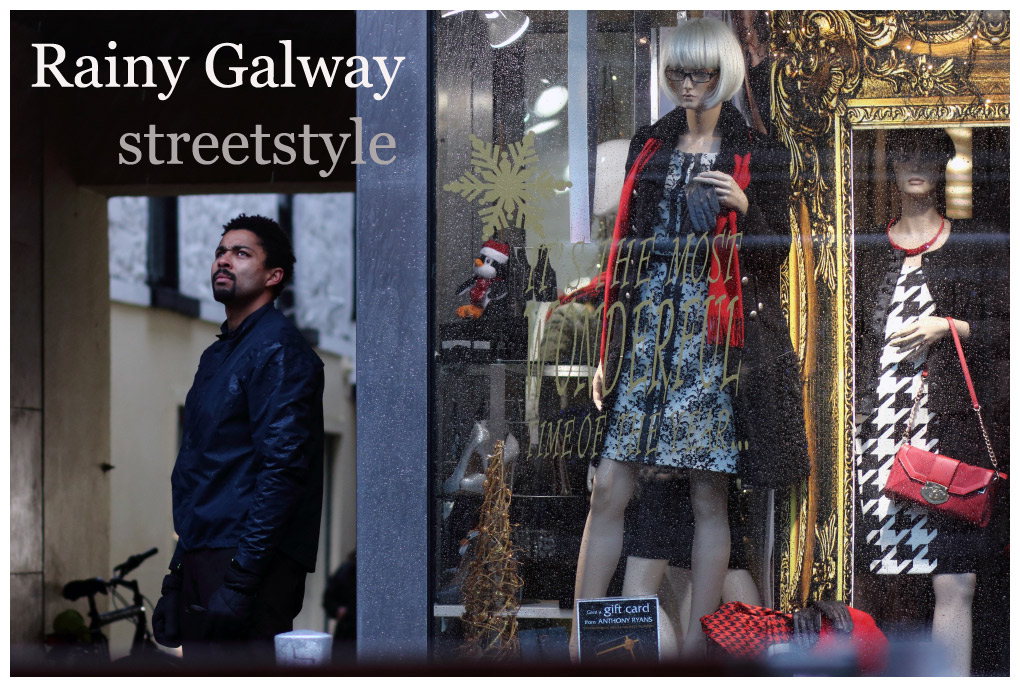
It’s a windy, dark, mid December morning, and I’m watching the rain pelt down along shop street. From the barely-there shelter of the cafe I annoy passers-by with my camera. But I like the atmosphere of the Sunday morning downpour, and there are few enough people to actually see them as they pass by. The shops are opening late and the rain is keeping people away, but needs must and the brollies come out. Street portraits in Galway on a rainy day.
Burgundy. Cabernet Sauvignon. Merlot. White, red, rosa, bubbly. Brian bought 500 grams of dry fusilli pasta in Dunness Stores before going to the Dole Office to sign on. He should have gone earlier; it was overflowing when he got to the doors. Now he was back outside looking at a display of wines through a pane of clean glass that reflected all the way back up St. Augustine street. He shouldn’t have paused. So long as you are moving you exude a sense of destination and purpose.
Brian had already checked his watch seven times and his phone twelve. There were no beeps or alarms or missed calls. But when he stopped for more than a few seconds he couldn’t help but go through the motions. So long as he didn’t stare into space it was possible he still might have a place to urgently go or a vital message to check or need a second to choose how to portion his precious time among many worthy options.
Between left index finger and left thumb he had clamped the queue ticket. The machine in the dole office had rolled it out with a whine once he figured out which of the three buttons to press. All of the seats were taken so he had searched for a clear stretch of wall or pillar to lean against. From the pillar he had listened to the numbers being called out by the officious recorded voice and watched the glacial progress of the dense crowd: a young mother trying to pacify three restless children; two young guys with moody lowered heads in hoods; a middle-aged man with a faded corduroy jacket; a girl with headphones and plimsolls at the ends of skinny jeans looking out of the windows. In the dim light the dense group waited and listened and kept a low-key order.
“Ticket number one hundred and twenty-four to counter number nine”
A heavyset man raised himself with effort and pulled his shopping bag from the floor, leaving a vacant seat. Brian stood close by but didn’t budge. He looked at his ticket and then at his watch. Two hundred and sixty-eight. Eleven thirty-four. He really should have gone earlier; lined up outside before the opening of the doors. He really should have a job and be at work, busy turning some little wheel of the ocean of little wheels that keep the whole show on the road. Now the simplest things were hard to justify. Why is the taste of food affected by the slightest weight of mood? Brian tried to remember Bertrand Russell’s unromantic view of work from a half-forgotten lecture:
What is work? Work is of two kinds: first, altering the position of matter at or near the earth’s surface relative to other matter; second, telling other people to do so.
Stepping back out in the sunshine was startling. The narrow streets seemed impatient for his feet. They slipped along of their own accord, cobbled treadmills. A light salty breeze blew in from the sea, whose tides lapped out of sight behind the apartment buildings along Merchant’s road and the docks. Morning was done, day was winding out and on. If it wasn’t for those pauses he might have been on his way somewhere important. But he was still in the queue, waiting to sign on, number clutched in his pocketed hand. Eventually he let it drop into the small collection of loose change and receipts for pasta and tea and a lifestyle magazine.
There was time for food but Brian walked up one street and down the next on an empty stomach until he couldn’t avoid retracing steps. He glanced at window displays and their reflections, peered into their wares, followed the gaits and graces of passersby, caught snippets of their conversations, noticed their bags and brands and faces and walking paces.
Eventually, like a spun coin he came to rest, at an outside table of a cafe at the corner of Eyre Square, where flags of the fourteen tribes of Galway ruffled over the edge of the park. A horse and carriage stood waiting opposite the tourist kiosk. The horse had its head wedged deep into a nose bag and chomped. A rich medley of accents flowed up and down towards Shop Street: thick Connemara Irish, high-pitched Japanese- now a noisy gaggle of gregarious Spanish students wearing matching yellow backpacks.
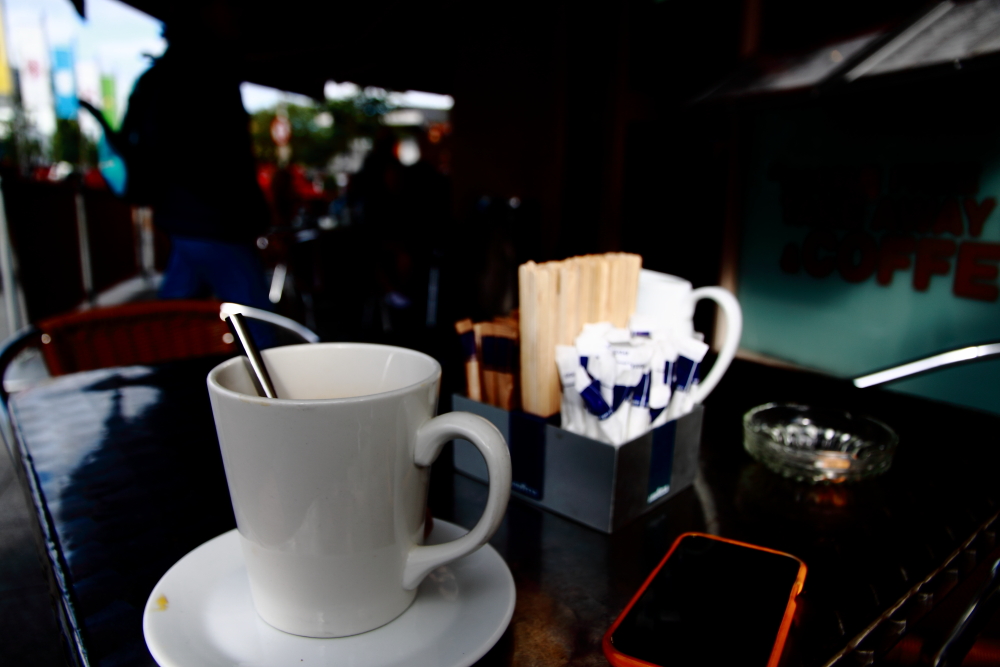
Brian checked his phone again as he went through the menu. Coffee would give him energy, but for what? His forms were filled and signed and ready to be checked, his day was ebbing away in an idle agenda. Yet like every day for everyone, bounded by food, sleep, maintenance and upkeep.
When the chirpy waitress spotted him and came over he ordered a tuna sandwich and Americano. At the next table two men and a woman were finishing their coffees and talking about money, marriages, and the price of houses. Relaxed in tidy suits, comfortable in their lunch break banter, Brian had narrowed them down to banking or insurance when the beggar approached.
He emerged from the passing crowd not unlike the way Brian had paused at windows, as though some force had plucked him out of a current. Ragged redgrey beard, puffy brown weathered skin, loose old sports jacket, short squat fingers, faded blue tattoos behind worn stubby knuckles. Brian didn’t catch the first muffled request for money but one of the men slipped out of the group’s conversation to say “Sorry mate, not today”.
Something made the begging man stay. He repeated his entreaties to the others one by one, stepping closer and leaning against the table. Their conversation disintegrated.
“I said not today”
“Just a couple of euro for some food”
“Do you mind? We’re trying to eat our lunch in peace!”
“Sure I just want some lunch too love”
“Yeah? I can smell the drink of ya! Leave us alone will ya? Go beg somewhere else”
Lunchtime peace shattered, the intrusion sprouted hostility. The security of outdoor tables was called into question as a wave of uneasiness spread out from the confrontation. Other diners began to look abstractly away but pay close attention. Their pupils narrowed and heart rates rose slightly and their movements became forced. The beggar now snarled. “Look at ye! I hope ye have a life like mine- the worst kind of life.” Then suddenly he reversed and shrank back, and held out his hand. “I don’t mean you any harm, shake my hand. Will ya shake my hand?”. After an uncomfortable pause and stare at the outstretched hand, it was accepted limply, but a low addition from another, “Make sure you wash them now” brought out another twist of anger.
So it went for a minute or two. The beggar flipped from direct nastiness to apologetic gestures, while the group, long since committed to ignoring or getting rid of their assailant, battled to restrain their tempers and tones. Pitches rose and faces flushed. “This is a welfare state! I pay my taxes! Everyone is entitled to a meal and a bed! No, I’m not shaking your hand.” A cafe waiter tried to get the man to leave but instead he shuffled a few yards and returned, this time to Brian’s table, close enough to share a smell of stale beer and disrepair.
With averted eyes and muted gestures Brian reached into his pocket and awkwardly handed out a two euro coin, getting a thank you and a tattooed hand on his shoulder. He stayed in his chair and focused on his coffee cup until calm returned.
The risen tide of lunchtime groups retreated. Streams of passing people continued up and down Williamsgate Street. The sun came out and the patches of grass in kennedy Park dried enough for people to sit. A wino slept in the warmth on a bench next to teenagers kicking a football. Brain checked the progress of the afternoon on his phone. Two ten. Two hundred and sixty-eight.He wondered who two hundred and sixty-nine was. The machine must still be rolling out numbers, its button faded from the pressing of infinite unemployed fingers. A gust of fear blew sharply through his unemployed interior, which felt suddenly hollow. Formless, jobless, in flux. Who owes whom? How does it keep meandering on? Every life spilling, eroding, wearing, growing, backing up behind disruptions and into cracks and through tight narrow bends and eventually tricking on again and falling forward, drop by drop… Was this town really a graveyard of ambition, too comfortable and walkable and visited and prone to grey misty days to foster urgency and success? He rested his eyes again on the river of moving faces and crumpled up the ticket with the discarded napkin on the empty plate. His body seemed distant, his mind a dreambound pilot fighting to awaken, in control of a moody vehicle from a long way away, bidding it to stand up, breathe, walk inside to the till, hold the door for a couple on their way out.
The chirpy waitress smiled as he paid. Her dark darting eyes were brown and a loose strand of wavy hair fell over her face. “Was Everything o.k.?” She asked, her eyes tilting up with the smile. “Sorry about that guy. He’s so hard to shift!” The coffee machine let out a hiss of steam. “That’s ok. what can you do?” Brian had fallen back into first person, living in the brimming details, catching the trail of darting dark eyes, lingering awkwardly, dropping two euro into the jar marked ‘Tips’, deciding that tomorrow he could queue, that it would be something to do, and walking out between the chairs into the tide of people all going somewhere.
Ticket number two hundred and sixty-eight to counter number four.
…
…
Ticket number two hundred and sixty-nine to counter number four.
Donal Kelly, August 2013. Trying to be more consistent and follow one effort with another in the hope that something will stick. It seems that a good story is, no more than a good joke- easy to perceive but cursedly hard to invent. Does it take a certain kind of person to think up a new joke? Do you have to be a joker? Can you stumble upon one by accident? Who starts chants at football matches?
Yet maybe drama is not always necessary, action not always vital, and the growth of some fresh edge or digging claw enough to set a frame and get to the thick of a scene.