Posted on

Short Story: A Day in the Failures of John R. Clancy

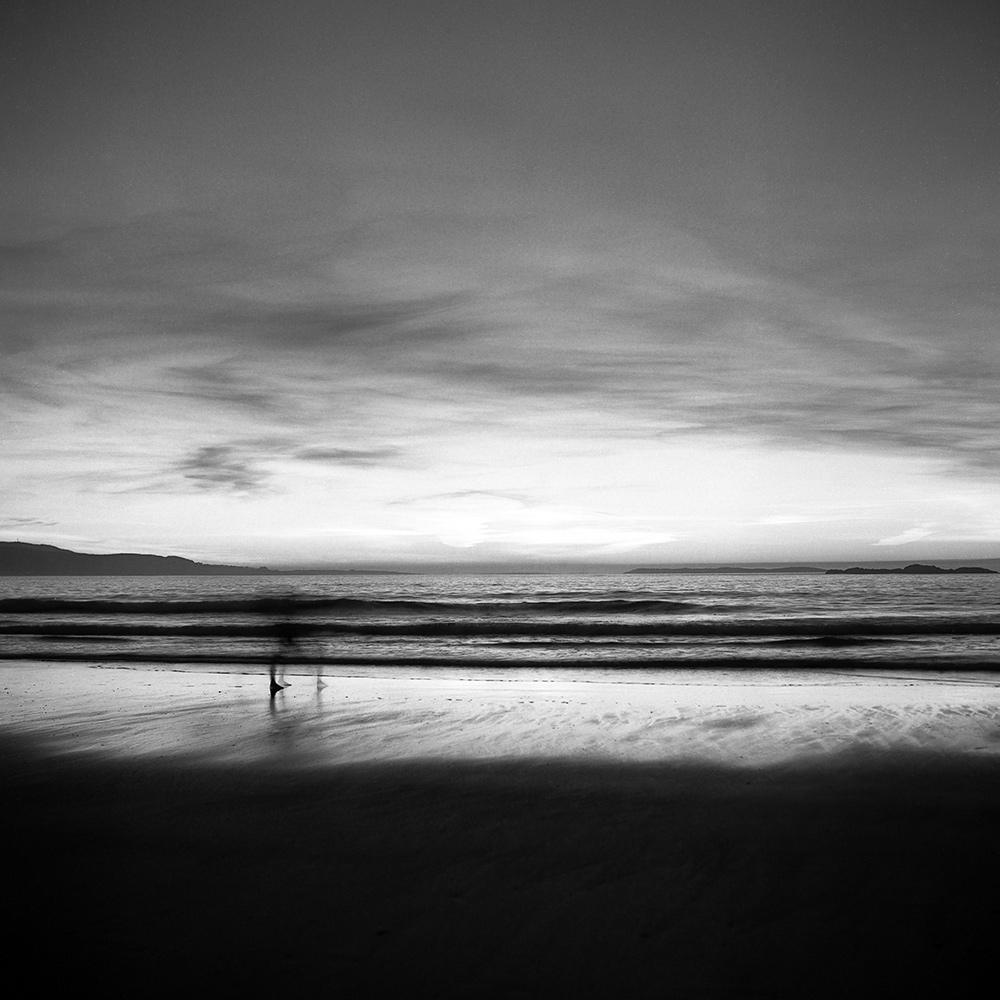
lettergesh beach black and white, two figures

A Day in the Failures of John R. Clancy

LISTEN:

John Rufus Clancy tried to become so still that he could feel time pass, but he failed. He could see the clock counting up, but he couldn’t feel its passing. There: that transition between 14:59:59 and 15:00:00, that transition from not late, to late. Where was it? Even if he stared blankly at the mutest emptiest stillest surface, or shut his eyes completely, there was no way to register time itself, just the numbers of its count, the recording of wheels turned or electrons spun. All of his senses were in the soup, a jumble of ingredients unaware of their own dish’s name. His senses and senses of his senses and the idea of a self and its selfness, were all balled up and spun out in time, of time, all the time.

Maybe though, if he pushed himself, those counted numbers themselves, or the idea of counting, or at least some such stuffs, are on the outside, even if the thinking with them is not. Can I, wondered John R. Clancy, 1 minute late now and counting, in my flow of slippery mental states, contain – hold as thought-subject – something that is genuinely outside of time?

The car in front slowed abruptly again. John reacts. Right foot up, over, down, hard on the brake. Friction bites, and his body pushes forward against the rush of road, weight flows into his hands and onto the steering wheel. Find calm, find calm. No, his circulation spikes up, and blood rushes ventricle and vein. Why did he brake? He/she/they/it… there was nothing in the way. Stewy warm anger spurts, encompassing, bladed, intentional, spills like gloss green paint in clear midday sun, or the sound of a cracking plank of dry wood under much load. Kurrsquack of a jagged black raven. The violent words and their rowdy hues assemble with intent at street corners. Will a man ever be calm again? Left foot down, clutch in, gear disengaged, down to fourth, then to third, and all under control again, with enough space, bumper behind bumper. Two minutes late and growing. If you’re stuck in traffic you are traffic.

Would she wait for him this time, clinking her coffee cup and checking the time on her phone? Is she counting up or counting down?

A radio ad is trying its earnest best to sell John a new car, trying to sell him the idea of a new car, trying to sell him the idea of a future, brand new, John R. Clancy in a minty glistened fresh new car, all humble and correct and to be highly regarded, pulling ahead, up the road, citius, altius fortius and high on a sharp summit of escape and presence at once.

Would she wait or would she tip on, and by leaving cleave the story into a before and an after, a then and a not then?

There would be parking on Munster Avenue.

John Rufus Clancy tried to come to rest like a spun top finding its halt (though it is the more graceful aloft), but he failed. Surely, there is a stable plane for all things to return? Equilibrium. Or was it just another connivy dream’s spin? It comes down to a story, its telling when told, and the politics of the organs as they take to any telling. Surely there was a plot where this was the end: the happily afters or the bitter-eat embers of a shot down hellhound. There are the sudden jolts, and then the stretches in between. It could yet be the beginning? There is the spinning mill of narrative, threads woven and rewoven into fabric and pushed out and piled up, in the good old production of order, consistency, structure, cohesion, resolution. Thunkathunkathunkthunka… down it spills like the scroll of a news feed, falling translucent, topless, bottomless, and more real than what’s outside windows with its sweaty graft and buzzing-by flies and mouthfuls of dust and unexplained itches. Imagine eating food that makes you hungrier and hungrier. You eat more, you need more. John R. felt a kind of desire to have more appetite, or something like this, but more vague, muffled, the echo of a banged pipe down the gullet of the briny brain.

“I made my bed, so I have to sleep in it.”

History class. Nineteen-Ninety-something. She didn’t do her homework, or something. Something lost, buried in the scrollfeed, in the making and unmaking of beds. She said that after, whatever, and John had never heard it before and saved it as something really significant. But what wasn’t significant then? Could a life be primed forever by a few snippets plucked from the sky in early days of feels?

The rain is still coming down when John R. reaches the cafe, but is more drizzle now than pelt. Earlier on, the June bloom had been spoiled with light. It turned as it often does, under the whim of blown bellyheavy clouds. It’s wet, or it’s dry. So it rolls, by and by. It’s wet, or it’s dry, or it’s ‘it’s wet, or it’s dry’, and so on. He didn’t put money in the meter- there was less than an hour left in the working man’s metered day.

Maybe she’d left by now, and there was probably a message or three unread. Maybe she’d left just now or five minutes ago or a year ago, according to the piled fabric of narrative, according to its thick knots written and unwritten, a thing to be counted but not felt. Time. Take the world at its most solid, as a lifted black rock from wet soil in the hands or the idea of the number one while lying in a quiet (lonely) bed, and yet but a passing flow over an abrupt stone in a river, or the shimmer of a bent ray deflected by a little ripple of a gurgling stream down a boggy hill finding a pair of eyes and all their percept on some point. Did the history of the world conspire to arrive at just this or that flicker on a ripple?

The ostentatious John R. Clancy was there, but she was there or she was not there. It’s hard to tell, that something isn’t there. You have to search every possible seat and wait to see if anyone comes out from the toilet. Coffee for one so, and messages checked, too late, and suddenly sweating at a little table, with barely tasted cappuccino and cake. Maybe it was a waste of a few euro, or maybe the motions of teeth and throat kept John R. upright, with head down, reading some latest breaking news on a bright screen, hunched over a surge of anger aimed squarely at the idea of himself and all its pretentious wanderling baggage and lazy adorned habits. He wondered if she‘d sat at the same table. He could ask but he wouldn’t ask. Was there a dark-haired girl in just now? How did she appear; I mean, did she look pensive, agitated, or resolved, confident, calm? Did she leave with an unwiped tear or a fine carefree air?

“Get over yourself”

She said that in an art class some time before some forgotten exam. That was when the collapsed self of later school years was still pending reformation, still stuck on its spear-tip of self-consciousness and self-disregard. What self? What over? To jump? And where to land? to climb? And where to ascend? And yet it seemed again, significant, so he saved it down good and deep. To here, years later, some thin- spun maturity, the aggregation of accumulations. Maybe it’s better to barely be a self, but always intertwined and carried by the senses to the great outside, and less aware of the looker looking and just looking, just being.

Ah… beds made, holes dug, selves to get over, and the deeper dimmer dug the more enticing then to just carry on, head down, busy out, duvet over the head and back to sleep, digging.

**********************************************

Much later, John Rufus Clancy tried to set up a comfortable place to sleep, but failed. The only flat patches of open ground that he could find around Ballyvaughan all had signs with

“NO CAMPING. NO OVERNIGHT PARKING. BY ORDER OF CLARE COUNTY COUNCIL”

He had eventually found the lumpy stub of an old broken pier outside the village, and pitched the tent in the middle of it, on a bumpy crop of tall grass and weed. He had cycled down with laden pannier bags, and eaten a pizza where the young waiter spoke English with a Clare accent and French with a French accent. And he had sat out by Monk’s pub on the wall over the sea, with the sounds of a folk band’s ballads carried out through the open door on a calm bright late June night.

“Black is the colour, of my true love’s hair”

High over the bay hung wisps of red and purple woven into the deepening dusk.

“Her lips are like, some roses fair”

He had sat there until his legs grew numb, and he tried to see the fading of the light, tried to see the change itself without looking away, but couldn’t. Lights began to twinkle on the far shore from Galway city out along the west coast of Connemara.

“She’s the sweetest smile, and the gentlest hands”

Only if he closed his eyes for a minute, or more, then opened them, could he see that the sky had dimmed further. But whenever he closed his eyes, so many thoughts argued for attention. Better to stare at the outside. Tourists walked the pier and up towards the village centre. Groups, couples, togethers. The light slowly fading.

“And I love the ground, whereon she stands”

He’d follow them soon, up to the village and continue on out the narrowing road with a flashlight blinking, to the tent on the pier.

John Rufus Clancy tried to get a proper helping of deep dreamless sleep, but he failed. He’d forgotten how damn loud everything was and whenever he slept, restless dreaming. A rookery in the trees over the main road had settled but not settled, and every so often a chorus of kak-kak-kak-kak-kak skrrrrrrrraaaaukkkk sounds would jar him awake. At two thirty a group of drunk people passed, loud, shouting, laughing. Someone lagged behind and got sick on the roadside. “Timothy” they yelled up ahead. “Are you getting sick?” Did they see the bike, the tent? Should he go out and check?

Then, before seven am, he woke from a dream where he could hear an old cat getting sick in a kitchen, and as the sounds got louder, he struggled to break out of it, urging himself to wake, wake, wake, squirming in the tight sleeping bag as though he were bound up in ropes. Eventually he dragged himself to the surface, and unlocked consciousness, and the sound resolved into the lapping of the high tide on the old pier stones a fistful of metres away.

When he figured that the water wouldn’t rise as far as his tent, John scrambled back inside and lay down and listened to the lapping and tried to let everything else down too, and tried to stop holding things at all. He figured he was making some progress too until the phone pinged, and it was from her or it was not from her. It was on the line between not late and late and here and not here, and somewhere in the story, maybe the beginning, maybe the end, and it said

“Hi John, how are things? Are you ok?”

Or maybe there was no message at all, and outside the sea just glooped between the stones and he could see a squadron of earwigs scrambling up the inside of the flysheet and he had nothing to eat for breakfast and he had failed to make provision for these eventualities at all.

THE END

written June/July 2017. Tried a recording outside, Oughterard, July 13th.

Posted on

Short Story: A Fairy Gust

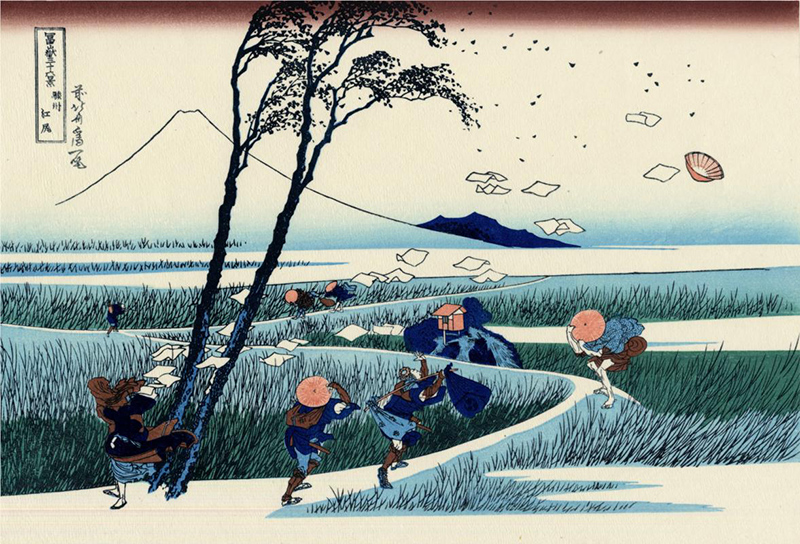
Hokusai: Ejiri in the Suruga Province

***page title image: Ejiri in the Province of Suruga, by Katsushika Hokusai (1832)***

“A fairy gust,” said the mother to herself in the kitchen.

It had come flung from the Atlantic, down through the low mountains and into the narrow valley, lifting the galvanized tin roof clean off the shed and toppling two of the old ash trees in the top field. Three pieces of TV aerial were stabbed stuck in the mossy front lawn and the telegraph poles at the boundary wall corners were both kinked over at the base with the black rubber-covered wires flapping loose.

“Ah for fuck sake,” said the son, lying on his bed after the sudden rush of snap and crash. His Internet signal had disappeared. The window had swung open and a plastic bag, leaves, and twigs had blown into the room. He rolled off the unmade midday duvet and slumped to the kitchen swearing at the damage. No Internet, no phone, the shed roof dumped in the front hedge, and the dog howling away madly at nothing.

“A fairy gust,” said the mother to the son, standing between the fridge and the sink with a mystical nod towards the window. She began to put on a pair of old boots, and went outside without tying the laces.

The son fired on a pair of runners, and followed her out. She was trying to quiet the dog.

“Two of the ash trees are down” she said to him. “And the aerial’s gone off the roof. Look at the tiles!”

“I know, I know. I can see them. There’s no phone. The shed roof is off.”

The mother pulled a broken tile off an upturned flower pot.

“My geraniums! That was some gust!” she said.

“You’ll have to go down to Paddy Fitz and see if he can come up.”

“Yeah, yeah, whatever. Jeez.”

“For fucks sake,” said the son, as he pushed away the wheelbarrow that had been blown up against the side of the van. Its handle had run a long white scrape along the red finish. The van had cost him a fortune. He started the diesel engine without waiting for the coil to heat up and it grumbled into a fit of smoke-sluggy coughing. Fairy fucking wind. He drove around the tilting poles and off down the neck of the valley. He could see more trees down along the side of the hill. It wasn’t even windy.

The second gust arrived after the son had turned on to the main road, and was driving in third up the rising shoulder of the valley. It caught the red van square and off it went, laterally, almost holding grip then suddenly breaking free sideways and flipping over the low bank and down into the bog, rolling onto its roof and back onto its wheels in the soft ground.

“Another one!” said Paddy Fitz to himself, on the other side of the valley shoulder, looking at where the corner of the shed had been separated from the wooden frame by the second gust and stacked turf had fallen in a pile beneath.

He went in to tell the wife.

“Damned if I ever saw one like that before. And the oak tree down on the wall!”

She hadn’t seen the likes of it either, but out on the islands she had heard a few stories,and she kept still a store of omens and signs, pishrógs and bad cesses and rules, like going out the same door you went in. The aerial was gone from the roof, and one of the bedroom window panes had been shattered by a tree branch. Paddy stared at the mobile.

“No signal at all.”

“The mast might be down.”

“They should never have put the damn thing up there anyway.”

“Well, they’ll have to fix it. I’d better call the ESB.”

“Call with what?”

“Oh, right, of course. Well, can you go down to the town to see if they have reception there? They can’t leave it like this”

“For fucks sake,” said the son, as he struggled to pull his sinking feet through the bog and back up to the road. His nose was swollen and his neck was vibrating with pain and he felt like he had done a full cycle in a tumble drier. The van was fucked, its roof crumpled in and the chassis buckled. And still no reception. And it was totally calm again, too. All along the road up the hill, poles had been plucked and scattered like rushes by the stalk. He walked with a worsening limp, stepping around debris, until he got as far as the old Garvey house. He went up and knocked at the door.

“Hallo!” he cried.

“Hallo! Mrs Garvey? Are you in?”

The mother was out picking up scattered wood and pots when the third gust grabbed her whole and fired her as far as the rhododendron bush. Pulling herself out of the dense stalks and purple flowers, she looked darkly up at the sky, a line of blood snaking down her wrist. The cleaning could wait. She headed for the house, limping. Today was not the day for fixing.

The son was standing on the cement path outside Garvey’s with the cup of tea in his hand when the third gust whooshed down the valley. He had gone out when he saw Paddy Fitz’s van coming down the hill, slowly negotiating the downed wires. The house behind him took the bulk of the weight with a dull thumpy whack, but he still fell forward into the grass. Mrs Garvey screamed from somewhere inside, and when he stood up, he could see Fitz’s van, upside down, wheels spinning. A shower of roof tiles, a chimney pot, branches, fencing, feed bags, and all kinds of branch and leaf, were scattered across the garden, and the beech tree at the back of the house was leaning over with two heavy branches hanging by the bark.

The son limped down to Paddy Fitz’s van, no more than fifty metres from his own, and helped him out from the upside down passenger side door.

“That was some gust!” said Paddy, coughing. “Never seen anything like it! Took me clean off the road!”

“Come on up to the house”, the son said, and between the two of them they made it out of the soggy bog and up to Garvey’s. Mrs Garvey was in the kitchen, looking out at the jumbled mess.

“The electricity is gone now too.” she said. “You’ll have to wait here a while.”

Paddy Fitz spent a few minutes quietly checking his bruises and rubbing his twisted ankle.

“Never seen anything like it Mrs Garvey!”

“Maybe it’s a sign?” she said, after a long pause.

“A sign of what? ” said the son.

“A fairy gust!” said Paddy Fitz. “Sudden burst of wind in off the sea. They get them out on the islands.”

“And not one, but three!” said Mrs Garvey. “Could be a sign. We should stay put. It’s not a day for going out.”

She went to clean the dust from the old stove and put down a fire to boil some water.

The three of them settled in at the kitchen table. Outside, it was calm and quiet. No radio, no TV, no phones, no cars on the road, no birds singing. Not even a rustle from a fallen leaf. A general deep stillness fell around them and they stopped talking.

The son stared into his hot milkless tea. As gradual as the sipped emptying of the mug, he stopped reaching to check his phone reception, and let the pain in his neck and nose and joints flow like his blood throughout until it seemed to merge with the quiet and they all become a background hum. He stopped seeing the crumpled van roof and bits of broken tile and aerial stuck in the mossy lawn. In his foreground, all tendrils of his attention craned out and came together in a narrowing coil, like a sensor for the faintest hint of the next sudden gust. Yet it remained solidly quiet and resolutely still, until a lone thrush began to slowly pitch up again outside the window.

The son didn’t believe in signs or omens, prophecies or fate, or even the future per se beyond the continuous consumption of the present. But in this strangely locked, loaded, cocked heavy calm, a tide of fidget and lie-ins seemed to roll back: a low tide drawing out the sea to expose a fresh strip of naked shore. He swirled the last gulp’s worth of tea in the mug and broke the long silence.

“I’m off for the city come September,” he said.

Paddy Fitz looked up as though awoken. “Oh! Well sure there isn’t much out here lad.”

“Yeah, yeah, I need a change.”

“Good lad. Do you have a job lined up?”

“No, nope, but I’ll figure something out!”

“You will” said Paddy Fitz. “You will.” He had forgotten about his ankle and put both palms flat on the pine tabletop.

“I’m going to head over to see my brother in England myself”

“The brother in London? Larry?” pitched in Mrs Garvey.

“That’s the one.”

“Never been over at all. Long in the tooth now but… I’ll bring over herself and Tommy. We can stay for a month- I can sell that heifer. sure we’ve never been further away than Galway.”

Mrs Garvey leaned in. In the distance, perhaps, or perhaps not, a fourth fairy gust was being conjured up above the ocean to be flung inland, and chunnelled down a narrow valley where a thin reedy river cut through bog that pitched up into the ancient Maamturks. She could feel with calm clarity, the weight of bodied silence around the wooden table that had raised two generations but was creaky now with more meals of memory than food.

“I’m selling the house.” she said.

“Oh?”

“Selling the house, and I’m going to get one of those nice little apartments in the town.”

“Isn’t your young one down in the town?”

“She is.”

“Well, sure she’ll be glad for that.”

“She, she might. Some family can take over this old place and to hell with the lot of us fighting over a patch of grass and an old building.”

“That’s if it isn’t all blown down today Mrs Garvey!” said the son.

“And us with it lad!” added Paddy Fitz.

The three of them settled back into their waiting for the next gust, having breached impasses deep below the chuckling of the wind.

Donal Kelly ----- written June 2017

Posted on

Short Story: The Suitcase

The Suitcase

“Frankie, you’re for the birds”

Frankie sighed and looked at his watch again.

Annie sat by the range on the well worn couch.

“Not now Mike; give it a rest.”

But they let Mike go on as they generally did. Everyone needs to vent. The air would not be clear until the birds for Frank were perched on the doors and balancing on the picture frames, cooing and clucking and idly sending droppings onto the lino.

There followed, in the kitchen, on that day, a faintly familiar wounded silence. Frank declined to defend his life choices, even if his expensive college degree was indeed a wasted sheet of glorified dusty toilet paper that qualified him as too smart for his own good, and even if he didn’t give a damn for all the good that was given him. The air was swollen but the kettle was on again. More tea would be made. The rituals of family are river beds to the rain.

Mike moved around his old inherited bungalow kitchen as though it were embedded in a stadium pitch, surrounded by a village of spectators. Only the dog was at the back door, scratching to be let in, and a cat sat peering in from the window ledge.

The trio gathered thoughts that condensed in the thick kitchen air while the kettle gurgled on and up towards its steamy crescendo. Amazing too, how electricity snicksnackled through metal elements inside and how there was a whole wired world strung up outside to get it there. There was once a kettle in that same house that would never switch itself off, was missing its resolving CLICK, and it was tempting to sit on your hands and watch as it boiled its contents completely into the air for as long as you could stand. “It’s good enough” said Mike, maybe proud of its deterministic rebellious nature, until a new one was bought and swapped in, and no more was said about it. A rebel’s idle discontent is easily buried under patinas of habit and routine.

In any case, the rebel Tom Bubbles had steamed his last, was dead and buried just. Here they were, three siblings back from the graveyard, back from the CLICK of finality to a life’s bubbling that sounds like shovels of fresh dug damp soil on wood over hollow. Thump, thump, thump; getting weightier and fainter as the hollowness fades while the filling men labour away- the neighbours, a few younger cousins, the fitter drinking partners, and the husband of a niece.

Annie sat with the long black range tongs in her hand, clasping and unclasping the ends, which crossed themselves like dysfunctional pliers. She wouldn’t stay the night, she’d drive back up to Dublin even if it was well past midnight, happy enough to while away the small hours on the motorway. She would be the most dismissive of the occasion and feel the most remote whenever there was a time for getting together, far from the safe and needy city rhythms, a foreigner to the village ways.

The rest of the funeral gathering would be at McGreevy’s bar, well oiled by now and going through the book of anecdotes, chapter of ‘Bubbles McCorry’. The teeth of each harmless tale would be sharpened through its telling. Bubbles had put in the long hours there himself, propping up one end of the bar, shining the varnished countertop with the elbows of a worn jacket, getting slowly polluted on pints of thick stout until going quiet against the rising and falling backdrop of a weekend, a holiday, or someone else’s funeral. He listened more than he spoke, and sought solace less in being heard than in being present.

Frank lifted the kettle off and poured the steaming water into a metal teapot. Two spoons of ground tea leaves; weak unless you left it to draw. No biscuits. The dog was let in, and hopped up on to the couch to doze. The cat was still outside, carefully cleaning its face with wipes from the backs of licked paws. She wasn’t much of a mouser but dragged in an odd luckless half-dead victim once or twice a season.

From the window opposite the range you could see the departed Bubbles’s house at the end of the top field. He had lived there for four decades, and it was the only material he left behind, a compact seventy year-old farmhouse with thick draughty walls, a small yard at the back and a square garden at the front, bisected by a narrow concrete path, and two fields above and below the house on the sloping landscape. The wild greenery of the civilised section was prone to being left to its own devices for months before sudden days of cutting and cleaning, and the geometric tidy lines would soon be buried again by the eager growth. Bubbles never appeared upset by a disheveled lawn or mismatching socks.

The siblings would have been in McCreevy’s too, if not here in the old home kitchen, navigating through fault lines and obliged to talk up and around shared stories and secrets, to see if they were still marked and buried the way they had been left. In summers well gone where the trees were buckled from being climbed, when their aul fella would sail precarious between bouts of quick humour and dull heavy anger, steady-as-she-goes Bubbles would let them stay with him, teach them how to solve crosswords, play cards and draughts, list the scandals of each neighbour, show them relics like the gun from the civil war that hid in the attic, and make pots of smoky tea with the kettle that was burned black from being boiled in fishing day fires.

It was a long time since they had found the battered suitcase of bones buried under the slender birch trees, and the birch trees now were taller than the houses and creaky in the wind and listing in layers of cracked bark towards the open bottom field.

********************************************************************************************************

Mike reached up and pulled at the curtains.

“Well, what’s the point of saying anything now? What’s done is done.”

“It’s not a good way to leave it though, is it?”

“Just let bygones be bygones; we have enough to deal with already.”

Frank poked at the newspaper on the table.

“You know what I think the aim of life is?”

“What is the aim of life, Frankie?”

“The aim of life, the actual thing to aim for in your day, is to be able to sleep soundly at night, and wake up feeling lighter than you went in… good sound solid sleep”

Mike rolled his eyes.

“For fucks sake Frankie, do you ever take anything seriously?”

“I do, isn’t that what I’m doing? What’s more serious than a funeral?”

“You’re away with the fairies. We just have to get on with things, and we’ll sleep well enough. There’s no other way; we can’t start coming out with stuff now.”

“Don’t mind him Frankie. We said we’d do something when he died.”

“Away with fairies, or with birds. Which is it then?”

“That was before he died. And it’s different for us, we have to live here.”

Annie dropped the tongs into the turf box.

“Are they still there? I mean the suitcase, is it still even there?”

“Yeah it’s still there. Who would have touched it?”

“I don’t know, I’m just wondering. It’s a long time ago now.”

“It’s too long ago to be dragging up.”

“But we never knew what happened and we spent so much time… I spent so much time anyway thinking about it, and we couldn’t tell anyone.”

“It wasn’t right to tell anyone, it would only have made things worse. We had enough to deal with.”

“But it wasn’t right to say nothing either.”

“We managed alright. We’re doing ok, it’s just the way things happened. If things were different, but they weren’t. They aren’t.”

Annie let herself slouch into the lumpy couch cushions while she scratched the dog’s ears.

“Did ye ever talk to people about it, since?”

“What good would that do? Think of what people would say? Did you?”

“No, no, of course not.”

“A body buried in a field in a suitcase, sure it’d be in all the newspapers if you said anything- imagine what would happen?”

“I know , I know. But it’s not an easy thing.”

“It had to be a man didn’t it? I mean it was too big to be a woman, and didn’t you count the ribs? Had to be.”

“It doesn’t matter, we have to let it go.”

“I’m sure it was a man, and not that young either. Bubbles was never cruel to anyone.”

“Bubbles was a good man.”

“There’s no point digging it up again, are ye even listening?”

Frank put the newspaper back on the table, the crossword done.

“But remember we used to sleep there when mam was away and he’d be up half the night, like he couldn’t fall asleep.”

“Lots of people don’t sleep.”

“Frankie, life isn’t all about sleeping- you’re barely alive at all when you sleep. Is that what you learned in college?”

“But what I mean is, sleeping is a measure; it reflects the rest of you. Everything is connected, that’s all.”

“Or if you’re drunk enough most nights to barely walk to the bed.”

“That’s not on now, he never said a bad word about us, and he’s just died.”

“No, it’s true, he was very good to us.”

“He could handle the drink, and he could handle himself. It’s just a pity he never did much after coming back from America.”

“Well, that’s when it happened isn’t it? Isn’t that what we knew, isn’t that suitcase in the picture from when they went, and he came back with it a month later and never said why?”

“It’s a long time ago, I haven’t seen that picture since, maybe we just made it up”

“He was there for three months.”

“We made up the whole thing?”

“No, no, but we were young and maybe we wanted some drama or something, to focus on. And it might not have been that particular suitcase.”

“There was never any other suitcase, was there?”

Mike opened the fridge, took a slice of ham from a plastic bag, pulled the curtain open, pushed out the window, and dropped the ham out for the cat. Night had fallen and there was no light on in Bubbles’s house for the first time in a generation. They had planned to go down to start cleaning but now they would leave it to Mike. Frank would go back home to Rose and Annie would go back to Dublin and Mike would have to go down and clean out the place and sort out what was left. The suitcase wasn’t under the birch trees anymore because he dug it up when Bubbles was in Donegal for a week in 1998, and he checked it again and buried the dull bones in a deeper hole under the beech tree in the corner of the bottom field, then burned the suitcase in a mound of hedge cuttings and cardboard over the filled-in hole. He had put up a little cross but took it down again after a few hours and cut the grass in the two fields and piled it there and it looked like nothing had happened.

Annie was looking at her phone.

“How come you never got the Internet Mike?”

“I don’t need the Internet Annie, I do well enough without, and I can use the library computer if I need it.”

“The library? Is that still open? Well, the Internet’s very handy”

She held up her phone to show them more pictures of her two kids. Sean was 4 now and Sinead was 6, and they were in a good school in Rathmines and they would come to visit in a few months, but it wasn’t a good time now.

The talking faded and Frank turned on the television. They watched the end of the news and finished the tea. The budget would be another austerity affair, the weather would be clear for a few days, Munster had beaten Leinster, and no mention was made of human bones buried in a suitcase on a small farm in the west. The doorbell rang and some neighbours came in wearing sad dignity and carrying scones and more stories about Bubbles, and then for a few hours people came and went in the cool night. Annie went outside to smoke.

Gradually the flow slowed until only the three siblings remained again, and by then it was time for Annie to hit the road. Frank got up too and said he would be back on Saturday to help out after the Minor county semi-final match. Mike expected he would show up on Sunday when it was all done, but made the effort to just grunt and not complain, hiding in the yesno meanings of mumbles the edges of civility.

********************************************************************************************************

The night was still dry and Annie was away on the dry narrow winding roads that would eventually hit the motorway. Frank followed her for a mile before turning left at the village. Instead of going straight home he pulled up at McGreevy’s, where there would still be a few he knew and a fire down and he wouldn’t be able to sleep until it was much later anyway.

Mike stood out in the lawn and then walked round the house and scratched the cat and looked up at the stars. The Plough hung to his left, rotating around the usual North. A light breeze ran through the grass and tugged at the birch trees.

“So did ye ever figure out about them buried bones, Frankie? We were just wondering about them.” Sean the Slip leaned confidentially in, sluggish but eager.

Frank took a sip from the pint and set it back down and stared at it. The place was quiet and only a few steamed regulars remained, Bubbles’ comrades and a few relatives with no will to leave.

“Well it’s all in the past now Sean, and I don’t suppose we’ll ever know the full story.”

“Sure, he used to talk about it himself the odd time, back in the day… but he wasn’t, he wasn’t too clear about it.”

“Well you told me that story Sean- about the girl from Lahinch?”

“Well, between myself and yourself, I remember it well, from the time… she was a lovely… and they met in New York and came back after a month with grand plans, but… her family were a bit odd you know? and the brother was a bit crazy.”

“I don’t know Sean, how does a story like that get hidden?”

“Different times Frankie, different times. There was many a row and many a man that didn’t know when to stop. Didn’t he come into the pub here demanding to know where she was, where they were, and off he went down yer way, and the next day didn’t she leave and he was missing. And Bubbles was a fine man then, strong as an ox, but he wasn’t the same after.”

“Well he’s at peace now Sean, and I never once saw him raise a hand to a fly.”

Frank gradually tuned out from the bar chat and found himself away on a slow wave of sadness. He knew well enough he should wait for the slide to subside before going home, and he knew he should go back to jokes and banter to stay afloat until it passed.

“Did you know, Sean, that we humans kill more than fifty billion chickens a year?”

The M6 motorway bisects the island from Galway in the west to Dublin in the East. Its monotonous stretches shorten the time through the flat midlands and great bogs, and iron out the kinks and obstacles for a purer means of travel: an empty lane and no bend or bump in the road. Annie liked the way it calmed her but had forgotten how quiet it got, and she flicked through radio stations from the bottom of FM to the top. When she reached the outskirts of Dublin she hit the M50 ringroad with relief and took the exit south. It was almost empty, though in a few hours she would be driving back up to the office and it would be bumper to bumper.

David was in bed but awake. The kids were long gone to sleep.

“How was it love?” he asked, putting his phone down.

“Grand. Quiet. Frank and Mike will find it hard but they’ll be fine.”

“Sure, sure. Did you tell them about, you know?”

“No”

“No? Oh, I guess it didn’t come up. Maybe for the best. Let sleeping dogs lie.”

“That’s what Mike said. Say nothing, all done and dusted.”

“Well… might be for the best.”

“I don’t really want to talk about it now”

“Yeah, sure, better to sleep on it.”

She went downstairs again and poured herself a glass of water. Then she wandered into the living room, and bent down to open a drawer at the bottom of the bookshelf. In it, she rummaged until she found and pulled out a little cardboard box. In the box between a pile of old papers and notes and a few cards, she found it, a faded black and white photograph tinged yellow brown. Bubbles looked so much younger, strong and squinting in bright sunlight, hoisting up the suitcase like it weighed nothing, with his cousin John Thomas from Dunmore, a bit behind, laughing at something you couldn’t see. Annie looked at it for a while and thought about the day she showed it to Bubbles and asked him about the suitcase and he told her in his low voice after a long pause, about that summer and about getting to New York and about what happened there. A fight breaking out, and being chased by a short stranger from somewhere east, who started to beat him with a chair leg, and in the struggle took a blow and fell down some steps and never got up… and then he squashed the body into the case, hid himself, told his friends there was a family emergency, planned to dump the stranger in the sea but couldn’t bring himself to, and brought him all the way back home to be buried in the night under the birch trees in the top field.

Annie put everything back in the box and went up to sleep. But she couldn’t drift off. She needed a distraction, even a grumpy complaint

“Hey, are you asleep?”

Mike was still up at 3, half reading the back page of the newspaper, unsure whether he should be outraged or nonplussed, unsure about the permanent semi-ironic tone of the article. Frank had finished the crossword again without asking. It had been a long day, but yet he had time to notice the shadows thrown by the hedges grow out into the garden as the sun went down, and O Connor’s cows chewing with their heads over the briars, and a frantic flock of starlings bickering on the telephone wires. The shadows are longest when the sun is about to drop into the ground, and then everything is shadow. There are days when you notice so much, and others when you see so little. Mike wondered which ones he preferred.

On the table was a shoebox with the lid off and a bundle of papers half in and half out. A photocopy of a photograph was on top: two young men bearing suitcases from nineteen sixty two, though it could have been sixty three. One was uncle Bubbles, and the other was cousin John Sweeney. They left that sumer, sixty two or sixty three, for New York and for America, following a gull-strewn Atlantic path already worn deep into the wild waves by generations gone. They were pulled or pushed, maybe searching for a way out, maybe drawn by ideas of open nights and open space.

Bubbles came back after three months, but cousin John never returned at all. Mike spent hours in the library, emailing, calling, and cajolling when the mood took him every few years, looking for answers. As far as he could tell, cousin John was never heard of again after he left that summer. A letter had been sent and then all quiet. Bubbles’s sister once said that another one of the Sweeneys went to America in sixty seven in search of John, but found no trace. Bubbles himself had said very little, only that he and John had separated after a month and John had travelled up to Boston for a good job. And suddenly Bubbles was back in Ireland, back living in the small farm he had fled, and suddenly he no longer wisted to chase the outside world and cross the globe. Johns parents, loathe to see him leave in the first place, did they blame Bubbles? Was there something he never told them? Did something happen in New York or Boston to split lives into before and after, or here and gone? And would Bubbles have been able to break a certain kind of news to such parents?

The clock in the kitchen ticked on. The dog and cat lay on opposite ends of the couch. The newspaper’s reports of the latest industrial dispute and the upcoming budget seemed broadcast from a faraway country.

Mike still wasn’t sure why he dug up the suitcase in ninety-eight, but he remembered well counting two missing teeth in the skull. And only three years ago he learned that cousin John had lost two of his teeth when he fell off a bicycle in the fifties. Dentistry wasn’t so good back then. Many a mouth had its molars pulled for want of better care. He supposed that a lot of people lost two back teeth from the right side of the top plate.

He put the picture back in the box. The Stanley range was still warm, glowing through the open draught door. He lifted the round cover with the edge of the tongs, and poked at the embers of clods that sat on the grate below. In went a few more clumps of turf, and in went the box of cuttings, emails, the photos, and the shoe box itself, crumpled to fit. Then Mike walked softly down the hall to try and sleep.

**************************************************************************
Written 2016, Donal Kelly, all rights reserved. If you have read this far, thank you. It's bloody hard to get anything read these days. I should make things more clickybaity I knows but whatsoever, you get what you get. I'd love to think I was a Kafkan hatchet hacking away at frozen seas, but tis more likely a case of a blunt toothpick failing to dislodge an after-dinner crumb from between those two molars.