Posted on

Short Story: The Frape

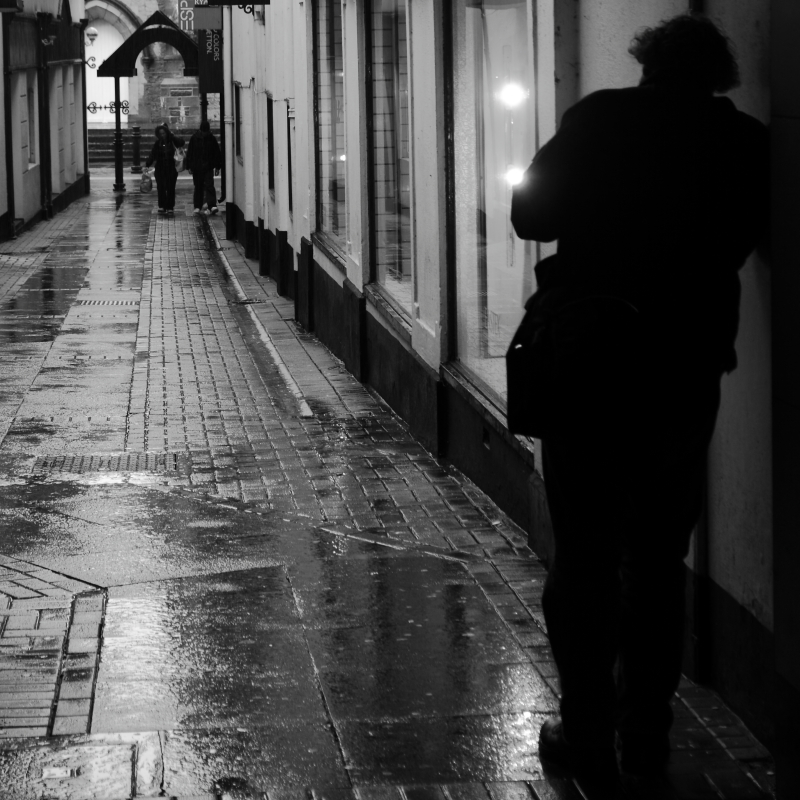
Buttermilk Lane Galway

Jamie works in one of those offices down on Abbey Street. It’s a call centre or something: the European office of some American tech company. Anyway he’s been there over a year now. Most of his gang are in Australia, though Tommy O’ Rourke is home next month. I’ve been living with him since he moved out of the place down at the docks. He’s a sound guy, though I don’t know him that well to be honest.

Anyhow, he spends all day at work on the phone or on the computer. Half of the time he’s on Facebook, putting up random links and fishing for likes- the usual shite. But he’s a bit serious now, has a streak in him. Nothing nasty but… it doesn’t take much. I don’t think he likes the job, but who does? Sure isn’t work what you do while you want to be doing something else?

Well there’s another guy in his office from the same village Jamie grew up in; another culchie head. They were practically neighbours but there’s no love lost between them. It must go way back, to some primary school row, or an under twelve GAA fight; you know the carry on. There might be something older: a family feud or something. If one met the other in Timbuktu he’d cross the road and look the other way.

So this other guy is a real Facebook addict too; can’t tie his shoelaces without telling the world about it. Isn’t it mad how we’ve all become OCD about checking something that didn’t exist at all a few years ago? Jamie reckoned this fella went to Spain just to get a better profile picture. Sure it’s hard to know what it all means nowdays. You share nothing and people think you hate yourself or do nothing. You share too much and they think you’re full of it, or too insecure to just let life be lived. We’ll all be buying books soon about how to let it go and live in the moment, whatever that is. Didn’t my aul wan buy me one for Christmas? “Getting to Now”, it’s called. I read about five pages.

Sorry, I’m going off on a tangent. I was telling you about this bad blood. You see, Jamie sneaks over to this guy’s computer during lunch and makes changes to his Facebook the odd time. I told you he had a streak. He told me about it one night in here when we came down for a few scoops after work. He keeps it real subtle, small thinks hard to notice, like commenting on strange pictures and adding odd friends. I think he changed the guy’s birthday and ‘de-friended’ some of his best friends and stuff. He was really proud of it. He reckoned he was some kind of psychological secret agent, wreaking the head of his enemy. Sure we all do the same stuff, but normally to our friends. The closer the friend, the more you can get away with! But that subtle stuff, where you’re hiding your tracks… that’s a different style altogether. You know, it’s all about hiding your intentions, or allowing yourself the space to make it out to be a joke. There are fine lines being drawn up all the time; new etiquette needed now that us monkeys have come down from the trees and are up all night spectating on each other instead.

Sorry, sorry, you know I get carried away after a few pints. Jesus I should get rid of those books. To cut a long story short, Jamie was in awful bad form this week. I think he had a row with his girlfriend at the weekend. He went to lunch early yesterday, and when he got back he snuck over to yer man’s desk, , as usual still logged into Facebook. He starts liking a few dodgy groups and sends a message to a total stranger, and God knows what else – I only know what he tells me – and then up pops a message. Right then and there, and it’s from his own girlfriend, and it says something like “C U @ 5 so?” So he must have lifted off the chair, and before he has time to look again he sees the fella coming back into the office. So he ducks out of the cubicle, and I can imagine he was falling over himself getting back to his own desk. Sure when he came home from work he was still white as a sheet. I had to ask him what was up; I thought he was sick or something. His head must have been going a mile a minute. I was like an old granny making him tea and calming him down.

He told me he rang his girl but got no answer, and I got the impression that he tried to follow that guy after work, but he must have lost him. He was totally convinced there was something going on, but how can you know? That was how he went- no half measures, bit of a drama queen. I think he must have gone for a drink. He might have gotten on to her later but I was out training with the Astro-Turf team so I don’t know. He left early today for work, but he sent me this message a few hours ago. We normally meet up here on Friday anyway, but hard to know today. Here, look: “Know now, see u later”. He’s normally the first one here, but it’s after nine now and no sign.

Like I said, it’s a weird one. I hope he didn’t go off and do anything stupid. Funny fish. Anyhow, Your round is it? I know you’re good for it. Same again for me. Hey, what’s that on the news? Is that…? Hey, turn it up would ya?

**************
Donal Kelly, August 2013
Had a go at a first person perspective, let the narrator be a local guy in a local pub telling a story to his mate about another. As usual I have no idea if the end result is any good, though it was interesting to try. It's amazing how different our written speech differs from our spoken. It feels sometimes that how we speak is a pale mistake-ridden version of how we write, but speech is a lot older than writing, and is so much more efficient and context-aware. Speakers use shortcuts and omissions and smatterings of slang and pauses filled with ums and ahs and a 'protocol' for managing question-response, etc etc. With dialogue you have to get the story across in the voices of character, setting the scene without being able to jump in and out of descriptions of mental states or directly describing the setting.
Making the narrator an actual character also forces you to be more aware of the role that a narrator has, always present but often stripped into an objective know-it-all. More food for thought!

Posted on

Short Story: The Hunter

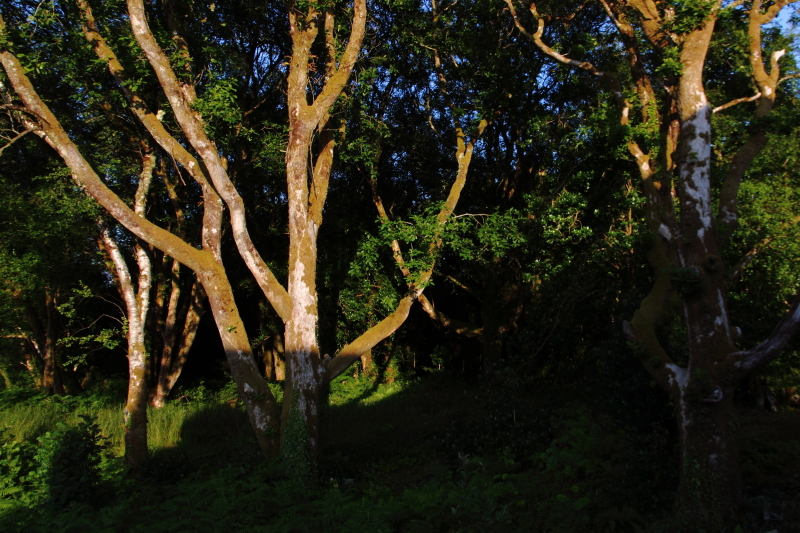
Oak trees in light and shade

Richard Sadler stayed perfectly still as drops of sweat began to form on his forehead and trickle down his long nose and lean cheeks. It was already mid afternoon. Completely enveloped in a dense thicket, He was invisible from beyond a metre, darkly camouflaged clothes blending into the sprawl of summer overgrowth, stock of the rifle wedged against his shoulder, barrel barely protruding out of the leaves. It followed the line from Richard’s eyes to an open clearing a hundred metres upwind, where a lion was going to appear.

It seemed like an age to Richard since he had been holed up under the unblinking fluorescent lighting in the stuffy basement office on Weston Street, going through the D’Estre accounts figure by figure, welded to a cheap office chair on flimsy swivel wheels, punching numbers with index finger while trying not to squint, supping stale coffee and blinking. Clouds never drifted across to change the lights, and they never dipped and dimmed by the hour. Breezes carrying smells of the season never sifted through the stacks of papers or down the sterile corridor. “How many hours slowly seeped away here? How many ticks of a clock -beats of a heart – passed in that sunless scentless interior, where raw life’s natural dramas declared a ceasefire and raw life’s potentials evaporated?”

A fly lands on Richard’s neck but he does not budge. Out here there is no ticking clock; but his pulse thumps out a steady rhythm. It is important to be able to not scratch every itch. This is what he has been training for. He must not give away his position, not after all of the effort. The climax is close. He wanders again over scenes that seem to be from a previous life. “How inhuman and unnatural! How cruel to senses honed over thousands of generations to be deprived of the rhythms of day and season; the morning sun, the spring rain, the cold winter nights. How stifling and strange to portion off precious heartbeats according to mechanical regularity, an indifferent exactness, labouring for an abstract currency under digital timers, removed and twice removed from the guts of existence. How far we are from the sowing, the growing, the harvesting, the killing, the filling of bellies from hand to mouth, wild on wild under an open sky? Contemporary man, struggling to define himself in a chaos of artificial structures and orders. Where now the synergy between the ebb and flow of the Earth and the straining of finger and thumb? What of a man chained to a painted plywood desk, badly postured on a squeaky chair, prey to a needling middle micro-manager called Harris, captive in a closet world pinned down by structure, by institution, by regulation, by fear and order? Did those D’Estre accounts ever balance out? Why were they so slow in submitting expenses?”

Something snaps him back into the present, and thankfully he is still frozen into his pose, a solitary hunter drawing neat breaths of pollen-heavy air. He lets his glazed focus sharpen again on the scene, the dappled light and dark patches of bush leading out onto the short-grassed embankment where the lion was going to appear. Any second now. He has to remain in the here and now. From now on, from now on, at one with emerging experience, and no more second-guessing or easily-provoked doubt. Embrace the unregulated fear.

One hundred metres from the unmoving barrel of the rifle, a two-hundred and twenty-three kilo adult male lion rises softly from his slumber and pads from a familiar shade to a familiar clearing, flicking his ears. Fresh despite his eleven years, clear-eyed, thickly-maned, carrying some healthy fat around the shoulders, he yawns deeply, exposing glinting curves of teeth. Only moments before a sudden hole opens from shoulder to torso via heart and lung, he scans his domain: two lionesses lying with a restless cub down in the hollow to his right, a medley of afternoon odours in the air. He flexes his claws and finishes the yawn with a bored growl.

Richard balances his promise of deliverance against the trigger and squeezes. The sharp snapping booming sound rips out and fades slowly. A steady clean shot. A perfect kill. Pumped up on the kick of adrenaline, he strives to grasp the primitive identity as it falls into him and through him. “I am erasing the doubt! I am connected to the earth! I can feel the rawness of life and death, I can find purity in the hunt, and solace in the kill. I can feel at ease in the meat aisles of supermarkets, and relax at the desks of domesticity. I having faced the primeval, accepted the challenge, have blood on my hands and in my veins and stand above the dislocation and separation. I am a legitimate man, I can eat in peace, and stand at the copier machine with a faraway glint in my eye.”

************************************

The South Bay Zoo officials were slow to react to the inexplicable gunshot that shattered the normal Tuesday afternoon calm. It took several minutes for scurrying keepers to converge on the lion pen, where a small group of shocked visitors had just seen the zoo’s star attraction shot dead with a hunting rifle in broad daylight. The African lion Helmut had been an expensive investment, brought in from South Africa after long-running negotiations with the board; management were radically upset. He had been bought from the zoo in Capetown using a five-year loan on a fixed interest rate, to try and boost the visitor numbers that had been falling steadily for the last decade, but his calm demeanour and propensity to hide away from viewers hadn’t captured the public’s imagination or coffers.

Thankfully, the subsequent news reports and flood of journalism, the drawn-out manhunt, dramatic capture, fascinating trial, and final sentencing of some deluded assistant accountant brought more publicity and visitors then most of the previous carefully planned campaigns put together. It was the lead story in even the major newspapers for the best part of a week and popped up in catchy headlines for many months. A large plaque was erected in the clearing where he was murdered, a small ceremonial burial was photographed and shared, a line of flowers gathered along the railings, and debates raged about whether of not he should be replaced with another lion. The whole enclosure was named in his honour and a Wikipedia page was created to document the whole affair. Every so often, Charles Smith, the Zoo Media Coordinator, logged on to his laptop just to see if it had been changed.

Posted on

Short Story: Nothing Happens

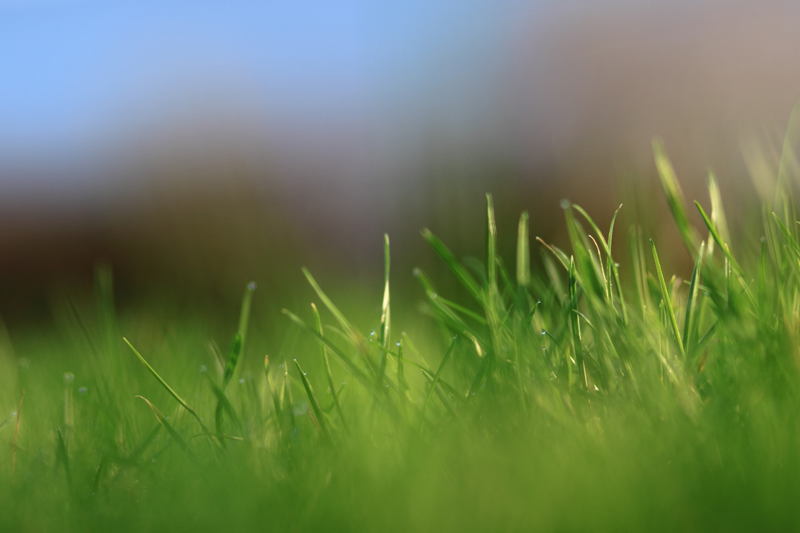
Grass in the Morning

Joyce sat on the wall looking over the road at the lake. Small quick waves lapped against the stony shore. “Nothing ever happens here”. Ray stopped sharpening the stick and stuck it experimentally into the ground. “Not my fault.” “Never said it was.“Yeah, well you have to cut the lawn today.” “You do it!” “Your job. I cut the hedge.” Joyce looked sidelong at the stretch of raggedly rectangled hedge. “It’s stupid. It just grows back in a week.” “You have to.

Deceptively full silence returned. Leaves rustled, waves lapped, insects buzzed, and small birds chattered. The midday sun hung above a flotilla of slowly drifting clouds. Joyce examined a loose flap of dead skin on his wrist where it had been burned. Ray walked out onto the lawn and began throwing the sharpened stick in spinning arcs. Sometimes it caught the soil at the right angle and dove in deep. The rest of the time it came in too acute or obtuse and glanced or bounced forwards.

An hour later a white Toyota pulled up to the gate, slowed, and turned into the short drive. It stopped at the gable, the engine shut down, and after a pause, Mr and Mrs Billory got out. Mrs Billory looked moodily at the tarmac then wrestled a box of groceries from the back seat. Mr Billory cleared his throat as he lifted bags from the boot. They walked wordlessly in the back door. Ray appeared from the living room, chewing and humming. Mrs Billory heaved the box onto the kitchen counter and turned sharply. Ray stopped humming. “Are you two watching TV?” Ray stopped chewing. “No”. Mr Billory straightened up. “Did you cut the lawn yet?“I cut the hedge. Joyce didn’t do anything.” “Where is he?” “I told him to do it.” Mr Billory took a step forward just as the sound of a lawnmower’s uncertain first revs burst into life. “Go down and tell him to use the petrol from the black can.” Ray grunted as the adults started to put the groceries away without looking at each other.

“Why do you always cut the edges first?” yelled Ray over the drone. Joyce shrugged as he kicked the red can back into the corner. The throaty cackle of the engine swelled as he pulled the throttle lever all the way up and pushed the mower onto the lawn. The power drive was broken so he had to push and pull it around the garden. He started at the edges, letting the blades skim right up against the flower bed. With a loud crack they chewed some soil and hit a stone. Satisfied, Joyce continued on. Every so often the racket was punctuated by another satisfying crunch or snap.

Ray stood leaning against the shed door and watched until he could see that Joyce was sectioning off the lawn by going round the edges and mowing joining lines. He sniffed the hanging petrol fumes, looked around for the stick and saw it wedged in the grass. As he watched Joyce approached it and kept his line dead straight. “Crackksnackksnapsnackksnackk”, gargled the struggling blades as they chewed up the wood. Ray sighed and put his hand in his pocket to feel his cool metal penknife. Thoughts of undone homework flitted erratically across his awareness. He swatted them away, turned on his heel, hauled his bike from the shed, and pedalled it out onto the road. As he passed the corner of the house he could hear arguing: the shrill angled pitches of his mother followed by low defensive returns from his father.

Joyce was yelling over the din. “Nothing nothing nothing”. He had finished the edges and was halfway through an almost square area whose sides were steadily shrinking with each length cut. Nobody could hear him. “Nothing nothing boring boring” he sang out, the tuneless air hidden. A flock of flies hovered around his head carving aimless doodles. A startled blackbird fled suddenly from one of the birch trees. Wilted daffodils had given way to bluebells and greening shrubs. Some dog or fox footprints criss-crossed one of the flowerbeds. The sun went in and out of the patrolling fleet of clouds sending patches of shadow and light across the lake, over the little house, and out into the fields. “Nothing boring boring nothing”.

The next sudden crunch was satisfying at first too, but when Joyce looked down he saw the frog’s leg on one side and the rest of the frog on the other. He stopped singing, stopped moving, stopped breathing, and stared. The leg twitched and the body writhed. The frog’s bulging eyes looked helplessly up as it tried to kick itself away but only flailed in convulsive half circles. Its smooth green skin was darker than the grass and its tiny delicate digits opened and closed in disorder. A thin growing trail of blood followed its jolts from the glistening pink open wound. Joyce swallowed and unbreathing stomach-tightened stared. His hands loosened then gripped the metal mower handle. His mouth dried up and he felt like he was falling forward. Another cloud-shadow was edging towards the garden over the road from across the water. Three crows flapped over the roof of the bungalow. The birch trees shivered in the late spring breeze. Joyce could see his mother angrily peeling potatoes through the back kitchen window. Her head was down and her hair was over her face. The mower roared on, eager to mow more.

The sky suddenly looked huge and the world impossible. Joyce closed his eyes and took a short breath then held it again. He remembered his granny’s funeral and the frogspawn he had forgotten to take from the jar, and wondered what Ray would say as he pulled the machine back and pushed it forward to the left, breaking the line, trying not to listen. But he had no voice for singing now, and no choice but to hear.

**********
Donal Kelly, August 2013. I've been trying to find a 'way in' to a story. I am always amazed at the rich tension or insight that a master storyteller can weave with even the sparsest of details. They say you should write what you know, but what do you know? A motley collection of gathered and mostly dropped, discarded, and forgotten undeveloped ideas. A litany of paths trod on then abandoned. Maybe what you need is a stubborn insistent search to root out and develop ideas from the myriad potentials. Look at the wealth of drama and violence in even a local newspaper. I wanted to try and capture a little of the complexity of life through hints and details, suggestions and nudges. The reader creates the story; the reading has its own short life. Surely I have crushed any possible delicacy and spoiled the fruit, but maybe next time.
**********