Posted on

L’Étranger: Alone and aloof in a blind benign universe.

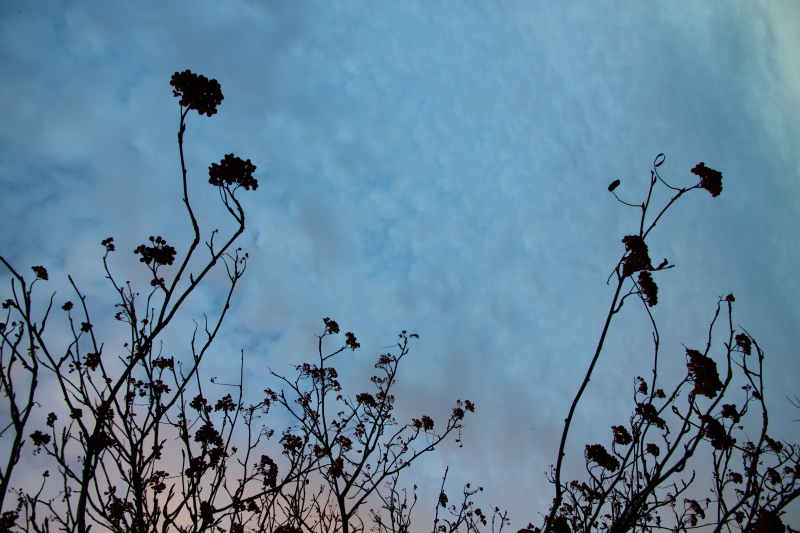
flowers against the evening sky

“I laid my heart open to the benign indifference of the universe”.

To feel the incongruity of the book’s situation, you have to feel what Mersault seems to refuse to: empathy. With a reader’s empathy you follow his thought and actions with a sense of understanding, and allow yourself to be as confused and blinded by the heat and sun as the he is, actively reaching out to see through his passive spectating eyes.

Mersault is a passenger, a non-judgemental observer who immerses himself in the present, in his senses, in the patterns of people and the play of light, but perhaps disassociated from the simple moral stories that give structure to social life; that give events the satisfying structure of a moral tale with winners, losers and sharable explanations. He is as indifferent as the universe. Why one thing, one choice, and not the other?

In the courtroom officials take over, imposing a moral interpretation to the hapenings. A man is dead, though we never get to meet him; he remains a distant, obscure, knife-wielding Moor. We hear more instead about the heat, and the overpowering sun, and flow of sensation. Mersault is accused of having a callous nature, of abandoning his mother and showing no grief at her death, and for cruelly firing four shots into an already limp body near the rock and cool stream on the beach. Yet we as readers were there with him; did we notice this despicable nature? We were exposed to his thoughts from the funeral to the killing; did it jar out moral senses and provoke disgust and anger?

It is hard not to rebel against Mersault at times, when a response wells up and his behaviour seems to be missing some aspect of human nature. Does he really not recognize the relations and expectations of the situation he is in? Does he not have a desire to please the court’s need for repentance and guilt? Does he really feel indifferent enough to never slip into an acceptance of human behaviour? At what level does he connect to others? It seems like it is on the level of a role player who is overly conscious of his act. It is hard to imagine him following the funeral from the retirement home and only seeing the beads of sweat and the sun and the efforts of Thomas Perez to keep up by taking short cuts. Would he not become immersed in feelings of loss? Perhaps… but perhaps this is another ingrained expectation. Or perhaps he is an incomplete construction of a human character.

Is there no meaning then, in Mersault’s life, as he sits in his prison cell awaiting execution with a fatalistic acceptance? There is the hole in the cell through which he can see the sky. There are his memories of his life outside, his intricate memories of his apartment and rooms. Perhaps the problem is that there is too much meaning, too much awareness of the condition of being this person here right now in this place in the universe of senses and caught up in a human world compatible only with a particular subset of interactions?

He decries the lack of hope in a process where the guillotine will simply be reset if it fails. His liberty has been removed, and after the surreal arguing in the court now comes a concrete unavoidable route to the end. Liberty then has worth.

The chaplain is horrified by this atheist man who refuses to profess guilt and regret in the face of doom. His message of God pushes no buttons and generates no interest, though his persistence to implant an idea of divine hope in suffering eventually triggers a rage. Like the Court Prosecutor, he is interpreting Mersault and judging his subjective experiences as if he can see them and understand them more clearly himself.

Mersault is carried along without saying what people want to hear; the assurances and protocols of interactions are just another aspect of the universe to be observed and experienced. Yet his liberty is denied, he is judged to be someone or something else, and the I the reader am left frustrated at his inability to sacrifice this passive journey and engage in the human interactions with the emotions that will give him back that limited liberty. Yet then am I, are we, simple actors and players in a world where meaning and value are an application of an accepted process that is on some ways an arbitrary mechanism to an open mind?

In any case, coming out of such a book with more questions than answers makes more sense to me.

Posted on

Wonderful Things

Up and down, so it goes. repeat something often enough, it becomes a mantra. The good with the bad. i wrote a song about acknowledging in a time of loss that good things can happen. The cold winter earth harbours the bursting buds of Spring.

Listen:: [audio:http://donalkelly.com/wp-content/uploads/2013/01/wonderfulThings.mp3|titles=Wonderful Things]

Recorded simply in one take with Audacity, sparse as usual, one effect (reverb) to add some depth.

Chords are as simple. Dm C G

Lyrics:

I wanted to ask you if you feel the same,
I wanted to see for myself as well.
It’s been a while it’s been too long,
The earth has moved the year has gone.

Chorus Wonderful things can happen (X 3)
If we let them…

I got on the bus and I got on that plane,
And life since then hasn’t been the same.
I wanted to fight but I had to wait,
The lights blew out and it grows so late.

I look to the future but see the past,
The sun in my clouds and flags at half mast.
A chink in my armour, a glint in your eye,
I’m seeing your season passing me by.

Now your replies are remote and the calls have stopped,
I’m fully aware of what I have lost.
I wake in the mornings and I can’t get up,
But the birds in the garden will interrupt, saying…

Posted on

The Price of Rights… Killings in Connecticut.

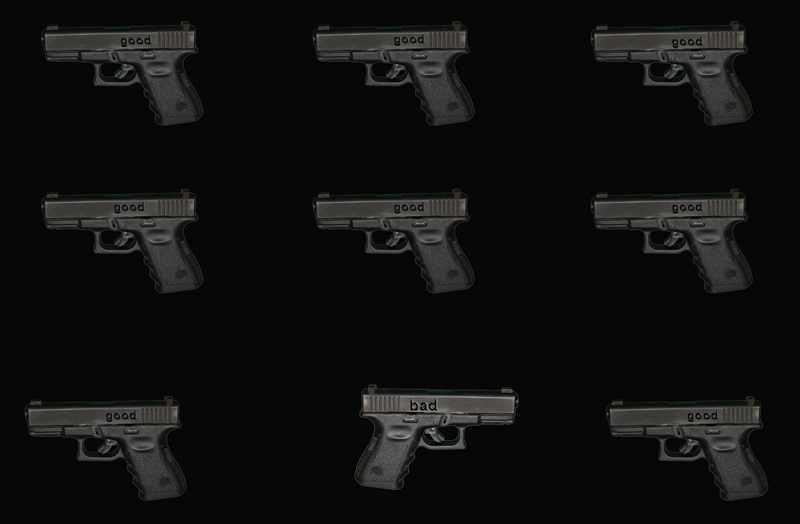
Good Gun Bad Gun

Is the need for people to be secure not undermined by their right to buy guns?

It is happening again. Another unhinged slaying of innocents. Another school, another young man unleashing a shocking expression of hate and anger. A scarily familiar news story emerging in its horrible details that resolve from vague guesses to real names and a score of small coffins. It is another addition to an ever-growing list of public shootings that result from the personal issues of a tiny minority.

In Sandy Hook Elementary School, Newtown, Connecticut, things will never be the same. Like Columbine, like Virginia Tech, like Aurora. As a foreigner the place-names are learned through their tragedies. Why does “school shootings in the US” have its own Wikipedia page?” ((http://en.wikipedia.org/wiki/School_shootings_in_the_United_States))

Coming from a country (Ireland) where the police rarely carry guns and where the scars of past violence help sustain a peace from ‘troubles’ (the Omagh bombing in 2008 killed 29 people, and was the worst single atrocity of the decades of turmoil((https://en.wikipedia.org/wiki/Omagh_bombing))), the regularity of public shootings in the US is shocking. These men, real people like any of us, in their moments of crisis, responding to bullying or some internal breakdown, their anger swelling out, knowing no innocence, can reach out with little effort and fill their hands with guns, their minds with precedent, their Internet history with gung-ho videos about guns and gunning. And after each event the society is cocked and primed for the next. So many triggers; so many fingers.

A well regulated militia being necessary to the security of a free state, the right of the people to keep and bear arms shall not be infringed

(US Constitution, 2nd Amendment) ((http://en.wikipedia.org/wiki/Second_Amendment_to_the_United_States_Constitution))

To those who own or use guns, there are arguments of security, and arguments of rights. Are you more secure with a loaded weapon permanently to hand? In the few moments in life where you might ever feel the need and justification to point a weapon at someone, does having it actually improve your chances of surviving? On a battlefield or video game, sure. In a ‘domestic disturbance’ or a robbery, or in your kids’ school? Raising a gun dramatically increases the odds of you being shot. Having access to guns means having other people access guns. After the shooting in Aurora earlier this year there was a surge in gun purchases in the area ((http://www.bbc.com/news/world-us-canada-18980974)). In parts of Texas teachers can be armed, as can students in some Universities (concealed no less). It sounds more like the wild west than a modern state with a secure society. Yet if your neighbour were robbed at gunpoint, it would be hard not to feel the need for a personal gun, unless you could guarantee that others had none.

In Killing Them Softly, a 2012 film where failed and failing criminals engage in an unromantic battle under the backdrop of the 2008 presidential election, Brad Pitt’s character sums up his attitude at the end of the film:

This guy wants to tell me we’re living in a community? Don’t make me laugh! I’m living in America, and in America you’re on your own. America’s not a country, it’s just a business… now fucking pay me! (Killing Them Softly, 2012)

If you’re on your own, then you don’t just have a right to defend yourself, you have a need to. Again, it sounds like a lawless state of affairs. Killing Me Softly has a setting far removed from an Elementary school in Connecticut, but the price of the theoretical right to defend yourself includes the cost of others being able to express themselves in bullets and blood. Would you not defend yourself and your children more by taking guns out of reach of those who may one day use them maliciously?

This guarded right to carry arms is a core part of the national identity and concept of free individuals. It’s enshrinement in the constitution guarantees huge commotion when questioned. Is it related to the ideas of liberty, that it is acceptable to do something as long as it is not causing others to suffer? Do a breed of Libertarian principles push the perspective of society into the that of an isolated individual: a cowboy riding solo with only wits and a six-shooter between freedom and death? Or is it as a bastion of a personal freedom, constantly infringed by big government? Given that every gun has its inherent deadly potential, and given that fighting for the right to bear one is also fighting for the right for unstable individuals to obtain them, how wise is it to regard this right as something that cannot be sacrificed for the sake of a safer society?

Congress shall make no law respecting an establishment of religion, or prohibiting the free exercise thereof; or abridging the freedom of speech, or of the press; or the right of the people peaceably to assemble, and to petition the Government for a redress of grievances.

(US Constitution, 1st Amendment) ((http://en.wikipedia.org/wiki/First_Amendment_to_the_United_States_Constitution))

The right to bear arms, the second amendment, is surely not built from the same stuff as the first. They are not built from the same foundations or aspirations. The right to free speech protects and encourages in any society and will always be a goal: diversity is healthy; necessary. Guns kill people. They are life-ending objects, much more than sticks and stones. It’s not that names can never hurt, but although some things are hard to listen to you don’t have to agree. The brutal argument of a bullet cannot be questioned. Having an armed population prepared to defend their right to defend their right with an anti-society device is hardly something to aspire to. It is not a goal.

Times change, societies change, and how a person act always needs to consider this. It is no longer 1791. The right to own and the decision to buy guns has powerful externalities: the ability of those who are consumed by intentions of harm and separated from the world by alienation and anger and a sense of injustice, to arm themselves and aim. In a dense interconnected world where we are always in a public domain, we have to have some trust in the social system. When we get on an airplane or in a taxi we have to assume that the pilot/driver is not drunk or high. We have no choice but to have faith in strangers, trust in others, while accepting the destructive potential of human nature. Our money is a number on a computer, our economies are constructs of confidence. Yet modern identity is based on knowing your own mind, making your own choices, and acting as an individual. These are not shopping cart choices though; these are the choices we make about how society works. And when the result of these choices is a situation where gruesome scenarios and public killings repeat themselves, new choices need to be made.

Modern society has countless rules that accept the potential failure of individuals. If everyone was an ideal human then there would be little need for law. What fully rational, empathetic socialized person would, for example drive recklessly on a public road? Every group of people has to balance the individual island with the social whole, balance rights with duties, and safeguard where possible against the threat of violence or corruption. If the system has too much power/responsibility there is no freedom. If the individual has too much there is a danger of chaos. In computer science it is commonly said that a very secure system is unusable, while a very usable system is insecure. There is a trade off between what users can do and how safe they are. There is a trade off between individual freedom and social stability. Where would we be without society?

And the life of man, solitary, poore, nasty, brutish, and short (Thomas Hobbes)

There are those that will be waiting for the powerful gun lobby to raise its vested voice loud above the affected and angry. Default behaviour of apathy and the reluctance to take on a well oiled set of arguments deployed by well positioned arguers and with the backing of a profitable business facilitate the next public shooting. It has happened too many times to allow everything to carry on as before.

Guns don’t kill people. People kill people.

This snappy return is fallacious. It relies on the flexibility of the verb ‘to kill’, which sometimes implies an intentional agent/subject ( a killer), and sometimes an indiscriminate cause of death. The ambiguous implication can be removed by rephrasing: Guns don’t intend to kill people (1), or ‘People are not killed by guns’ (2). Of course, only one of these is true. Of course people are killed by guns. The original argument implies that the only important factor is the intent to kill- that there is a murderous actor, which of course has to be a person. Switch ‘gun’ with ‘bomb’, a more indirect killing device, and it makes no sense any more; ‘Bombs don’t kill people. People kill people.’ ‘Drugs don’t kill people. People kill people’. This is not an argument at all, it is simply stating that guns do not intend or purposefully kill people, just like cars, or drugs or bombs. it tells us that if we are killed by a gun, that gun must be fired by a killer. Does this mean we should not notice or consider how or why the gun is in the picture? Should we simply look past it to the mind behind the finger on the trigger? The responsibility of not killing you is resting on the twitch of an enraged finger.

Go out onto the street, flag down a car, preferably driven by a tough-looking young man. Jump on the hood, kick the windscreen, insult the driver, his mother, car, children, religion, race, beliefs, job, and anything else you can identify. When you are sure he is utterly incensed, offended and enraged, hand him a loaded gun with the safety off. Has the situation changed? Has introducing a gun into this moment of rage raised the bar? Have your chances of waking away unscathed remained the same? Are you safe because the gun will not fire itself with its own subjective purpose? There is only the slightest squeeze of a finger between you and your death. No argument or situation is the same when participants are armed and guns are pointed. Introducing guns escalates the issue to a life/death situation with only the slightest of movement.

Some polar opposer of the gun lobby will likewise vent from a biased position (though probably one with less influence), and decry the whole apparatus of American society. Here, a country steeped in war and a history of warmongering, too heavily invested in the production of war machines for profit to be interested in negating the promotion of gun ownership. Points that need to be made, but it is important that this does not become a battle of extremes where the central majority ends up doing nothing. Lots of countries produce and sell guns, and no society is perfect. Many markets and products are loaded with incentives to not use them. Consider that in Australia cigarette packets are now completely de-branded, while in other countries they are splattered with abrupt messages along the lines of ‘you will die if you smoke these’. On top of that we have the laws and social norms that allow life to function in the first place, from road signs to bank regulations. When they fail, they must be addressed and altered.

Does the US have a history or principle or special status that make it different enough to warrant more liberal gun laws? Coming from a country that has been wracked repeatedly by invasion, oppression, partition, civil war, and modern terrorism, it is hard to imagine. What country carries no history of shots fired, blood shed? As for unique rights; the whole notion of a modern democracy involves that of personal freedom. Yet anarchy is not endorsed, as it is generally acknowledged that there are those that will not act in their own best interest if given the chance. That is why drugs are illegal and alcohol restricted by age. Levels of restriction should be based on the levels of danger. Is it not strange that liberal gun laws are associated with conservatism?. The dual nature of a gun as defender and aggressor is divisive. When we are all armed we are in danger of separating everyone, from neighbours to nations, into aggressors and defenders. I have a brother who is a policeman, and he rarely carries a gun. I don’t take pride in many aspects of Ireland but I take a certain pride in that. Surely this should be the goal?

Some defenders of the right to be armed argue that more guns are required, not less; that the teachers should all be armed, that the students should be taken and trained in the use of automatic rifles in case they might have to save their friends with an act of heroism in a firefight. Here is the wild west dream again, alive and kicking. Flood the country with more and more guns, and rely on the judgement and aim of strangers to save the day when the calm is upset by a crazed killer (or an annoying driver breaking the lights). Can you really feel safe when every person you meet is four seconds or less away from moving their hands to their pocket, raising them, and squeezing a finger? This power requires responsibility: you must now rely on every person you meet every day of your life to be responsible, reasonable, and in control of their emotions and behaviour.

All that is necessary for the triumph of evil is that good men do nothing. (Edmund Burke)

It is near impossible to make a black and white distinction between ‘good’ and ‘evil’ people in order to discriminate between them when it comes to gun control. Immediately we have to rephrase the targets to ‘probably good’ and ‘potentially capable of evil acts’. And it gets muddier: most of the savage killers have been young men with issues, perhaps quiet or aloof, distant and withdrawn, perhaps bullied or shunned. How many kids are aloof or bullied or shunned or distant? Surely a few in every class, and many in every school? Will identifying and targeting their isolation then restricting their behaviours serve any positive purpose? Would it not be better to aim to reduce their isolation and try to create conditions whereby an act of murderous intent would be hard to implement? Would simple paperwork and clear regulations not cut through the fantasies that burden those who may not have the wherewithall to discard angry thoughts of destruction.

In any case, time spent searching for errant individuals to monitor and control while at the same time promoting certain individual freedoms are at odds with each other. Surely it should be vital to make it very difficult for anyone, regardless of character or history to carry out these horrendous acts in the first place. It is obviously not enough to rely on moral character. It is impossible to identify potential suspects. Why isn’t there a trail of disincentives and obstacles to owning and using weapons specifically designed to kill?

It is deeply upsetting and profoundly unsettling to be continually faced with episodes of slaughter that could have been prevented. It is not possible to prevent all of them or remove their possibility completely, but changes have to made, and questions asked again and again.

Insanity is doing the same thing over and over again but expecting different results

History, psychology, science, anthropology, and simple people-watching all teach us that humans are fragile complex beings with a nature both social and selfish, docile and dangerous, caring and yet capable of irrational madness. In the tumult of debate and emotion, the desire to stem these events has to involve clear thinking and focus from all sides. Bias should be exposed, ‘rights’ should be questioned, and the core values of a ‘society’ held up in the spirit of amendment 1 to see the weakness of amendment 2. In nay case, if it was perfect first time round, it wouldn’t have been amended at all.

In a quiet town in Connecticut small coffins will be buried along with the hope and ideals of those affected. Parents, friends, brothers, sisters, teachers and students. Things will never be the same again here. But if no actions are taken, things will be the same again somewhere else. And again and again.

Posted on

The Mountain

A short short story about two small brats and one big hill.

Serena and Andrew were 7 and 8 years old, respectively, when they climbed the mountain. It took them a full day to get to the top and when they made it they sat down and cried and cried.

In the beginning, they both wanted the mountain. In fact, they demanded the mountain. They followed their mother and their maid around the rooms of the big house asking for it. Serena let her face swell with red rage and Andrew threw a tantrum and then threw toys against the wall before drawing on it with fat crayons. Ever since they watched a documentary about a boy who climbed Kilimanjaro in Africa with his father they wanted a mountain of their own to climb. More than anything. More than the soft fluffy toys piled in the corner and the electric toys stacked on shelves and the touchscreen toys filling their pockets. Much more than the sandpit their mother had ordered. That was far too small. They climbed it and stomped on it and got sand in their shoes and buried toys in it for two hours then started asking for a proper mountain again while depositing sand on the floors and carpets and rugs and chairs and even in the beds.

Their mother hurried from room to room and tried to put the maid between herself and her children. Father was always at work during the day and could only be consulted about very important matters at lunchtime and after seven PM, when he was driving home. When he arrived he would whoosh past the children and his wife, start his computer, and sit at the dining room table with a thick leather notebook by his plate. He went through pages of the notebook and tapped buttons on the computer while he chewed food, making notes with an expensive black pen and every few minutes taking out his phone to make a call or check the time. Sometimes Serena and Andrew sat next to him, and once they dropped his phone in a pot of thick brown coffee, but they were always shooed out before long. The Company was not doing well and father was busy.

So the children went to their mother and their maid and demanded things they knew they could not get. They spent hours deciding on what impossible object they absolutely required. For three months they wanted a pet lion, for six weeks they craved their own castle, and for almost a year (with breaks) they desired a dark dungeon (or an underground jail with proper metal bars and cages) to lock prisoners in.

Of course, they also demanded many things that were possible, but (at least until the Company stopped doing so well), always eventually got. They got the Dalmation puppy and the Siamese kittens, the outdoor playground and the indoor racing tracks, the buckets of chicken and the giant bars of chocolate and the bikes with the silver bells and the walkie talkies and the latest smart phones. So what they wanted above all else was something they could not have, something they could demand and demand until the maid screamed in Spanish and fled, slamming the door; until their mother disappeared into the bathroom wiping her face with scented tissues; until the dog and the cat ran away and never came back, and at least until father arrived home and pulled up his tall chair at the dining room table, turned on his computer, and scratched his head while talking on his phone about the Company. Sometimes he talked quietly, sometimes he shouted angrily, sometimes Serena and Andrew listened and interrupted until their mother appeared again and offered them food or TV.

******************************************************

Everything was different on the mountain. It rained but there was no shelter, and they had no jackets or coats or scarves or hats or gloves or high-tech climbing boots or gps devices or even a compass. There was nobody around to hear them roaring, no matter how red and angry they became, and the wind blew and blew so hard they could hardly hear each other. It was so steep and so windy that they kept slipping and felling in the loose stones, scraping their knees, bruising their arms, and bashing their bodies, and they were so hungry and thirsty that they began to get tired of cursing the maid. It was all the maid’s fault. The maid made the mountain.

Actually. it was the maid’s grandfather who made the mountain. He arrived at their house to talk to the maid one morning while Serena was being particularly angry about not having a mountain to climb. She had climbed onto the sofa after not eating breakfast and was trying to swing off the new curtains.The maid’s grandfather appeared suddenly, just as Serena finally got a good grip and jumped. He was tall and skinny and said nothing as the curtain ripped in two and Serena tumbled down at his feet. He didn’t even bend down to pick her up. Serena cried for a moment then unwrapped the curtain and stood up.

“Who are you?” she demanded. The old man looked down at her with big blue eyes under dark bushy eyebrows and said something that she could not understand. “Do you speak English?” asked Andrew from across the room. “ENGLISH??” he demanded. The old man was silent. His skin was dark and he had a short grey beard. The maid came into the room and began to pull the ripped curtain while scolding the children. Andrew began to blame Serena and Serena jumped up and down on the spot and kicked the torn curtain. The maid and her grandfather spoke to each other quickly. “Speak English!” roared the children.

“You promised us a mountain” said Andrew. “Where is it?” added Serena. The maid tried to hush them and suggested they play in the sand pit again. “It’s boring!” said Serena. “It’s too small!” added Andrew. “Show it to my grandfather” replied the maid. Maybe he can help you find a mountain.

******************************************************

The sky looked so blue from the top. After they stopped crying they started to notice the view. They had climbed for so long yet everything around them seemed higher and far away. They picked up stones and threw them down the side, then argued about which way was home, then suddenly stopped when a giant wasp flew over and landed next to them, clicking its giant wasp jaws and flicking its giant wings. They didn’t scream at all. They started running immediately, and didn’t stop until reached a giant upside-down blue bucket.

The bucket looked very like the one Serena had thrown at the old man much earlier in the day. That was after they had put sand in his hair and his shoes, and before they buried his wallet in the pit. At first he didn’t say much but he became angry eventually, and muttered under his breath as he tried to shake the sand out of his hair and his clothes while he searched for his wallet. That was when Andrew put sand down Serena’s back and she screamed and threw a spade and bucket at him but missed and hit the old man. He went very quiet and stood up and rubbed some more sand off his knees and looked back at the house. “Speak English” Serena said severely. The maid’s grandfather bent down on one bony knee and looked her right in the eye. His own eyes were so blue and deep and wide open, that for a moment Serena said nothing.

The giant wasp thumped against the upturned bucket and tried to squeeze under it. Its black eyes pushed under the gap and its legs rattled against the thick plastic. It made a buzzing noise so loud that the children covered their ears and yelled. It had almost squeezed inside when suddenly it stopped. The enormous head disappeared and there was a deafening roar of wings and it was gone. For a moment there was silence, then the ground collapsed and an absolutely massive cat knocked over the bucket and picked Andrew up in its long razor sharp teeth.

It looked like the cat that the children threw in the pond to see how well it could swim, but it was as big as a house. That cat belonged to the nasty neighbours but it often visited their home because the maid used to feed it bits of leftover food. There was always lots of leftover food. Serena and Andrew liked to argue at mealtimes and throw their food. Their mother liked to nibble little meals and leave behind the fatty parts. Their father liked to forget to eat his food and leave lots of it to become cold and hard on the plate. The children knew that the maid liked to feed the leftovers to the birds and cats, and demanded that she stop. Even after their mother agreed she had to stop, they suspected she secretly fed them. But it would take a whole cow to feed this giant cat, or maybe a whole herd of cows. Andrew screamed as he dangled from the teeth by his pants while Serena screamed as she dug herself out of a pile of stones and ran in circles.

The blue eyes were so dark and deep that Serena seemed to freeze. The old man was whispering something in a strange language. It didn’t sound English or Spanish or like anything she had heard at school. His eyebrows furrowed and met in the middle. He stared right at her seemed to look through her while he patted the ground with his long fingers. When Serena disappeared with a small pop Andrew scrambled over. He tried to open his mouth to exclaim but felt the air being sucked out of it as he disappeared with a pop too. He didn’t hear the pop, just the rushing of air and a deep voice that seemed to be stretching out say “Have your mountain!”

******************************************************

The vast cat had decided that Andrew was a toy and tossed him around for a while. The more he yelled the more excited the cat became, expertly dangling him from between her teeth, flinging him in the air, pretending to ignore him and concentrating on cleaning her paws, then pouncing abruptly as he came close to shelter. Serena stopped watching from behind the rocks and thought deeply about running down the steep mountain. She tightened her laces and was about to set off when a dog as big as a hotel came crashing up the slope and sent her, the cat, and the exhausted Andrew flying through the air.

After the pop and before they started climbing, the children were feeling pretty satisfied. The old man was gone, the boring garden with the boring little pile of sand was gone, the big boring house with their big boring parents was gone, and a huge mountain towered over them, blocking out the sun. Now they had done it; gotten the ungettable. They had never even met someone who could so this- it was a triumph. It looked so high that Serena wasn’t sure about climbing it. She thought about going back inside but couldn’t see where the house was any longer. Andrew was already scrambling up. It was their mountain, it had to be climbed. She raced after him and pulled his arm, then overtook him and said “last one up is a rotten egg!”

There was a lot of noise and crashing and stones flying everywhere when the hotel-sized dog caused an earthquake at the summit. In fact, neither of the children knew exactly where they were, and wandered around in the mess for some time. Eventually Andrew arrived at the lip of the upturned bucket while Serena was knocked over by the tail of the colossal dog. He turned and eyed her, then sniffed her with a nose as big as a car, pulling her off her feet. She stood up and started to move but he followed with his eyes and sniffed again. After standing up and falling over several times Serena gave up. She tried shouting but all her shouting was gone. She tried to cry but her eyes were dry. She looked at her hands and her feet and back down the mountain and wished… she wasn’t sure what she was wishing for. The dog looked away, panting. A drop of saliva fell from his mouth and landed with a heavy thump nearby.Then a gust of wind blew. There were new sounds, and the sun was low. It was getting late and cold. Huge shadows like dark clouds appeared high above and covered the sky. The dog was gone. Serena didn’t look up as one of the clouds began to drop closer and closer. She only looked when the blue eye was so close she could hear its blink. It seemed to fill all of her view. A mixture of wind and thunder seemed to say “there you are.”

The children were not happy about been plucked up by another giant creature, but had resigned themselves to this pattern and were at least less unhappy than before as now it was a hand and fingers that lifted them into the sky. After a lot of jolting and more strange sounds and different bright lights and the rush of air, they were set down again. Now they were looking at the blue eye again. It stopped blinking and seemed to focus. Everything went very still. Then there was a sound somewhere between water splashing and paper tearing, and the world around began to stretch and warp.

******************************************************

Serena and Andrew sat very quietly on the edge of the couch for a long time. They sat and listened to their frantic mother who seemed to be angry and happy at once. They sat and watched the maid and her grandfather as she looked at him and he at them. Once when he knew nobody could see he winked. They sat until their father arrived home and didn’t turn on his computer. After he hugged them and spoke for a long time and marched them to bed they recovered their voices. There was a lot of fuss about the scratches and bruises, and question after question tumbled from the adults. After an hour telling the truth Serena began to add more realistic details to avoid the disbelieving responses. Eventually both admitted to running away and getting lost. They stopped mentioning the wasp and the cat and their terrible ordeal. Eventually they stopped accusing the maid’s grandfather and agreed that lies were indeed an awful thing. Finally they lay there with the same resignation as before, and even though both had neglected their homework again, their brains hummed with a new sensation of something lived and something learned.

For a few days their mother was surprised and the maid delighted with the children. Their tantrums subsided from savage storms to short breezes, and their eyes looked out at everything with a different kind of attention. The house was filled with calm. Of course, everything changed when Serena hopped up on a chair beside her busy father while he tapped away at his computer and wrote his notes, and stared at him in an intense way with her bright blue eyes wide open until there was a distinct popping noise and he disappeared.

Posted on

Teaching English in Korea: Activity Doodles

At my desk I always tried to have a few black pens, a pencil, ruler, eraser. In between or after getting through some book corrections before the kids arrived I created doodled away at some exercises, mostly to focus myself on what I wanted to cover and what students of some class should/could know.

Each doodle was for a particular class. Some students love to draw and colour, while older ones tended to like puzzles. After I had amassed a little stack, I randomly gave activities out to students who had finished book work.

Some doodles were reviews of material covered, while others targeted problem areas that I found cropping up repeatedly with the Korean students. There, they’re or there? I, me, my? Its or it’s? These are simple though compared to the minefields of English idioms and prepositions- especially prepositions combined with verbs. Jump in, jump around, jump on, jump off, jump at. I noticed students getting frustrated when they reached a certain level and starting to chip away at the endless ocean of the idiomatic or regional English phrases.
Pronunciation causes problems too. For starters, English is incredibly variable whereas Korean is far more predictable.

I take it you already know
Of tough and bough and cough and dough?
Others may stumble, but not you,
On hiccough, thorough, lough and through?
((Richard Krogh http://www.spellingsociety.org/news/media/poems.php))

In Hangul, the Korean alphabet, there is one character for R and L sounds, and no character for F or V. Also the sound of ‘SEA’ does not occur- it will be pronounced as ‘SHE’. I used tongue twisters like ‘She sells sea shells on the seashore”, or “Four fat frogs fought five fit fish on the first Friday of February”, or “Learn library rules really well” regularly to practice the sounds. I used two words from the last one, “library” and “learn”, to test new or advanced students to see what level they were at. “Learn” seems particularly difficult for Korean students.

Another note on pronunciation is that the younger students were often better at getting the sounds, while older ones (12+) were much harder to motivate into really making an effort and tended to stick with a heavy Korean accent. I think it was embarrassing at that age for already shy students to speak with a foreign accent. Those who had mastered them at a younger age were happy to oblige.

Towards the end of my time in this school I introduced songs and music. I was afraid that it would be too distracting, that students would go into party mode, and in the close connections from student to student to parent to Hakwon boss, I would soon be reprimanded. I had some great classes though, especially with songs like the Lion Sleeps Tonight ((http://www.youtube.com/watch?v=O8milJNj_W0)), where we wrote all of the words on the board and roared it out. While a couple of guys didn’t participate, the majority, including me, got caught up in a feelgood song about a lion-surrounded African village that was first recorded way back in 1939. Another great one is Fool’s Garden “The Lemon Tree”. Everyone knew the song so we learned a couple of verses- I tried to get students to tell me the words as we listened. I also made doodles where I wrote out most of a song’s lyrics and got students to fill in missing words by listening. Simple dictation, but I tried to pick songs that they liked, and even get them to pick the songs.

Doodling was a way of learning for me, for keeping my sanity and interest while machine-correcting books and homework, a way of coping with lulls in book activities in the classroom, and a kind of reward for students, as I tried to make them whimsical and fun and local (using local places, events, and people). Of course some went down like lead balloons and had to be abandoned, but others worked well.

[nggallery id=3]

Posted on

Coole park Panorama

The trees are in their autumn beauty , (Check)
The woodland paths are dry, (Check)
Under the October twilight the water
Mirrors a still sky; (check)
Upon the brimming water among the stones
Are nine-and-fifty swans. (No swans- so close!)

Coole Park is still beautiful, even without the swans.

This photo is a stitch of three shots taken handheld. I used the focus points to track the position of the horizon.

Posted on

Training with David O’ Loughlin: Ten Tips for Faster Cycling

(An amateur’s ode to winter training in the lull before it should start)
To help kick-start the winter training period after the 2012 racing season, the Galway Bay cycling club organized to have one of the top Irish cyclists of his generation, David O’ Loughlin from Cong, Mayo, to go through some of the nutrition principles and training techniques that have worked for him during his time as a pro.

Three Irish National Road titles, two National TT championships, a national Crit championship, three Rás stages, the Rás mountains jersey, national track records, the first Irish UCI track medal, one day classics such as the Shay Elliot, and the Olympic games… David has shown a remarkable ability to train hard and perform at peak levels when it matters; turning on enough power to leave all but the top tier in his wake.

Rather than go through all of the fine points and details, I’ve gone all decimal and tried to put what I picked up on the day into a list of ten. They come with no extended warranty or guarantee of success but they make sense to me.

1: No Pain, No Gain: Consistency is King.
This principle resounded in everything David was going through. There is no magic formula (no interest in discussing the drugs war here). You can’t expect results without the proper preparation and training. You can’t just show up at a race and compete against seasoned riders with good form without serious effort and commitment. Neither can you cram your training into a few weeks and expect results. It takes consistent work to build your strength, power, and speed. It won’t happen by accident or all at once.

2: Work on your Weaknesses
It is rare for a race to finish on a steep incline, especially in Ireland. It is rare for it to be completely flat either, or to finish with the starting bunch still intact. The specialists need to survive even where conditions don’t suit them. A sprinter has to get over the hills; a climber has to outsprint the other goats at the summit; a breakaway specialist has to have a kick to get clear after 50km off the front. Don’t just use the winter months to improve the style of riding that you feel you are best at. Target your weaknesses. If you are a climber build strength by adding sprints to your ride. If you struggle in the hills add hill repeats and hill intervals.

3: Train with Purpose; Fail to Prepare- Prepare to Fail.
If you set out on each training tide with only a vague notion of what you want to work on, you will only get inconsistent results. Decide in advance- today I want to do hill repeats; tomorrow I will do 30 minutes of zone 3 work. Hmmmm, it’s lashing rain… Ok, I’ll do those intervals on the turbo and 40 minutes of core work. Otherwise you will slip into the following habits: do 30 minutes easy to warm up, go hard going over the top of a climb then rest on the descent, stop looking at your heart rate, get bored and cycle along the prom in Salthill to see if there are any girls sunbathing. No? Oh, it’s winter, or a typical Irish summer. Maybe cycle through the city centre to see if anything entertaining is happening or work on your traffic light track stands. Or instead spend two hours daydreaming about hammering up the Alpe d’hUez in the big ring to take the yellow jersey by over 5 minutes, finishing on your own after emerging from the clouds, when in reality you’re freewheeling along at 23kph with a tailwind.

Granted, daydreaming (goal visualization with a dose of optimism) and enjoying the view (try a three hour turbo spin) are vital parts of your routine, but get the hard stuff done, tick off the session’s aim, and do some easy scenic miles with the satisfaction of sore legs.

Some of the intervals that David went through with us on the day:

  • Hill efforts: 20 seconds max effort- 40 seconds at 70%, repeat; increase max effort time gradually
  • Sprinting: On a group ride drop 50-100m off the back, come almost to a halt, then sprint to the front. Do a few of these even on an endurance ride.
  • Over Geared sprints: Sprint in a big gear- the 52 * 11 or close to it. Low cadence, lots of power per stroke. Power workout.
  • Power climbing: Do hill repeats in a big gear, in the saddle, focusing on pedaling in circles while keeping good posture. No bouncing, heaving, or head nodding!
  • Peak power: Sprint repeats with high cadence- move your legs as fast as they will go.
  • Team Time trial: Split a group into two, separate by 30 seconds and practice team time trialing. Switch riders in each team to try and keep them balanced. No rider can be dropped, but stronger riders can do longer pulls
  • Zone 3 Intervals: At 80% (of peak HR or power), just under your lactate threshold. Start at 10 or 15 minutes and increase the time gradually. This is equivalent to a fast moving bunch.
  • Crosstrain: Running and mountain biking are good ways to keep fit without feeling jaded from repetition. Be careful with running and begin at a slow pace- injuries are easily acquired, especially if you start running sub-40 minute 10km distances without stretching, in a pair of ten-year-old shoes that were growing mold in the shed for the last three years. At the very least don’t run in shoes with cleats.

4: Set Specific Goals
Following on from training with purpose is training with specific goals. Not the ones from the daydreams, but real achievable goals that will get you through the winter weeks when it seems that everyone around you is wearing several sweaters and gorging on mince pies with mulled wine while watching box-sets of HBO shows every night for 3 months.

Set goals and work backwards. Take time to plan. You don’t have to even set out to win, maybe aim to be able to finish in the bunch in a competitive league or finish a sportive ahead of guys that beat you last time round. Of course, it has to be a proper challenge. Easy goals= easy training= unrealized potential.

5: Measure your Efforts
Apparently, people trying to lose weight by dieting will eat less if they write down everything that they do eat. The very act of measuring improves performance! But hang on, don’t pull the trigger on the SRM and Garmin just yet- think about your needs first. There are different things and ways to measure, for example:

  • “I felt my effort intensity was about 7/10 and my legs felt about 5/10”
  • “I did 1:30 steady and 00:30 hard”
  • “I did 00:40 between 150 and 160 BPM”
  • “I did 3 * 10 of cadence at 115 rpm”
  • “I did 2:00 with an average of 159 HR and 286 Watts, climbing 300 metres in 19 C weather with a NNW wind of 4 knots”

It’s possible that you need the latest power sensors to reach a new level of fitness, but most cyclists don’t need that much detail. A subjective post-ride mark-out-of-ten for a few key factors might be a start. Keeping track of time spent on the bike is a definite plus, and a heart rate monitor can help you see and control your effort on rides, especially when you know your zones and threshold level. Speed however, is not a good guide to your development as it is too dependent on conditions (road surface, inclines, wind, size of a group). Distance is likewise not the best measure. Time and intensity (HR monitor, power meter) are the ones to watch.
One way a device with a decent display helps is by giving you something to focus on during a solo ride. If you know your zones then you can work on using a more structured training routine based on them.

Why is a power meter better than a heart rate monitor? Consider, for example, a coach comparing two athletes- their hearts are not identical and will be different sizes and beat at different speeds for a given effort. The same heart will also beat faster or slower depending on the size of the hangover, the length of yesterday’s spin, or the number of cups of coffee you just drank. Power on the other hand eliminates the differences and allows for proper comparison. How many watts and for how long? It is a much more objective standard of effort measurement. For professional athletes or amateurs with professional attitudes then a power meter is great. If they become as cheap as heart rate monitors or my pockets deepen and wallet fattens up then I will buy one.

6: Eat Real Food
David’s take on nutrition is to stick to the basics and eat real food. Whenever you see a new product that supposedly offers huge benefits, ask yourself if someone is trying to sell it to you. Sports nutrition is a big industry; an industry that doesn’t particularly want everyone to suddenly decide that bananas, small sandwiches, boiled potatoes sprinkled with salt, or rice cakes with chocolate chips are pretty damn good to stuff your pockets with.

  • Eat what you need: you need a lot less if you are trundling along in a slow bunch than when you are pushing hard in a break. Ironically it is much easier to eat in a bunch than in a fast break, so it is very important to remember that you need to keep topping up
  • Drink enough. Measure yourself before and after a long ride. Any weight lost is mostly water. Becoming dehydrated is not good. Remember that in hot conditions you need a lot more liquid. Also, the fastest way to get your energy is through a liquid source, so a carbohydrate mixture is a good idea. Just don’t wait until an important event to start using it.
  • Get recovery food in quickly: A glass of skimmed milk and a banana will do nicely. Chocolate milk is all the rage, and of course there are plenty of expensive protein products.

7: Take Care of your Core
Core training is a part of practically every sport, and it makes sense, given that the abdominal area is the point about which the rest of the body levers. The core muscles are constantly being engaged (and are the first muscles to switch on for most body movements- what muscle moves first when you raise your arm?) and need to be in good condition to keep proper form and posture. The off season allows you to focus on it a bit more and spend time making it stronger for the next season. There are lots of core workouts online- cruches, planks, leg raises, etc. Integrate a short workout into your routine. This is a case of the ‘easy’ being ‘hard’. It is hard because it is easy to skip, miss, or neglect. It is normally considered a separate, extra effort outside of regular training. It shouldn’t be.

8: From Strength to Strength
Another off-the-bike focus is building strength, for example using a gym routine, or a home workout using a swiss ball, dumbells, a medicine ball, etc. Again the off season is the time to do it, and general advice would include:

  • Focus on cycling-specific muscles. Big guns might look good but are mostly extra weight on a bike.
  • Maintain good form: Get an experienced instructor to watch you and show you how to do things right, especially when it comes to back position.
  • Build up weight/resistance gradually and progressively make it harder

9: Train with a Team
You will cycle harder and faster with others, and an hour or two will pass much quicker than it would on your own. For sanity, morale, camaraderie and to practice skills such as bunch riding, hiding behind the biggest rider, hanging on to the fastest wheel, doing smooth turns on the front, and maintaining a conversation when you can only hear 20% of what a person says, a regular group ride is a must.

10: Enjoy It!
Finally, I made it to ten. I nearly didn’t make it. I ran out of steam somewhere around point 2, but there could be some good advice here- based on my own experience and David’s advice (or at least my memory of it). If you actually managed to read this far then you’re probably fully qualified to be mad enough to get out there and enjoy the pain, the suffering, the rain, the potholes, the angry impatient drivers, and Sunday evenings lost to a post ride funk. If you read THIS far, you might appreciate the rush of fresh morning air, the sound of gears gently clicking and tires smoothly rolling, the feel of legs pulsing their binary rhythm, the gradual but steady rise and departure of landscape and landmark, the full blooded charge of a club ride when the guy just back from five weeks in France attacks after ten minute of making excuses about bad legs and last night’s pints.

If all else fails go out with a tin of long lasting paint and write your name all over the local hills. If that doesn’t motivate you then you’ll have to hide from your neighbours’ smirks and will probably end up dropping the Sky sports subscription.

Posted on

Good Together

LISTEN!: [audio:http://donalkelly.com/wp-content/uploads/2012/09/GoodTogether.mp3|titles=Good Together]

Another day, another song. This time I returned to Audacity, downloaded the latest version along with the package of plugins and the decoders (to export mp3s). I used Fruityloops to create a basic rhythm track after I had played around with the song structure. I wanted to have a feel of change in the song- I know a lot of my stuff finds a comfortable spot and stays there- this time I wanted a different progression. I ended up with a verse/rhythm section that (I think) contrasts a bit with the chorus, though only using the regular chords in the key of C; no sevenths, and nothing diminished.

It was originally called ‘Broken Shores’, and about self exploration and release, but I wanted a more positive life-affirming message, and a bit of the softheart stuff to bleed into the nonspecific detail.

The original chorus went

And I see way down inside me a place to explore once more
Untie me let me arrive we cannot survive these broken shores

But it was too similar to the verse, so eventually I came up with the idea of being ‘good together,’ realizing that after all the baggage and stress and change, some things are worth fighting for, and that life is illuminated by moments- breaks in the cloud. So the new chorus is

I’ve been feeling inspired by moments in life that push through the heavy weather
and I’ve been hoping to fly been waiting in line I know that we’re good together.

The verse then has its own structural pattern- “when you XXXX you can’t XXXX, ” which seemed strange at first but sounded good to me in lines like

When you leave you can’t leave, Behind the scenes of empty

Where leave is followed by leave behind. As usual I’m not sure exactly what it all means. But knowing what everything means is not the domain of art. Foraging in the darkness and being struck by a flow of creative juice, expressing something intangible, something that touches on or captures, distils or engraves some measure of something that connects to others, Actually I would struggle to conceive of a description of musical art that accounts for everything from the latest billion viewed idol tune to the raging fuel of death metal. I cannot even ennumerate the genres. BUT, again, back to the main direction of the post, being the song, this song, from the latest round of foraging in the ether.


Am F G
When you stop you can’t stop
starting things you can’t drop, over the hill and down again
When you move you can’t move
Till you find your own groove, time to kill, lose to win

C F Am G
And I’ve been feeling inspired by moments in life that push through the heavy weather
and I’ve been hoping to fly been waiting in line I know that we’re good together

When you wait you can’t wait
To get out on your own way, to boldly go to slowly grow
when you fake you can’t fake
the secrets that you won’t take, heart to sleeve, half believe

I’ve been feeling inspired by moments in life that push through the heavy weather
and I’ve been hoping to fly been waiting in line I know that we’re good together

Dm C Am G
What we do when we are doing something new is just a novelty
no matter how she speaks, we we play this game for keeps

When you leave you can’t leave
Behind the scenes of empty
Glasses left on floors unswept
When you hope you can’t hope
For more than you have let go
Your open hand I understand.

we can go through the lists and tick off the things
that we never did and see what we missed and
start a new chapter call it whatever as long we’re good together

I recorded the guitar rhythm track using the fruityloops beat as a metronome, then added vocals, and a few layers of them for the choruses. I went back to FL to fill out the beat, then exported it and imported it into Audacity. A bit of low end comes from another acoustic track with only the E and A strings used- I cut out the highs and boosted the lows with an EQ plugin. I also compressed a little and added some reverb. The short solo uses my Telecaster through a Pod II, I just played and replayed on the same spot on the neck till something sounded half right.

I tried to space everything out in the mix and fill the spectrum more than I normally do After reading Guerrila Home Recording I was more confident using the effects but I tried to err on the side of caution and keep them pretty low, panning them left or right to balance things out.

Posted on

Poem: Rainy Day in Renvyle

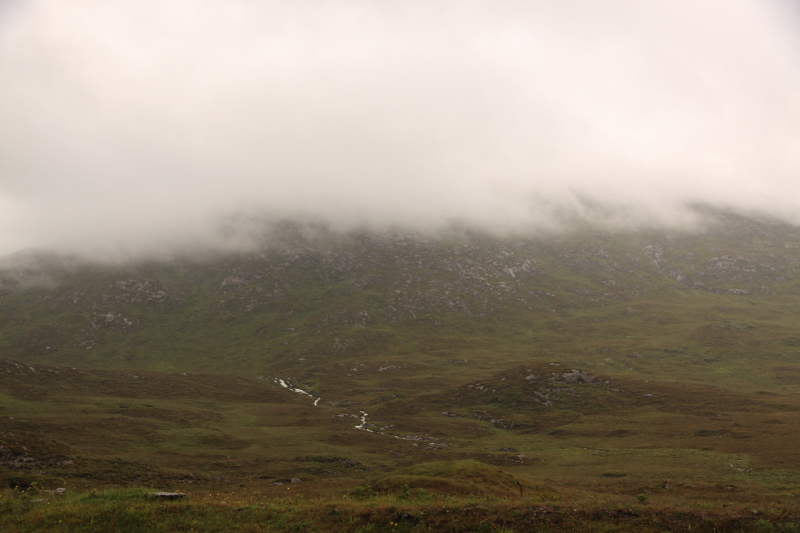
low clouds and rain in Maam valley Connemara

Rainy Day in Renvyle

Rain sweeps across the wide open,
Clouds rolling in from the west,
Tears from the sky set in motion
Blown by a wind that won’t rest.

Ceaseless the changes chase over,
The shelterless landscape at speed.
Soft underfoot grows the clover.
Soft as a heart full of need.

It’s hard to stand tall in this weather.
it’s hard to stand still in this land.
But deep as the bonds of a brother,
Run roots from the ground where we stand.

The flesh of a bog keeps things fresher,
But we can’t sink in history’s grip
Traditions give way to new efforts,
Old lessons will easily slip.

Rain sweeps across the Atlantic,
The tide rises high on the coast
The beauty of sloped Connemara,
Slips into your sight like a ghost.

A sense of a place that seems empty,
Or savage, desolate, bleak.
Is rich to the eye that knows plenty,
We find what we set out to seek.

Posted on

Moods of Conamara

Rain tumbles down. From the swift clouds that scrape over the maamturks it pours onto the boggy land below. The wipers of the aging Peugeot van snicksnack across the windscreen as I drive the winding road north from Oughterard. With no radio reception, I try a CD but the speakers are tinny and irritating. Visibility is poor, and the road is hard to make out; the sky melts with the forground in a bustling wash of grey and water.

I turn left at Maam Cross and head up the hill that leads down to Maam valley. At the top I stop and roll down the window, letting drops of rain splatter inside while I hold my camera out to try and catch the swollen gushwhite streams that race down the gray-green mountainsides. Peaks disappear into a white blanket of mist.

At Keane’s pub I go right, onto the Cong/Clonbour road, but I swing the van round after a few kilometres. I just wanted to go until I caught sight of the North-West corner of Lough Corrib, a broad finger of the lake that curls around the Hill of Doon and on to Maam. Between the end of Glann and here there is only a short stretch, but no road; only the Western Way hiking route tracks across the soft ground and skirts up around Lackavrea mountain. I stop again and this time get out, risking the wet to see what the day looks like to the lens. Out under the shadow of the mountain on a small island sits Caislean-na-Circe, Castle Kirk, which served Grace O’ Malley well as a safe haven around 800 years ago. The corrib has fished well this year, healthy catches of brown trout despite the explosion of zebra mussels that coat the floor.


When the light is low and clouds cover the whole dome above like this, the greens and browns of the earth show little contrast but thick dull colour. We are in the last gasp of July and every inch of fertile ground is a riot of growth. These hills were mined for lead and silver in the 19th century, hauled to Galway city across the lake. Only a derelict crushing plant can be seen now from the road.


Back through the junction at Keane’s, and straight on this time heading for Leenane. There are few cars on the road, a bad evening for driving, and I make slow progress. The road meanders like a stubborn river through scraps of conifer forest and acres of soggy fields. Left and right rise steep hills up which run brave stone walls. Leenane is living up to its reputation as the wettest place in Ireland. The deep cut of the fjord is hidden by the heavy mass of grey. Outside the van, in the whip of the wind, I can smell the salt of the Atlantic.

After Leenane the road rises up again from sea level then swings away from the coast, into the more sheltered valley of lakes where Kylemore Abbey draws in the crowds to its postcard buildings and gardens. This time though I only stop at the nearby waterfall and sprint to the low bridge to see its short white fury crashing down. Designed by James Franklin Fuller, and built by Mitchell Henry from 1867 to 1871, it was later sold to the Bendictine nuns to cover gambling debts by the Duke of Manchester.Almost self sufficient thanks to carefully maintained gardens, it was until 2010 a secondary school for boarding and day students. My great-Uncle John Joyce worked in those gardens for most of his life.


Camera splashed again, back in the van, it takes more than a few extra seconds to start, but eventually kicks into its usual diesel grumble, and I pull out and drive the short distance to Tullycross, then down to meet the coast again to Mullaghlos. From the front of my cousin’s house you can see the broad Mweelrea mountain rise 814 metres over Killary harbour. Cnoc Maol Réidh in gaeilge: “Smooth bald hill”. The highest peak in Connaught. Clare Island, Caher island, Inisturk. Inisbofin too far west to make out. If you look directly north you can normally see the cliffs of Achill almost 40km away, towering over Keem bay under Croaghaun mountain. Not now though. It is late, dark, wet, and windy.

The cosy stovehot modern cottage is a welcome haven, sheltered on one side by a deep cut into a high bog bank. It is too far from the road to hear the odd car bumping by over the potholes, but the wind whistles through the poles and around the gables, and the ever present heaving waves throw low rumbles up the grassy cliffs. Even at night the wildness of the terrain can make its presence felt.

It is almost 24 hours before I get back outside with camera in hand. I spend the next morning and afternoon typing, some office work to help recover some lost documents. I can see the shifting weather bustle across the seascape from the North-facing window. Rain spits and spatters in short showers, hurried by the west wind.

It is evening again when I call it quits and ignore an empty belly to scramble with the wrong shoes up a waterlogged bog road. The epic rambling clouds throw wide shadows but pockets of warm light separate them. It is a desolate landscape, soft acidic soil, and virtually no shelter from the salty knife edge of the wind.

I pass the carcass of an old tractor, metal eaten, almost motheaten, disintegrating under the elements.


Lettergesh and Mullaghlos


The sun has dropped below the horizon, but as I leave I see flashes of silver in a dark pool. Jumping across the seaweed covered rock I make out a mass of sprats whirling in the water, thousands of tiny fish clumped in a ball. A few seconds later I see larger shapes flashing through, dark daggers slicing the school. Atlantic Mackerel, probably a whole shoal, chasing the massive numbers of sprats into the jagged bays.

I clamber up the steep slopes, and risking the fading light, borrow an old rod to see if I can get back down before the mackerel disappear again. I tie a cast of 5 hooked feathers onto the gut and string a small weight at the bottom. Sliding down to the rocks one more time, I hurry back to where I had last seen them. The sprats are still there but no sign of their predators. After a few casts and only lumps of seaweed to claim I move further out onto a bigger rock. The “monach rock” we called it as kids. After a few more futile efforts, I am ready to give it up, then suddenly thump thump on the hook, the line zippping left right, white bellies swivelling and darting in the green, and the satisfying tension of a rod with fish. I haul up two mackerel flapping on the hooks, their flesh punctured by steel hooks. With the rod high they struggle against the grey sky, gasping, furiously beating. But I have started so I finish, dropping them down, pulling out the barbed hooks, bashing their heads against the rock. Some recently devoured sprats fly out of their mouths with the force of the blows. With the nightfall and the tide changing there is no time. Out again with the feathers, and another strike, this time four fish straining.

Twenty-four mackerel and one pollack later I call it quits. I have enough to eat and share, and enough fish blood and dying fish twitch for one day. It is hard to see much as I fill the plastic bag and tackle the climb. I use the rod as a walking stick, and the bag as a counterweight. Going over the top a full moon emerges like a torchlight.

I gut the fish at an outside sink, cutting off the tails and heads and putting the organs into a bucket.

The next day we cook up some of the mackerel for a late lunch, baked in the oven in foil, eaten hot with boiled potatoes and peas. Another overcast showery low pressure has moved in, so another day mostly indoors, bar a short trip to Clifden in my cousin’s Ford pickup. A tree surgeon by trade (http://www.westcoasttreesurgery.com/), he points out interesting trees and their properties. In a part of the country with few trees, and hit hard by the heeldragging recession, it is surprising how you see forests of detail emerge as they are spotted, and realize that there is still busy work for a busy man. A fine oak or ash, a slow growing beech, a scots pine or a blackthorn. Even after a decade and a half of hard labour climbing and cutting, sawing and chipping, he still has a grá for trees, a curiosity and interest that will outlast the current economic stillness.

Clifden is wet but alive. It has an energy and art that mark it as a cultural and tourism hub, far as it is from a city or industry. Small galleries, cafés, and hotels survive here, hibernating a little during winter but sustained by a steady stream of interested visitors. Signs point to the spot where Alcock and Brown crash-landed their Vickers Vimy in 1919, an indecorous but momentous conclusion to the first transatlantic flight from Newfoundland. A dog slumbers outside the door of a pub. People scurry for shelter between the shops. Paintings, Aran sweaters, Leprechaun and shamrock strewn mementos. But also Lidl, Aldi, Supervalu supermarkets, hardware stores, a hospital.


Late in the evening I hit the road again, taking a different route by traversing the Inagh Valley from east to west, driving along a dividing line between the Maamturks and the Twelve Bens. Grassy Benbaun is followed by stark Bencorr’s jagged peaks jutting above Lough Inagh. Everything is shrouded in mist, the low grass and rushes bent by the wind and rain. Bogs are soft and wet after a summer of heavy rain, and the rivers are full and angry after the last few days. This is a bleak road in bad weather. It was named the famine road to us as kids, and along its sides are supposedly buried the bones of those who fell in the desperate years of the famine. It is still barely populated. The wipers snicksnack across the windscreen again. Hard to believe that the evening before had been so bright and colourful. Unpredictable, fickle, a land exposed. Does the sun shine between the showers or the showers fall between spells of sun? On such distinctions seems to rest the mood and conversation of those who live under this weather and among these peaks.


Posted on

36 Hours in Transit

July 15th, 08:00, Busan, Korea.
Torrential morning. Last morning. Feels like no plane could get up out of this rain. But bags to pack and a bike to box, already hot and sticky and late. Time for a haircut? Up first for breakfast, and then a couple of hours of folding, loosening, taping, stressing, and hurrying.

11:30. Suddenly realising that there is no airport bus at 2:30, plans change. Now I will aim for a bus to Seoul and then another to Incheon. Still torrential, the monsoon rain hammering down and engulfing the streets. Still, under a flimsy polka dot umbrella I venture forth in flipflops for the hair shop. Thunder raps above, streams of water gushing over my feet below. How could a plane take off in this weather? Kwang Hee is already there when I arrive, confident, unapologetic, expert customer. The barber is young, friendly, interested. He asks questions and namedrops in English. Guinness, Baileys, Tupac, Eminem. An hour goes easy while the storm continues.

12:30. I brave the cloudburst again to get to Homeplus. My last trip to the giant supermarket, topspeed pace through the aisles looking for more Scotch tape and bubblewrap. Some Dr. You Energy bars too, and a cheap Japanese raincoat that I can throw over the bike box it if is still raining when we leave. Back to the hair shop, the road well under water at the crosswalk, I put on the raincoat, though I am already wet. Despite the water it is still hot.

2:00. Leaving Sajik, four of us carrying bags, the dog let out too and running up the street. Nerves tense and taut, caught in the swirl of lastness that pervades every step, each footfall the first of a long large gap. The rain at least has relented, and though the sky still threatens we make it to the subway unsoaked. Then another goodbye, and a subway trip to Nopo. A friendly Ajumma tries to get me to sit and jokes about the weight I bear. But I stand and wait, and in Nopo wait again, a ticket bought, in paris Baguette with bad appetite.

02:40. Leaving Busan, for Seoul, on a full bus. Straining out of the window to see the waves, eyes cursedly heavy, no glory in this departure. Heavy moments. I can’t sleep on the bus. It pulls out onto the highway and heads Northwest. I watch the city slowly recede and between hills and tunnels see farms and fields, rivers and trees.

We stop at a service station, a 15 minute break, then continue the heavyhearted journey, arriving in Seoul Express station after sundown. I struggle with my bags, struggle to go to the bathroom, struggle to find the bus to the airport. I find it only after asking three people and 30 minutes in the rain carrying uncomfortable bulk on a busy street. Eventually bus 6020 appears and now I am leaving Seoul, another hour through the megapolis and out to Incheon.

21:30. I make it to the airport and find the Emirates check in desk. There’s a long queue, and as I wait my baggage anxiety grows. Two arabic men are arguing with an official over visas to Yemen. Some people are opening bags to repack. I have little money and an empty Korean bank account. But that stress evaporates when the friendly Emirates girl lets everything through. She puts Fragile stickers on the bike and points me to the oversize baggage counter. Everything is fluid now. The plane then is taking off. It is real. I get talking to an American who lives in Korea and is going to Dublin to meet a friend then on to Glasgow for a convention. We become airport buddies, chatting away an hour over expensive food. He speaks real Korean, has a Korean wife, a university job, an unfinished phd, and a child.

23:55. The Airbus A380 seems new and full. In my aisle seat I have no view through the window as we taxi out then hurl down the runway and up into the sky. Leaving Korea. I can feel the strings and threads straining as we rise, and though my mind is still there the distance roars between; a gulf opens and widens and half the world crosses beneath.

Dubai, 04:20 local time. After over 8 hours in the air, now 2 and 30 in the bus Dubai airport. I change some won for Euro and buy 200 Marlboro cigarettes. Not for me but they will save money for someone else. I go for a €5 hot chocolate with Gabe the lecturer and wander the busy cosmopolitan expensive shops. It is 33 Celsius outside but too cool indoors for my light shorts and T-short.

Dubai 07:00. Now a Boeing 777 to Dublin. Lots of kids, more familiar accents, two Tipperary GAA jerseys. I watch Tintin and TT3D: CLoser to the Edge. On the A380 I watched Haywire and, damn, forgotten. An inflight movie half watched stranded in my memory somewhere.

Dublin 12:15 local. Arriving in Ireland. Down through the grey onto the runway with an assured thump and roar as the flaps twist up. Slowly slowly we move across the concrete, before the people finally start to filter out. Through the passport control with the ease of a local, then on to wait for my baggage. My bike trundles through first, and later my backback. When I get through the departure gates Aidan is there, unexpected, a face as familiar as my own waiting. We head to a local bar and tackle a huge lunch. Bacon and cabbage no less, with lashings of tea. The bar is old and musty. Familiar familiar familiar.

Dublin 2:15. I horse the bags onto the Citilink bus. Buying a ticket s refreshingly easy, and I relax as we pull out and through the port tunnel into the city centre before heading west on the Motorway. The low city of Ulysses then the soft quiet fields of the midlands rushing by. Already my headspin is groping and finding the patterns of a lifetime, settling into the grooves of an often played record.

July 16th, 17:30, Galway, Ireland. I can count down the miles, as we come in the Dubilin road, past Merlin Park and GMIT then down towards Lough Atalia and up Bohermore. I scan for changes and see the same shapes and patterns looking back. These places are as much inside me as outside, well etched on the brain and easy to coax out, memories lapping thick on the streets and buildings. Home is history, wrapped around your core.

We pull into the Coach station. I have no phone but there is no stress. It has faded over the final miles, and now everything is as it was, but fresh and new at the same time. I am waking from a long dream, or plunging into a new one and too tired to fight, though for a short while I am stranded between the two, getting a glimpse of one from the other, foreign dweller and local son, both ideas easily lost in the stream of strangers that traipse up and down streets and cities.

The Arts festival is underway, tourist fill the few main streets, and the traffic is building when Dara arrives and we load up for the last leg.

An hour later I am at home, arriving as a surprise and basking in the newness of the old. The wet weather has lifted and a cool evening casts rich blues and greys over the calm lake. The garden is scattered with flowers in bloom. The grass is cut, the two dogs are lazing in the house. Greetings and welcomes, respite from the many goodbyes, before a meal that hits the stomach like it never left.

Only a day in transit, but a year and more of differences dissolve as my feet step into the same shoes. The little changes, chips in the chinks, are seen at first but melt into the background. I try to cling to the appreciation of what has passed and is passing, but it is hard to force a mind that relaxes at every glance into the known and the accepted.

Posted on

Never Effortless

It feels colder than the reports, the promises of July burdened by skies of rain and mist. The summer has dragged I’m told, a few spits of kind soft green weather between the canopies of grey. Still, the beauty is there, if under a soggy morning’s breath you choose to step onto the earth.

Hopes willing, hearts desiring, go filling up with rising sun

It is a time between times, a period loosened from definitions, perhaps the leading pause of a comma, perhaps the jarring halt of an unexpected full stop. The wishwash of my mind has yet to settle, it balances on a sloping back above the scuttling feet of an earnest anxiousness, that hither thither bounces blindly against the way’s walls looking for delivering doorways.

But life is marked by fleeing moments and sustained by minor victories. What say another badly recorded poorly performed song tackily stuck to the running hook of four thousand photos. What say another unpolished lump of shot loosed into the pregnant airs of late summer. A summer sodden, yet full of the steady green growth of leaf and shoot, tree and root.

Across the lake another shiver of wind stirs the surface under a thin sheet of mist. Overhead roll Atlantic born clouds laden with heavy drops. Ready to fall, ready to burst and drench. Under the rolling bulkheads of a cumulus or the crest of a blanket of stratus, I pause in the month and squirm to claim a grip on the rough outline of myself.

What seems without effort is already in motion under the moment of some external force. The beat of a heart; the rise of the moon; the guarded power that drains the spool.

Posted on

Leaving Busan

Rain is hammering down outside, striking its damp intricate melody on the cacophony of roofs and streets. How could it be rainy season again? Where did the year go?

The shapeless sprawl of Busan took a long time to imprint its layout, and deliver me from following scribbled notes of subway stations and getting off at wrong stops, to cycling alone across the city late at night without a map. On my first day I was afraid to leave my tiny apartment for fear of not finding it again. By now I have a sense of orientation with the landscape, and with the food too, and the people. Sadly I cannot traverse the language for any distance beyond a motley crew of common words. At best I can read hangul painfully slowly in the hope that the key words are Konglish.

In less than two days though I will be gone, assuming I make the airport on time and my trail through the international jet traffic is routine. Then the process of reverse culture shock will begin, with restraint of head bowing, an Irish diet of potatoes, and the pain of all of those high prices. Goodbye cheap dentists, taxis, snacks, alcohol, Internet, haircuts, and doctors. Hello the dismal fiscals of the Eurozone.

Last week I spent a day with my camera and tripod in Nampodong, in a vague effort to capture something of its detail and motion. Over 3000 pictures, 16Gb of jpegs crammed onto the memory card, two drained batteries, and many bemused stares later I settled into a cafe and fought with my laptop to stitch them together into a messy montage. Over the top went a song I recorded right before I came to Korea, a demo quality DIY effort inspired by the search for meaning and progress that scatters us from home in the first place.

As now, it was raining then in Nampo, but only in fits and bursts, and a steady breeze dragged the drops and their clouds and mist from the open sea over the squat mountains, whose lower shoulders support mazes of steep streets and dense hives of irregular houses. From the water’s edge at Jagalchi, among the camera-carrying visitors and fish-gutting workers, I waited and watched the weather roll across Yeongdo to the east and Amnam to the west. The bridge from Songdo appeared and disappeared in the fog. Boats scurried across the port from every direction, cranes rose and spun over hulls pulled from the water.

* * * * * * * * * * * * * * * * * * * * * * *

Behind me an ajumma in a big black saloon runs over an ajoshi’s foot. He yells and beats her windscreen with his umbrella as she struggles to realize her error. Faces momentarily turn to look then gradually go back to catching, poking, gutting, selling, buying, or eating something that until recently swam, crawled, or drifted in the open water. Every inch of the market is laden with the ocean’s bounty. Some flopping, some already fried, they all wait the same fate. Fat mackerel slice easily under quick steel blades.

Only a street’s width from the sea the clamour of the fish market begins to crossfade with heavy traffic and high street shopping. Another intricate maze of detail and motion takes hold, another forest of competing crowded stalls, cosmetics shops, chain cafés, and busy restaurants. Here too there is a restless energy. Competitive and hurried, with a stratified social structure that is cohesive, conservative, and consumeristic, the streets are alive under the canopy of chaotic wires.

This mass of humanity seems comfortable when concentrated; gaggles of students, herds of tourists, a stream of color-coded couples, and the odd old grandfather pulling his stacked cart of cardboard to earn some minor measure of paper money. The latest overproduced pop tunes try to drown each other out from each well-staffed well-branded business, though most heads are slightly bowed, not out of respect, disregard, or politeness, but to catch the light best from the necessary smartphone.

A few more streets north and the ground climbs to ascend to Yongdusan park. Above this rises Yongdusan tower, its lower half currently smothered by scaffolding. From its lofty vantage I rise to get a broader view, and try to pick out familiar details below. Now I can see beyond Nampodong, from the ship strewn sea over the streets thrown on streets up to the weather satellite of Gudeoksan. I find the construction site opposite my just-left apartment (another health center), and a little further on the area where the school I taught in will be on the second class of the day. I can name the students and the books they will be using.

* * * * * * * * * * * * * * * * * * * * * * *

After a year soaking in the detail it is still hard to get a broader grip on Korean life. A year of long evenings of English classes, hundreds of hakwon students willing or dragged, weekends of food and fun and trips to new places, and slowly, slowly the four distinct seasons giving way to each other as the clock ticked one rainy season to the next.

After a day spent chasing the tails of everyday lives followed a few of rest and easy leisure. My classes taught, my visa edging to expiry, my plans for the future as cloudy as the monsoon season’s grey temper, I will catch a flight with a headful of Busan, and will dream scattered farewells in the night from a tin tube going west in the sky. Maybe I will be back- I cant say. But it is better to head home with a heavy heart, because if leaving has no cost, then the stay has not been of value.

I expect a rainy welcome in Dublin, and a sharp recognition of myself in a familiar world. Another bus to bring me further west to Galway, maybe more rain once over the Shannon, and welcome exercise for the green cones in my eyes. Family, friends, sleep and jet lag, and anxious promptings about what to do next. Has this thrown stone another stretch to skip?

Posted on

The Long Span

The long span, a slice of sky stretched from border to border, time ticked by a bird’s wing on the wind. Morning shuffling from door to door, knocking quietly with soft insistent knuckles, on the heads of the dream-enclosed. Spring has been chewing for a while, and finally it is getting to grips with the hard frozen meat. But even as it gets soft, it gets hot, and already the sticky throat of summer waits impatiently to swallow.

Circles anon, according to the rules as we best can explain, to be looked up and presented unpondered. Time is what clocks measure indeed, and from the three dimensions we struggle to gather, maybe more. Existential, the pull and pulse of sensation, light bouncing off a cold surface. Animal, the heat inside, anger under a dry tongue, heavy gulping breaths when the valves are all open. Social, labelled practitioner of a numbered generation, aware of the many strands of interaction.

Get into a corner and turn around. This is the law of the observer. Find the scenic view and fling words into anageing files, phrase piled upon phrase, body hoisted above the set as a distended specimen, a metaperson, curious creature who comes out at night.

And it usually rolls slowly. Rain pit pattering on a tin roof, and the sloshing of feet in wet wellingtons. The trees shiver and bend under the patrolling clouds. Distance collected and distilled, awareness again an oyster pearl hardened from some arbitrary speck of dirt. Don’t you know that the precious stones are from pressure born?

Answers gush faster than the questions, a sea of information engulfing simple fishers. How we lose our hooks and tackle, in the spinning sea of modernity. Adjust, adapt, take flight with simple fisher wings, up into the network on ladders of smoke and binary things.

Alone again, return to ground level until, the gnawing splices of new devices tear a tread into the rubber of your soul. Here we go again, the part is searching for the whole. I hear that what is unstable is more able to change, but there is only so many times that paper will fold.

Be bold, be bold. Tear a strip of the haunches of existence, grip it with your most stubborn molars, eyes alive on the bloody prize. But then, the bitten animal will buckle and tumble, knees helplessly dropping, cells bursting and the thin thread exposed to the edge. “Retreat to slumber,” calls the ship’s captain. “Only in the confines of the mind will we solace find.” “Oh dear,” you hear yourself mumble, “the nature of these days are unclear.” And before them too that long span still hung, the same bodies with different cloth.

All in the head. Wring from your hands the spoil’s juices, return to the corner to hang another faded banner, greet the morning with mild humour, mild banter. Forget what you just said. All in the head.

Posted on

You Khan do it.

The scale of information on the Internet is exploding. But can it be harnessed to deliver quality education, and can this make it to the concrete classroom? If one teacher can give 91 million lessons… then yes it Khan.

If it can be known, then it’s probably on Wikipedia. If it can be shown, it’s already on YouTube. With a million hits and a thousand comments buzzing like a swarm of bees and butterflies, one demonstration reaches the masses. But despite all this potential, is technology being used effectively to educate?

The printing press was invented by Johannes Gutenberg around 1440. As cultural inventions go, it signaled quite a revolution for the spread of ideas. Nowadays, as the cliche goes, we are living in the dawn of a new age of information. From every angle a constant stream of data is radiated through countless devices, flowing through the dense networks of cables and protocols we call the internet.

Information, of course is not all of equal value. Bias, ignorance, profanity, lies, and enough statistics to interpret a horse as a donkey can engulf browsing brains and leave them no more learned than before; perhaps even less so due to confirmation of false beliefs or confusion of others. How can the Internet be leveraged to actually promote learning and not just entertainment, indulgence, or fact checking? Is the effect of the net really that great for developing brains?

Recent researchers have postulated that the mind of today has changed its tack thanks to the nature of altered information delivery. Nicholas Carr, author of “The Shallows: What the Internet Is Doing to Our Brains” has argued that the new style of consuming data is physically altering how the brain functions. This controversial opinion is not widely accepted, but even the lesser charge that our habits of thinking are changing is fascinating. An ability to search and scan and quickly jump from totally different contexts (e.g. shopping for new shoes while reading movie reviews while writing an email) may be replacing the capacity for deep thought specific ideas. Given the limited resource of mental powers and memories that we have, we are becoming dependent on artificial online memory to store our information and personal history, and our thinking patterns are now analogous to search engines. In an article in the Guardian, University of East Anglia professor Sarah Churchwell noted that:

“In 10 years, I’ve seen students’ thinking habits change dramatically: if information is not immediately available via a Google search, students are often stymied” ((http://www.guardian.co.uk/technology/2010/aug/15/internet-brain-neuroscience-debate Accessed December 2011))

“Do you know X? No, but there’s no value in knowing X because I know how to look it up, and I fully expect to be enlightened about X whenever I choose.” It’s more efficient to remember where to find information than to remember the information itself. Yet knowledge and wisdom must be born from deep thinking and learning that has been chewed and digested, mulled and mooted over a long period of time. Making good decisions or wise choices is not something you can look up. And even if you do look something up, can it be trusted?

The results given by a search engine will generally be arranged in favour of the most popular and most linked-to webpages. A majority of the searchers will click on the first link. More will try the second or third. A tiny percentage will go to the second page of results, and after that, the rest of the pages are pretty much anonymous, regardless of how many million of them there are. So instead of having a wide range of differing opinions and interesting viewpoints, the bulk of learners will follow the same well-worn paths and by that process make them even deeper. If every student working on a class assignment looks up the very same piece of text and set of pictures, then there will hardly be a diverse set of resulting submissions. It’s like a library where for each topic, the same few books take up 90% of the shelves, and the other contenders gather dust well away from eye level.

Here though, it is important to take a step back and acknowledge the amazing accomplishments and wealth of detail available via portals like Wikipedia or Google. As of December 17th 2011, the English version of Wikipedia reckons itself to have 3,824,473 articles. From January 1st 2010 to the same day one year later, around the time of the website’s tenth birthday, the number of articles jumped by 1025 per DAY. ((How big is Wikipedia? Ask Wikipedia!: http://en.wikipedia.org/wiki/Wikipedia:Size_of_Wikipedia)) Every nook and cranny of the world of fascinating facts is being explored, explained, uploaded, and more than that, monitored, maintained, and updated. A living encyclopaedia that ties current news to existing information, run with no ads or charges, created by the public for the public. Wow!

It is easy to forget how young the giant online content providers are. The first YouTube video was uploaded by one of the founders, Jawed Karim, on Saturday, April 23 2005, at 8:27pm ((http://www.youtube.com/watch?gl=US&v=jNQXAC9IVRw)). By their sixth birthday in May 2011, the official blog reported that they had gone “past the 3 billion views a day mark”, and that “more than 48 hours (two days worth) of video are uploaded to the site every minute” ((http://youtube-global.blogspot.com/2011/05/thanks-youtube-community-for-two-big.html)). Google, YouTube, and Wikipedia have arrived not with a gradual whimper, but with a precocious bang!

There is an incredible amount of material online, but again, it is quality not quantity that matters. You can find more ways to skin a cat than there are cats to be skinned on YouTube. Real education demands explanation, understanding, and practice. How can information created by the public be structured enough and consistent enough to turn short videos into concrete learning? Another young website, similarly free but with content created by one person instead of through public contributions, takes the role of a teacher, not a provider and organizer of information:

http://www.khanacademy.org

Salman Kahn was born in New Orleans, has three degrees from MIT, an MBA from Harvard, and left his job as a hedge fund analyst after a chain of events that began with him giving his young cousin some help with her math homework. He left what was surely a pretty good job to sit in a room all day and create videos. Videos and videos and more videos, none of which contain his face, but all of which contain his even, enthusiastic voice and steady straightforward explanations of everything from one plus one to the nature of black holes and central banks. The videos are hosted on YouTube, but are also accessible in a more organized way on the Khan Academy’s website, a not-for-profit enterprise with funding from the likes of the Gates Foundation.

There are now over 2700 videos on khanacademy.org, and while this seems miniscule compared to YouTube or Wikipedia, it is a fundamentally different exercise. This is one teacher covering the foundations of education in a way that is digestible, testable, and encouraging. Rather than skipping and jumping from one dry authoritative-sounding article to the next, dizzy from finding in each references to a dozen others that are required reading for a thorough understanding, we have a single mind that starts at the start and leads a merry path through the core components of education. Math, science, and the humanities. Ninety-one million lessons delivered, and counting.

Unlike the relentless debate that characterizes the wealth of knowledge and insight hidden away in forums and blogs, this is a singular vision with remarkable breadth, clarity, and accessibility, all presented with the learner in mind. The video format combining reading with a human voice and active demonstration, backed up by exercises, is a great way to learn. The extremely simple drawings are humanizing and as familiar as a blackboard. On the ‘About’ page, Sal surmises his approach:

“I teach the way that I wish I was taught. The lectures are coming from me, an actual human being who is fascinated by the world around him.” ((http://www.khanacademy.org/about accessed December 2011))

Beyond the videos is a practice area where students can set about a large tree of practice exercises. Starting with basic number properties and algebra, and slowly building towards harder stuff like calculus and trigonometry, this growing set supports the videos and creates a game-like environment with points and bonuses and progress tracking.

Wikipedia offers a remarkable reference set. The Khan Academy offers new ways to educate. Salman Kahn, or Sal, as he is known by his many students, is an educator from the open source generation, and believes that students should learn at their own pace, mastering each basic building block at that pace until they are ready to move on. In Los Altos schools in California, schools are testing a new style of teaching using his videos. Children watch the videos for homework, and spend class time solving problems and answering questions. The classroom is ‘flipped’, and the essential ingredient of application that is normally left to the unseen desks of homes is now the main focus during school hours. Could this be the way of the future? Teachers can log in at any time to look at progress and quickly see any weaknesses, and spend classtime giving vital one-on-one attention to those that need it.

For Kahn, the current one-speed-fits-all approach is akin to learning how to ride a bike for two weeks than immediately switching to a unicycle. Some learners will have mastered the bike and are ready to move on while others who needed more time on two wheels will find one wheel impossible. Thus the student who struggles with basic algebra is not ready to move on to more advanced topics, and will probably give up and begin to resent math.

However, is the Khan academy another enemy of diversity when it comes to learning? Just as the success of the one-speed approach to education is limited to some learners, so too is the one-source search limited to particular viewpoints. The aforementioned nature of search engines and most-popular most-emailed hottest-topic most-commented lists can give a weight of agreed truth to the highest ranked sources. The danger is that Wikipedia or Mr. Khan or any other single source is regarded as the be all and end all, and whereas every Justin Bieber view might be at the expense of a less heralded but equally or (heaven forbid) more worthy artist, the dominance of Wikipedia and co. might be at the expense of similarly worthy claims for intellectual attention.

The argument against these reactionary responses might emphasise the intentions of the entrepreneurs behind these ventures and the approaches that they take. The goal of the Khan Academy is not to become an authority or Gradgrind-style fact force-feeder. Sal’s approach is that of a curious and fascinated explorer, always open to discussion; far from a dogma-enforcing intellectual know-it-all, despite being introduced as “The man who knows everything” in a Financial Times article ((Article by David Gelles, accessed December 2011 http://www.ft.com/cms/s/2/0668fc92-002e-11e1-8441-00144feabdc0.html#axzz1gn0lvO7x)).

At the NewSchools summit in Aspen in 2011, moderator Ted Mitchell introduced Sal Kahn as “the icon for destructive innovation in education”. Like the vinyl record was doomed by the tape, which was then replaced by the CD, now being upset by digital players, these innovations and technologies have to ‘destroy’ to improve. As education is generally a public state-run enterprise, then there are extra barriers that will oppose approaches causing major disruption. However with increasing class sizes, cheaper digital devices and growing demand from education stakeholders (parents, students, and society as a whole) the pressure is on.

A mentor-like figure with great delivery and knowledge that uses the power of the latest platforms and tools to provide a coherent and well-organized library of educational videos available to anyone who can get online? That is surely a seriously valuable resource. The nature of learning and the process of education is taking its time to catch up with the flood of networked technologies, but not everything is as accelerated as the lifespan of the latest gadget, and surely the next generation of classrooms will have no choice but to embrace new approaches.

As for me, I’m going back to the Kahn classroom as an oversize student to relearn some stuff I’ve spent a decade forgetting.

Posted on

Teaching in Korea

Justin is sleepy. His head droops over his desk as I begin to run through the new vocabulary. Behind him Sean has yet to take out a book, bag still on his shoulders and cheeky nonplussed smile on his face. Alice and Holly are already interested and repeat the words loudly. it’s five fifty-five on a Friday. We’re doing a class on music genres. “Jawn-reh, jawn-re”, they repeat. “Pop… pop… rock…. rock…” I can hear “rock, lock, rlock”. I draw a padlock on the board and write “lock” beside it. “What’s this?” “Lock, rock lrock!”.

For almost five months I have been teaching English in a private school, a “hakwon”, in Busan, Korea. It’s a long way from home, and a long way from writing computer code at a computer desk. It’s also proving hard to find the ‘morning calm’ that Korea goes by. Perhaps no more than the saints and scholars and thousand welcomes of Ireland, it takes effort to find the depth and truth behind the tagline. Also, I get up too late to see the morning calm. I work late, eat late, and sleep late, and life is without fail always an order of magnitude more chaotic and noisy than Ireland, than Galway, than Oughterard, than the lake shore in Barrusheen.

But why am I here? There are loads of I.T. jobs at home, right? Well, yes, I can’t really blame the jobs market right now for my leaving, but I’ve been through two redundancies since university and had no work for months before I left. I had other motives too: a restlessness to see what would happen (life is an experiment), to see and do something new, a persistent itch about the downcast atmosphere at home… and oh, and there’s a girl too.

My first class was a tough one. I had some experience teaching cycling skills to kids in primary schools, and I normally consider my English to be ‘fluent’ (though sometimes I wonder), but I was put straight into class with some almighty jetlag, no preparation and no training. To the kids I was a new curiosity, and despite my inability to keep order in any way or remember their chosen English names, it… could have been worse. They don’t bite… although some try to climb me, and others pinch my freckled wrists.

Korea is great in many respects. Food is delicious, varied, and cheap, transport is reliable and cheap (the first time you pay for a taxi is joyous), the weather is predictable (although too hot in summer for me), the people are inviting and interested and fun, the language and culture is rich, shopping is a national past-time with real value possible, the mountains are seemingly designed for hikers and are genuine places of peace and calm, and there are always festivals on and things to do. The internet is blindingly fast and abundant, the dentists and hair salons and hospitals are nothing short of amazing. My experience with a malignant wisdom tooth led me to a dentist before I had any health insurance organized, to have it removed, and it cost in total (2 visits) about €30. You can get a full meal for €4, and from one side of the city to the other on the subway for €1.

The education system in Korea is, however, to most external observers, a little bit mad. My students start as early as eight in the morning and finish as late as ten at night, going to their regular school first, then on to private school sessions for different subjects like English and math. They have longer days, more homework, and shorter holidays than I ever had. They get assignments to do during their summer and winter breaks. They go to school every second Saturday. Once they reach middle school they are in a permanent competition for higher grades and better marks. Sometimes I have little motivation to try and keep the sleepy ones awake. The “zombie students”, I call them. Foreign teachers are drafted in here to boost the reputation of English schools, to attract more kids and appease the parents. I often ask them if they are tired and then try to turn it into a conversation. “Why are you tired, what did you do today? How many hours did you spend in school? Just ten?”. In fact with some classes I spend all of my energy simply trying to energize them, which in turn sucks me dry of vigor. Younger busier classes of energetic loud wild ones can leave me happy and awake.

Most countries bemoan their lack of interest and spending on education. Some strive to portray themselves as ‘knowledge economies’: shining lights that will ‘going forward’ build nations of educated prosperity. Here in Korea education has for centuries been of central importance, and unfortunately, an almost all-consuming obsession. There seems to me to be something wrong with forcing children to learn beyond a certain point. Sure, we all need the basics and those that like it should have the resources to forge ahead, but if it becomes a national competition on which your life seems to depend then is it worth it? Creativity and ideas are surely born out of choice and free interest, out of self-motivation? The individual learns, not the system. For those who like gyms, it is akin to using free-weights versus machines. The machines enforce a strict movement while the free weights force you to stabilize and learn the movements yourself. The big guys mostly use free weights.

At least once a week I dream of home. Not nostalgic sentimental journeys (too soon too soon) but simply the dislocating mental unravelling of my thin thread of experience. My mind’s clutter is still mostly from Ireland. I wake confused in my cube-shaped apartment, trying to remember exactly where I am and who I am. The fridge is a few feet from the bed, which is also my chair, couch, and sometimes table.

Sang-eun is a university student with only one semester left before she finishes the long haul of education, and her experience matches most students of her generation. “High school is the hardest, especially from grade two on” she tells me. She often started at 7a.m. and finished at 11p.m., and sometimes had private tutors come to her home as late as midnight. Private academies cannot operate after 10 p.m. by law, but where there’s a will there’s a way, and there is definitely a will. In most cases it is the will of the parents. The status associated with manual and practical jobs is low, and there is huge pressure put on children and teenagers to make it into one of the top universities. Getting there is the hard part, and families make huge financial and lifestyle sacrifices to play the game.

In some ways they have created a monster, a children-churning mill that takes all of the freedom out of learning and unbalances lives and families. Every parent wants their son or daughter to be an elementary school teacher, or a doctor, or a lawyer. The western teenager’s screams of “it’s none of your business” don’t seem to apply here, in a culture with more concrete roles based on rank and age. It is always your parent’s business. It is not uncommon for parents to phone the boss of an adult child about a problem at work.

Sang-eun though remembers high school with fondness; she and her friends sometimes wish they could go back. School was almost like home, and it wasn’t all study. Large high schools have canteens, clubs, and a radio station. Students spend their days with close friends in a safe stable environment. They are also consistently at or near the top end of global education rankings, with pupils smart enough (at least in exams) to create anxiety in nations like the U.S that tend to lag behind in the charts.

I use facebook and Skype to keep in touch with home, but though they close the gap they also point out the distance. My dad talks about the weather and how the turf isn’t home and how Ougherard lost the county final. He holds up the dog to the camera, who is gripping a new red rubber bone in his jaws, and doesn’t seem to see me but lifts his ears at the sounds. My brother puts a cup of steaming tea in front of the screen. A cup of tay. I yell at him to make me one, and my mom promises to send me some teabags in the mail. I eventually hang up, sign out, and sleep.

Kelly is coughing, as is Lily. The weather has suddenly cooled and there’s a cold going round. We are learning about sports. Amy is pretending to hit tennis balls at me with an imaginary racket. I pretend to flinch. Suddenly half the class are hitting imaginary tennis balls at me and laughing at my imaginary flinches. Annie is saying ” teacher I’m very very very very very cold”, but she always says that. Jenny is tearing her page and sticking something to it. I have them make teams and stick food names to the board, sorting them into the correct groups. “No, pork is not a vegetable! What happened to the carrot? Amy, I am not a toy… Amy, sit down!” Hopefully they are learning something, but secretly a bit of happy chaos is just what I needed.

[nggallery id=1]

Posted on

Buzz

I shouldn’t have watched three episodes. One was enough. I should have gone to bed then. Now it’s after one.

Too awake, but need to sleep. Wednesday tomorrow, only midweek. If I sleep late I wake late and I’ll be in a late cycle again.

Brush teeth, wash face. Mouthwash empty, must buy some more. Back to the box-room, all of my things. Switch off my laptop and switch off the plugs. Moisturise. Glass of water. Sleepier now but head clogged with tv. Thick duvet, too warm. October but still too warm. Summer was sweat; Autumn cooler but…

Kick it off, pull it back on. Head out one end, feet out the other. Fridgewhir changes pitch. Two metres from my bed. Sleep, sleep. Into the deep.

Bzzzzzzzzzzzz

Shit! Mosquito! Where, where? Up. Lights. Sore eyes blinking. Freeze! Where? Glasses? Here! There! Black spot on the wall. Above the bed.

Weapon, need a weapon. Book? No, too big. Notebook better. Here, fine. No proper swatter, need to get one. Heart valves all open. Calm. Relax. Just a fly. Son of a bitch. Bloodthirsty.

Nice and easy. Slow, slow, gently does it. Soft soft SMACK! Victory! Black spot now flatter on the wall, stain on the off-white wallpaper. Will have to clean it sometime. Not now.

Bed again, head down, too hot. Shift left. Shift right. Too hot. Too awake. Mind idling; won’t kill. Clock fuzzy on the desk. 02:30. Huh? Where did the last hour go? Switch off body- switch off! Stop thinking! The man I want to be would be able to… control the flow. Calm the muse. Caution the cortisol. Meditate. Mediate. Breathe. Yawn. Go left. Go right. Deeper into the night’s belly.

Ok, getting settled. Not so bad now. Starting to drift…

bzzzzzzZZZZZZZZZzzzzzz

What? Again? Fuck! Up! Glasses! Quick! Sonofabitch! Can’t see it. Why only when I lie down? Why can’t I see them when I am up and awake. Where did it go… ah, no, wait, yes, there, up high. Notebook again. Mosquit-ho! World’s worst alarm clock. Works great but only when you don’t want it. Raggedy zigzag flightpath. Looks aimless, graceless; but secretly poised. Long thin needlenose sliding easy into skin. Tapping a vessel. Suck suck gurgle gurgle red bellyswell. Go to hell!

Easy again, have to be nice and easy. Too hard and the air just blows them away. Need a proper… SMACK!!

Gotcha! Must have left the window open today. Stupid. All alone here, no one to blame. Box room is dirty; too many things. Smaller house easier to dirty. Always seem to be cleaning. Never clean. Life is maintenance.

Relax. Sleep. Heedless clock rushing towards dawn. Need to start soon. Eating into tomorrow’s reserves. Kids will notice. “Dark circles, dark circles!” And yell when I take off my glasses. Need to relax. Maybe if I remember?

Maybe it’s his first time around

Ok, drift, drift, think of safe places. A corner of a treehut. Smell of wood and leaf. Can see the lake through gaps in the planks. Slight sway. Or in Granny’s house, sunk in the soft old bed with broken springs. Familiar voices from the next room. Atlantic waves in the distance. Wind too maybe, the odd car. Don’t want to move. Safe in a cosy cave. Damn tv show cutting in. Random snippets. Images of myself in heroic roles, super something or other. Hero, winner. The moment of emergence. Turn to face and suddenly far superior. Can’t sustain the glory, unless accelerating into oblivion. The birth of the cool. Sleep damn it sleep! Why does it twist and turn, tormenting, picking, whining?

He doesn’t speak the language, he holds no currency.

bzzzzzzzzzzzzzzzzzZZZZZZZZZZZZzzzzzzzz

Again? Again? No way! Fuckers!! Where do they come from? How can they just appear? Have to find it. Lights glasses up notebook. Ok. There it is. Same damn place. Get it SMACK! missed? shit! where? look! where? no, dirt… climb. Check. No. Down low. Where? Lie on the floor. Smell. Not good. Food? Sink. What attracts them? No sign.

Turn off the light. Lie and wait. Glasses still on. It will come back. Wait. Think. Might as well think while I am waiting. It will come back. It needs blood. Why? How did they evolve thus, vampire parasites. How long do they live? Isn’t it just the females? Damn fridgebuzz is too obnoxious. Can’t hear properly. It will go off eventually. When? Could plug it out. Fridgebuzz flybuzz mentalbuzz. Chatter chatter chatter. Can I plug them out? How did it evolve? Cold blind evolution, pouring down through time the answer that is because it is. Change, test, and repeat. Define and refine and no master’s vision. Pouring down the ages. Searching. For what? No goal. Plumes of complexity flickering in infinity.

He sees angels in the architecture, spinning in infinty

bzzzzzzzzzzz zzzzzzzzzzz zzzzzzzzzzzZZZZZzzzzzzz

OK vampire fucker, your time has come! Switch turn see SMACK MISS! follow follow follow gone. No contrast. Too much clutter. Too much! Need. Awake again. Not letting them get me this time. Remember waking with sixteen bites? Only a month ago. Never had this at home. Where are you cursed bloodsucking fiend? Search search has to be here. Tiny tiny home. All alone. No comfort in that now. Bathroom? No. Sink, desk, window, pictures, poster, locker, wardrobe. Stand on the bed, sit on the floor- get another angle. Can’t see it. It’s somewhere.

Give up? No. Look it up. Information. Information will help. Must be a way. Know your enemy.

Plug back on. Laptop powering up. Wait for the Internet.

Mosquito. From the Spanish for little fly. The Culicidae. Disease vectors. Yellow fever, Dengue fever, Chickungunya, malaria. Only the females suck. Need it to grow eggs. Like all insects- egg larva pupa adult. Head, thorax, abdomen. Wings beating up to six hundred times a second. 1 or 2 kilometres per hour. Females live longer. Old ones are the vectors. Drink and lay and thirsty again. Five to forty days from egg to bite. Depending on conditions. Three and a half thousand types. Feed on plants too. Nectar. Nectar vector. Attracted to carbon dioxide. Octenol. Sweat. Like some people more than others. Different sweat. Sweetsweat. Mine? Their spit gets into your flesh. Causes swelling. Vampire spit. Insect spit. Thought it was piss. Is that midges? Has a load of spit proteins that screw with your immune system- stop it from reacting in time to clot and clog. Scientists trying to use it as an anti-clotting drug. Might as well. Dragonflies eat them. Some species eat other species. Eggs in any idle water. Buckets and stuff. My house is too dirty. Toilets maybe? Pipes and sinks. Insect eggs in the dregs.

Isn’t helping. At least I can call it she. She’s here somewhere, super-sensitive antenna and random flight and long legs and extended proboscis. All designed simply, symbiosis with the prey. Millions of years. How many millions in the world? Billions. Trillions? They can see me, smell me, find me. Or at least my sleeping head.

Must be. Yup. almost four. Can’t sleep. Give up. Will have a zombie day at work. Pretend I was out all night on the piss. Would have been better off. Data not helping. Might as well… clean.

Dirty kitchen dirty floor dirty sink dirty insect looking to inject my night with infected plight. Should just ignore. Lumps are small, go away fast. But that buzz. I can’t sleep with that buzz in my ear. That high tinny whine that sends my blood racing and my blinking eyes up to glasses and light and damn if I had had a better swatter I would be asleep and I need a net to go over the bed and surely they should be dead it is October after all. Years ago a Mosquito was a model plane. The Stuka was the one that whined. Airfix sticky glue fingers stuck together too little tins of enamel paint. Oh for a newly-minted mind!

Clean clean clean. Food into bag into freezer. Wrappers into plastic bag into bin. Bin full for the morning fine. Plugs and cables into drawer. Socks into washbasket. batteries into drawer. Eyes slowly sleepgathering growing mouldy old sneakers into the cupboard need to dump old scraps from the fridge Christ it’s a tiny home but it can fit an awful lot of dirt. How did it get so out of hand? A man needs a maid. Some mosquitoes eat other mosquitoes.

Finally the tv show drone has drained from my skull. late. Early. No difference now. Wave of weighty tiredness. Another. The tide finally arrives. To hell with the buzzing. I can sleep now. I can forget the million billion mosquitoes, the million billion details of life as maintenance. I can focus on nothing and let the rest of it slide.

Slidefall into bed. Duvet up around. Light outside. House half cleaned. Fice thousand miles from home. More than a mile for every damn species. More than a mile for.. every…

zzzzzzzzzzzzz zzzzzzzzz zzzzzzzzz

Posted on

Pre-match Jitters

Before the Match

It is 12:30. Three hours ahead in New Zealand it is 3:30, and counting down inexorably to a historical kick-off. Two celtic teams stand at the entrance to a sacred arena: a place in the rugby world cup semi-finals. Not since 1991 when Scotland beat Samoa was there such an opportunity. Scotland then lost to England. This could happen again, with one whole side of the knock-out draw filled with northern hemisphere teams.

So right about now the players will be entering their final preparations, and trying to get their minds into the best possible space. But what does this space look like? Is there really a ‘winning mentality’ that marks out a winner before a game has even begun.

I suspect that hindsight and the human bias to ignore statistics compel us to read history backwards as a story with a knowing author and a sensible plot.

Look at a man who spent a long life boozing and smoking but is still standing, and it is hard to remember the government warnings and sensible advice. The fact of the matter stands in front of you with a generous glass of whisky, a pack of Benson & Hedges and eighty years of history. He is a winner then, and the more rare he is, the more noticeable he is, and the more memorable an example he makes. So like a celebrating sports fan we can start out with the winners and trace backwards to find causes and purpose where maybe randomness and chance brought most of the mirth to the party.

Which leads not at all nicely back to pre-match psychology and the superstitious preparations of sporting soldiers to fortune. Does it help to visualize or build up a strict routine? In case, there is no doubt (o.k., there is acceptable doubt) that the murky mind is a tricky matter, and is susceptible to all sorts of issues that can stifle or stimulate a body. Its awareness of its own awareness is as much a curse as a blessing when it starts to second guess itself in moments of stress.

In virtually all of the bike races I attempted, I had a recurring problem before the start. I would suddenly get paranoid about racing for three hours with a full bladder and no chance of stopping. My mind amplified the worry, and hey presto! I would be stuck in the men’s room every five minutes for the half hour before the start, with glowing nerves and a second-checking tick making me check and recheck every visible variable- brake blocks, energy gels, water bottles, race number, brake blocks, energy gels…

So for even a small-scale effort the head can start to lose the run of itself, and plague the body with repeating unreasonable infatuations that resonate in a real physical way. Pressure counts. I was never alone in this pre-race routine. How do the pros deal with it, when the stakes are cut high and planted deep?

In the Beijing Olympics in 2008, a certain Usain Bolt made history by smashing world records and elevating himself to the pantheon of running greats. But one of the most marvellous aspects of his performances were his pre-race antics, and unbelievable coolness before the gun. How could he be so calm, in an Olympic final with the world watching and the fastest guys in it standing next to him? If you think about it…. ah, maybe there is the rub, not thinking. Maybe the best of the best have another super skill, and can turn off that overthinking brain before it gets in the way.

In the Art of Failure (http://www.gladwell.com/2000/2000_08_21_a_choking.htm), the human nature guru Michael Gladwell looked at the difference and significances of ‘choking’ and ‘panicking’. Panicking is where instinct takes over and a single immediate goal becomes all-important (get out get out!). Choking is when instinct is derailed and the higher-level learning mechanisms take over (Accompanied by voluble mental chatter). Both lead to failure.

Champions are marked by coolness under pressure. They neither panic or choke. In normal everyday situations we are not faced by these daemons. If we were we would have multiple nervous breakdowns every week. In sport, with everything to play for, and history to be made and the clock always counting down, it is an ever present foe, perhaps as big as the real, physical opponent.

There is just over 90 minutes left before the opening whistle. The Irish team have plenty of experience with pressure, from Heineken cup and Six Nations crunch games, and so have hopefully built up a resilience to the mental niggles that can upend confidence and cause the mind to lose faith in the body. As a team they have shown a little of the Bolt attitude in the off game snippets; cool, collected, and jocular. Their press conferences have nuggets of banter and wit. With their nicknames and jokes and the ball light-heartedness they can hopefully offset the tremendous pressures that exist in sport, especially at the higher levels, and especially in events where expectations are pitched up and a fever grips supporters and followers.

Every man, woman and child has been drafted in to swell the latest blarney army. Across the globe in every timezone, expats and gapyearers and happy travellers are looking up the kickoff time and setting their alarms. Thankfully for me Korea is only a few zones distant, and it will be an afternoon special.

Time to go, don’t want to be too late. I’m not the biggest rugby fan in the world- not because I don’t like the game, but because I never played it and don’t watch all of the games. It’s a fantastic sport, a balance between physical brawn and aggression and speed and skill. The rules are a little intricate but they allow for a controlled game with different styles.

Hopefully today, the Irish team will look like they did against Australia…. eager, together, and happy to be in the thick of it.

After the Match

Ouch.

Ouchery. Humbug and humbuggery. Over. Out. Shouldn’t read the media reports. Read them anyhow. Watched the ‘highlights’… lowlights more apt from the losing perspective. A solid first half but Wales’ defence stood firm and some crucial errors and slack tackling in the early part of the second sealed the deal. Two tries, one of them shamefully easy, put an end to the run, and the country will have to invest its interest and conversation elsewhere. A presidential election, continuing economic woes, the weather.

I was late. The bar was crowded with groups from most of the rugby-following countries, a motley crew in all sorts of colours. The game was streamed from the internet and kept freezing. When it froze people rang friends and yelled out developments. Ireland scored? It’s ten all? It’s ten all! But sadly the pop and fizz died away and the English guy who I had just met bought me a Guinness to help bring calm. And then a Jaegerbomb. And then there was some more beer and a burger and then England lost as well and France turned everything around and looked electric at times.

The English game never froze once. I left my new friend with his old friend to their consolations and headed off to find my own distractions. Nice sometimes to be able to disappear into a throng where few will know where you are from even if you tell them, if you could.

There is a Doppler effect with events like this. Slow to arrive and quick to leave. Beforehand, the build-up is intense and speculation rife. Afterwards there are curt reports, disappointed resignation and frustration that will hopefully slip away without a fanfare. Players give it their all and give it every day. Fans tune in to watch the games or highlights and are free to praise and blame. A good poker player will play with the same approach whether he is winning or losing. It is up to him or her to cope with the relevant excitement or dread that go with each. But it has to hurt… the joy of doing well is what they play for beneath it all, which they must take with pains of loss.

Did the Welsh team have a better collective mentality going into the game? Were they tempered with more stable determination? What was lacking? Was their game plan tighter?

The agony of analysis and still the suspicion that luck and chance were present and correct. This is sport.

Wales beat Ireland, who beat Australia , who beat South Africa, who beat Wales. Huh?

Posted on

Scrumble

Tilted
Hindered by passing breezes
Not trying to cause a fuss of course
Just

Sneezes
Rhythm upset
I’ll get there yet
Not trying to make a scene you know
Just

Woolgathering
Mossrolling
Dustgrowing
Oldening
Closefoldening

I’m not trying to upset anyone right now
I’m just

endlessly circling
prey that won’t die
For in the vulturesphere I must fly

mindlessly kindling
snatches of flame
not even visible in the corners of frames

a spark looks better in the dark you know
A cat or not on a tree in the woods

Those bundles of barbs you’re trundling towards… look pretty sore I’m sure

No, to tell you the truth,
the man we’re looking for is filled with restless reckless youth
Not a guilty branch tied to a tilting tree
Tooth to a string to a door
Feet nailed to the floor
Sprite sprung from a spore

Glistening with listless slivers
Hardbound with shadowed shivers
Every perceivable evil
accounted for and available by email

Supply and demand
the invisible hand
Argue till dawn
Leave it unplanned

but I
Out of steam
Did not wish to disturb the other’s order
my role just to look and learn and
rot
perhaps,
see what the others have got

Posted on

What it Means to Me

Finally started to use FruityLoops to work a bit more than vocals and acoustic into a track. Hard to keep it sounding smooth, but it does make for a far more complete sound. Here goes nothing. This is the result of a long day and then some, hopefully it has something of worth in it somewhere.

Demo: [audio:http://donalkelly.com/wp-content/uploads/2011/05/WhatItMeansToMe.mp3|titles=What it Means to Me]

As I waited to be, And I strained just to see
What it meant to me, What it means to me

As I learn from mistakes, and I see through the fakes,
The wood from the trees, the wood from the trees.

When I fall out of line, when I run out of time,
I fight with the shade, the dark and the blade.

And I guess I should know, by now how it goes,
But I’m still surprised, yeah I’m still so

Slow to, show you, why I, will try- to stay calm, heart in hand, dream of a scene where we we all understand…

I just wanted to say, that a day is a day
Too long to remain, too short to explain,

Why we fill our lives up, with distractions and stuff,
Makes no sense to me, makes no sense to me.

There is distance apart, and it drags on that heart
Do we still belong, do we still belong?

There are reasons to give, to grow wings and live,
But I’m still surprised, yes I’m still so

Slow to, show you, why I, will try- to stay calm, heart in hand, dream of a scene where I know who I am…

And with you by my side, there is no need to hide
Face up or fade out, face up or fade out.
And with you by my side, there is no need to hide
Face up or fade out, face up or phase out.
And with you by my side, there is no need to hide
Face up or fade out, face up or phase out.
And with you by my side, there is no need to hide
capo 3rd.
C and F for verse with melody played on chords

Am F E7 G7 for chorus